What's inside
- Compact rotary hammer comparison
- Why the DEWALT DCH072 is the best choice for overhead work
- When Milwaukee’s M12 FUEL 2416 is the better pick
- Is an 18V compact hammer worth the extra weight?
- Runtime: a practical way to estimate it
- Decision matrix for choosing the right size
- Vibration control and handling details that matter
- Ownership realities: bits, dust, and wear
- Final verdict
- Related Guides
- Compact rotary hammer comparison
- Why the DEWALT DCH072 is the best choice for overhead work
- When Milwaukee’s M12 FUEL 2416 is the better pick
- Is an 18V compact hammer worth the extra weight?
- Runtime: a practical way to estimate it
- Decision matrix for choosing the right size
- Vibration control and handling details that matter
- Ownership realities: bits, dust, and wear
- Final verdict
- Related Guides
As an Amazon Associate I earn from qualifying purchases. This post may contain affiliate links at no extra cost to you.
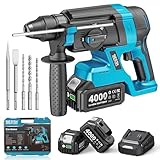
The best compact rotary hammer for tight spaces in 2026 is the DEWALT 12V XR 5/8-inch SDS-Plus rotary hammer (DCH072) for most overhead and confined-space work, while Milwaukee’s M12 FUEL 5/8-inch rotary hammer is the better choice when minimum size and weight matter more than drilling speed.
These two 12V tools are easier to control above shoulder height than full-size 18V or 20V rotary hammers. The trade-off is lower impact energy: they are excellent for small anchors, electrical and plumbing holes, and light chipping, but inefficient for large-diameter drilling or continuous demolition.
As an Amazon Associate we earn from qualifying purchases at no extra cost to you.


What we cover
- Compact rotary hammer comparison
- Why the DEWALT DCH072 is the best choice for overhead work
- When Milwaukee’s M12 FUEL 2416 is the better pick
- Is an 18V compact hammer worth the extra weight?
- Runtime: a practical way to estimate it
- Decision matrix for choosing the right size
- Vibration control and handling details that matter
- Ownership realities: bits, dust, and wear
- Final verdict
- Related Guides
Compact rotary hammer comparison
| Model | Tool length | Weight | Impact energy | Maximum capacity | Best use |
|---|---|---|---|---|---|
| DEWALT DCH072 12V XR | About 10.7 in | About 4.6 lb bare | 1.1 J | 5/8 in SDS-Plus | Best overall overhead balance |
| Milwaukee M12 FUEL 2416 | About 10.0 in | About 4.6 lb bare | 0.9 ft-lb, about 1.2 J | 5/8 in SDS-Plus | Smallest-feeling option |
| Bosch GBH18V-22 | About 10.2 in | About 5.7 lb bare | 1.9 J | 3/4 in SDS-Plus | More demanding drilling in tight areas |
| Typical compact 18V SDS-Plus hammer | 10.0–11.5 in | 5.5–7.0 lb bare | 1.7–2.2 J | 3/4–1 in SDS-Plus | Frequent drilling and larger holes |
Published dimensions and weights can vary slightly by market, chuck configuration, and whether a side handle or battery is included. A compact 12V tool usually gains roughly 1 to 1.5 pounds with a battery, while an 18V model may gain 1.5 to 2.5 pounds.
Why the DEWALT DCH072 is the best choice for overhead work
The DCH072 combines a short body with enough impact energy for the holes most tradespeople make above a ceiling, inside a cabinet, or between closely spaced framing members. Its 5/8-inch SDS-Plus rating covers common anchor, conduit, cable, and small pipe penetrations without the bulk of a full-size hammer.
Its main advantage is not maximum drilling speed. It is the balance between grip position, head length, and sustained control. When working overhead, every additional pound creates arm fatigue, and a long motor housing makes it harder to keep the bit square. The DEWALT’s compact 12V format keeps the center of gravity close to the user’s hands.
Choose it with a 3.0Ah battery if runtime matters, or a smaller 1.5Ah battery when the tool must fit into especially restricted spaces. For occasional holes in concrete block or brick, the smaller pack can make the complete tool noticeably easier to hold.
When Milwaukee’s M12 FUEL 2416 is the better pick
The Milwaukee M12 FUEL rotary hammer is the strongest alternative when access is the first priority. Its short, narrow-feeling design suits electricians, HVAC installers, and remodelers who make many small holes in awkward positions rather than drilling large holes continuously.
The M12 platform also has a useful ownership advantage: batteries are compact and widely shared with other M12 tools. That matters in a tool pouch or service van where space is limited. The limitation is thermal and runtime headroom. A small 12V pack will run out sooner than an 18V battery during repeated drilling, and the tool is not intended to replace a larger SDS-Plus hammer for deep holes or chiseling.
Is an 18V compact hammer worth the extra weight?
Yes, if you regularly drill dozens of holes per day or use bits larger than 1/2 inch. The Bosch GBH18V-22, for example, delivers about 1.9 joules—roughly 60 percent more energy than a 1.2-joule-class 12V tool. That extra energy reduces trigger time in hard concrete and gives the motor more reserve when a bit binds in dense aggregate.
The cost is overhead fatigue. A complete 18V tool and battery commonly weighs about 7 to 8 pounds, compared with approximately 5.5 to 6 pounds for a 12V tool and battery. Holding an extra 2 pounds at shoulder height feels more significant than the number suggests.
For a contractor drilling 80 holes per day, the 18V choice is usually sensible. For a maintenance worker drilling five to fifteen holes during scattered service calls, the lighter 12V tool is often more productive over the entire workday.
Runtime: a practical way to estimate it
Rotary-hammer runtime depends on bit diameter, concrete hardness, drilling depth, pressure, and pauses. Battery amp-hours alone cannot predict an exact hole count, but a useful planning estimate is:
Estimated holes = battery watt-hours × usable efficiency ÷ energy used per hole.
A 12V 3.0Ah battery stores about 36 watt-hours. If drilling 1/4-inch holes in ordinary concrete consumes approximately 0.7 to 1.0 watt-hour per hole after motor and battery losses, a practical range is about 25 to 40 holes per charge. Larger 1/2-inch holes may reduce that to roughly 12 to 25 holes.
An 18V 5.0Ah battery stores about 90 watt-hours. Even after accounting for its larger, more powerful motor, it generally offers substantially more work per charge—often around 35 to 70 small holes or 20 to 40 larger holes. Treat these as planning ranges, not guarantees; a hard slab or long bit can cut the number dramatically.
Decision matrix for choosing the right size
| Your situation | Recommended class | Why |
|---|---|---|
| Occasional anchors, tight cabinets, overhead work | DEWALT DCH072 or Milwaukee M12 FUEL | Lowest fatigue and easiest positioning |
| Many 1/4–1/2-inch holes every week | Compact 18V SDS-Plus | Higher impact energy and better battery reserve |
| Large holes, deep drilling, or frequent chiseling | 18V/20V SDS-Plus with at least 1.7 J | 12V models will be slow and may overheat |
| Already invested in M12 batteries | Milwaukee M12 FUEL | Lower total ownership cost and smaller packs |
| Already invested in DEWALT 12V XR batteries | DEWALT DCH072 | Battery compatibility without a new platform |
Vibration control and handling details that matter
Compact hammers rarely have the elaborate suspension systems found on heavier professional demolition tools, so technique matters. Hold the auxiliary handle firmly, but do not force the bit with your entire body weight. Excessive pressure can reduce hammer action, increase heat, and accelerate clutch wear.
For overhead drilling, keep the battery close to your torso rather than extending the tool at arm’s length. Start at low pressure until the bit creates a stable entry point, then increase pressure enough to keep the bit cutting. If the tool begins bouncing, reduce pressure or use a sharper bit.
Ownership realities: bits, dust, and wear
The first consumable to wear is usually the SDS-Plus bit, not the hammer mechanism. Dull carbide tips create more vibration and heat, so replacing a worn bit can restore performance more effectively than pressing harder. Use masonry bits designed for rotary hammer operation; ordinary percussion bits are slower and may not tolerate sustained hammering.
- Clean dust from the vents after each concrete job with a soft brush or low-pressure air.
- Wipe and lightly grease the SDS-Plus shank according to the tool manual.
- Do not leave a battery attached during storage in a hot vehicle.
- Use a dust-extraction attachment where possible, especially overhead.
- Stop if the clutch repeatedly slips, the housing becomes unusually hot, or the bit no longer locks securely.
Concrete dust is abrasive. Keeping it out of the chuck and cooling vents has a greater effect on service life than chasing a small difference in published impact energy.
Final verdict
Choose the DEWALT DCH072 as the best compact rotary hammer when overhead control, short length, and manageable weight are the priorities. Choose the Milwaukee M12 FUEL 2416 if the smallest practical tool and an existing M12 battery system matter most. Step up to a compact 18V SDS-Plus model if drilling volume, hole size, and runtime outweigh the fatigue penalty.