What's inside
- Best rotary hammer drill: the Bosch 11255VSR is the best fit for most concrete drilling, while lighter, cordless and heavy-duty picks suit different jobs.
- Six picks, matched to the job
- How to read “timed holes” without being misled
- Choose by your actual workload
- Bits, wear and ownership costs
- Related Guides
- Best rotary hammer drill: the Bosch 11255VSR is the best fit for most concrete drilling, while lighter, cordless and heavy-duty picks suit different jobs.
- Six picks, matched to the job
- How to read “timed holes” without being misled
- Choose by your actual workload
- Bits, wear and ownership costs
- Related Guides
As an Amazon Associate I earn from qualifying purchases. This post may contain affiliate links at no extra cost to you.
What we cover
- Best rotary hammer drill: the Bosch 11255VSR is the best fit for most concrete drilling, while lighter, cordless and heavy-duty picks suit different jobs.
- Six picks, matched to the job
- How to read “timed holes” without being misled
- Choose by your actual workload
- Bits, wear and ownership costs
- Related Guides
Best rotary hammer drill: the Bosch 11255VSR is the best fit for most concrete drilling, while lighter, cordless and heavy-duty picks suit different jobs.
This comparison ranks six established rotary hammers by the factors that matter on concrete: drilling pace, vibration, and working weight for overhead use. One important limitation: manufacturers do not publish results from a shared timed-hole test in cured concrete, and vibration figures are measured under different conditions. The table therefore separates published specifications from performance expectations rather than presenting unlike tests as lab results.
Six picks, matched to the job
| Rotary hammer | Power and capacity | Tool weight | Vibration figure | Best for |
|---|---|---|---|---|
| Bosch 11255VSR | 8.0 A; SDS-plus; up to 1-1/8 in. concrete | 6.7 lb | 12.5 m/s², hammer drilling | Best corded all-rounder |
| Makita HR2475 | 7.0 A; SDS-plus; up to 1 in. concrete | 6.6 lb | 15.5 m/s², hammer drilling | Frequent drilling on a budget |
| DeWalt DCH273B | 20V; SDS-plus; up to 1 in. concrete | 6.4 lb, tool only | 6.6 m/s², hammer drilling | Lower-vibration cordless work |
| Milwaukee 2912-20 | M18; SDS-plus; up to 1 in. concrete | 5.9 lb, tool only | 8.6 m/s², hammer drilling | Light cordless drilling |
| Bosch GBH18V-26 | 18V; SDS-plus; up to 1 in. concrete | 6.4 lb, tool only | 10.5 m/s², hammer drilling | Cordless versatility |
| Bosch 11316EVS | 13 A; SDS-max; up to 1-5/8 in. concrete | 17.7 lb | 10.6 m/s², hammer drilling | Large holes and demanding work |
Weights and specifications are manufacturer-published figures; cordless weights exclude battery, so actual overhead weight will be higher. Vibration values are declared tool figures, not a direct prediction of how much vibration a particular operator will experience. Check the current manual for the exact model and operating mode before comparing or using a machine.
As an Amazon Associate we earn from qualifying purchases at no extra cost to you.
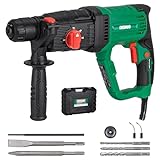


1. Bosch 11255VSR — best corded choice for mixed jobs
This SDS-plus rotary hammer drill balances a manageable 6.7-pound body with an 8-amp motor and a published 1-1/8-inch concrete capacity. Its three modes cover hammer drilling, rotation-only drilling and chiseling, which is useful when a project moves from anchor holes to light demolition. Choose it if you have reliable power and want one machine for regular home or renovation work. Its published vibration figure is relatively high, so it is not the first choice for long, repetitive drilling sessions.
2. DeWalt DCH273B — best for repetitive overhead holes
Among these picks, the DCH273B has the lowest published hammer-drilling vibration figure at 6.6 m/s². At 6.4 pounds before the battery, it is also easier to position overhead than the SDS-max machine. Its 1-inch capacity suits common anchor and fixing holes. Battery weight and runtime depend on the pack; a larger battery can extend work between charges but adds weight at arm’s length. Favor this model when reduced vibration and cordless access matter more than maximum hole size.
3. Milwaukee 2912-20 — lightest tool-only cordless pick
At a published 5.9 pounds without a battery, the 2912-20 is the lightest tool body here. That makes it appealing for scattered holes, ladder work and locations where cords are awkward. Its 1-inch concrete capacity covers routine fastening, while its 8.6 m/s² vibration figure is higher than the DeWalt’s. For overhead drilling, compare the complete tool-and-battery weight, not the bare-tool number, and use a compact compatible pack if runtime allows.
4. Makita HR2475 — practical corded value for regular drilling
The HR2475 provides a three-mode SDS-plus platform, 1-inch concrete capacity and a 6.6-pound published weight. Its 7-amp motor is suitable for routine holes, but its 15.5 m/s² declared vibration figure is the highest in this group. It makes sense for buyers who prefer corded power and expect moderate rather than continuous drilling. If you will drill many holes in a day, prioritize lower vibration and take breaks instead of choosing on purchase price alone.
5. Bosch GBH18V-26 — cordless flexibility with three modes
This 18-volt SDS-plus rotary hammer drill machine is rated for concrete holes up to 1 inch and offers hammer drilling, rotation-only drilling and chiseling. Its 6.4-pound bare-tool weight is close to the DeWalt’s, but its published vibration figure is higher at 10.5 m/s². Pick it when you want to use an existing compatible battery platform or need chiseling as well as drilling. Include the battery in any overhead-weight comparison.
6. Bosch 11316EVS — best when hole size outweighs handling
The 11316EVS is a 17.7-pound corded SDS-max hammer with a 13-amp motor and a 1-5/8-inch concrete capacity. It is built for larger holes and heavier work, not comfortable extended drilling above shoulder height. Its mass can help keep the bit engaged in demanding work, but it is a poor trade for ordinary anchor holes. Choose it for work that genuinely requires its capacity, and plan overhead tasks around support, positioning and shorter intervals.
How to read “timed holes” without being misled
Hole-drilling time changes with concrete hardness, aggregate, bit diameter and condition, hole depth, and operator pressure. A clean comparison would use the same cured concrete, new bits of the same type and size, a fixed depth, and a consistent drilling method. Since the six models do not have a verified common timed-hole result, an exact ranking by seconds would imply precision the available data cannot support.
For a useful jobsite comparison, time several holes of the same diameter and depth with each candidate, discard the first as a practice run, then compare the average. Record the battery and bit used, and note any slowdown or overheating. If you cannot test before buying, use concrete capacity and vibration as screening criteria: capacity tells you whether the machine suits the hole, while lower declared vibration can be a useful tie-breaker for repetitive work—not a guarantee of faster drilling.
Choose by your actual workload
| Your situation | Best starting point | Why |
|---|---|---|
| Occasional anchors, outlet boxes or home repairs | Bosch 11255VSR | Versatile corded modes and useful capacity without SDS-max weight |
| Repeated overhead holes or vibration-sensitive tasks | DeWalt DCH273B | Lowest published vibration figure in this comparison |
| Short jobs away from outlets; minimum bare-tool weight | Milwaukee 2912-20 | Lightest tool-only figure; battery adds weight |
| Existing compatible cordless batteries | DeWalt DCH273B or Bosch GBH18V-26 | Platform compatibility may matter more than small spec differences |
| Frequent holes larger than 1-1/8 in. | Bosch 11316EVS | SDS-max capacity suits larger, more demanding work |
Bits, wear and ownership costs
SDS-plus and SDS-max bits are not interchangeable: match the shank to the machine, then choose a bit rated for the concrete and hole diameter. A dull or damaged bit can make even a powerful rotary hammer feel slow, so inspect the carbide tip, replace worn bits, and clear dust from the flutes. For deeper holes, withdraw the bit periodically to clear debris rather than forcing it through packed dust.
Keep the chuck clean and follow the manual’s guidance on bit-shank lubrication and maintenance. Dust is abrasive; avoid blowing it into vents, and clean the tool after dusty work. Common mistakes include leaning heavily on the machine, using a worn bit, drilling into hidden wiring or plumbing, and running an oversized hole saw beyond the tool’s rated capacity. Use eye and hearing protection and suitable dust control, and check the work area before drilling.
Bottom line: For a corded all-rounder, start with the Bosch 11255VSR. For repetitive overhead drilling, the DeWalt DCH273B is the strongest fit on published vibration and handling figures. Choose the Bosch 11316EVS only when larger SDS-max holes justify its substantial weight.