What's inside
- Quick picks by situation
- Foldable solar panels compared
- Real-world wattage matters more than the label
- Panel materials: monocrystalline versus flexible
- Charging ports and compatibility
- Kickstands, weather resistance, and packability
- Decision matrix: which panel fits your use?
- Ownership details that affect value
- Bottom line
- Quick picks by situation
- Foldable solar panels compared
- Real-world wattage matters more than the label
- Panel materials: monocrystalline versus flexible
- Charging ports and compatibility
- Kickstands, weather resistance, and packability
- Decision matrix: which panel fits your use?
- Ownership details that affect value
- Bottom line
As an Amazon Associate I earn from qualifying purchases. This post may contain affiliate links at no extra cost to you.
The best portable solar panels for camping and backup power are foldable monocrystalline panels with a usable output of 80–110 watts, a stable kickstand, weather-resistant construction, and the right connector for your power station—not simply the highest wattage printed on the case.
As an Amazon Associate we earn from qualifying purchases at no extra cost to you.


What we cover
- Quick picks by situation
- Foldable solar panels compared
- Real-world wattage matters more than the label
- Panel materials: monocrystalline versus flexible
- Charging ports and compatibility
- Kickstands, weather resistance, and packability
- Decision matrix: which panel fits your use?
- Ownership details that affect value
- Bottom line
Quick picks by situation
- Best all-round size: A 100W-class foldable monocrystalline panel, such as the Jackery SolarSaga 100 or EcoFlow 110W Portable Solar Panel.
- Best for hiking and small devices: A compact 20–30W panel with USB output, such as the BigBlue SolarPowa 28.
- Best for a larger power station: A rugged 100–200W panel designed for the station’s voltage and connector limits.
- Best for occasional emergency backup: A 60–100W folding panel with an integrated stand and a standard DC output, rather than a lightweight USB-only panel.
- Best for tight storage: A two- or four-panel folding design with a fabric case and a folded thickness under 3 inches.
For most campers, 100W is the practical middle ground. Smaller panels are easier to carry but can take most of a day to refill a battery. Larger panels collect useful energy faster, though they become less convenient to transport and more sensitive to shading, wind, and poor positioning.
Foldable solar panels compared
Foldable panels generally use one of three layouts. A two-panel briefcase design is quick to deploy and relatively rigid. Four-panel designs pack smaller in one dimension but have more hinges and fabric seams. Flexible rollable panels are light and easy to store, but they usually need a separate support surface and can be harder to aim accurately.
| Panel type | Typical rated output | Typical folded size | Typical weight | Best use |
|---|---|---|---|---|
| USB camping panel | 10–30W | Approx. 12 × 8 to 15 × 10 in | 1.5–3 lb | Phones, GPS units, small lights |
| Compact two-panel foldable | 40–60W | Approx. 20 × 14 to 25 × 18 in | 4–7 lb | Weekend camping and small batteries |
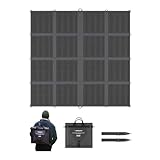
| 100W briefcase panel | 90–110W | Approx. 24 × 20 to 30 × 25 in | 10–16 lb | Power stations and vehicle camping |
| 160–220W folding panel | 160–220W | Approx. 28 × 24 to 36 × 30 in | 15–30 lb | Emergency backup and large batteries |
Dimensions and weights vary by revision, so check the current manufacturer specification before buying. A panel that weighs several pounds more than a similar-rated competitor may use a stronger frame, thicker glass, or a more substantial stand; that is not automatically wasted weight if it will live in a vehicle or emergency kit.
Real-world wattage matters more than the label
A “100W” rating is a laboratory maximum under strong, direct sunlight with the panel at the correct angle and temperature. In normal use, a 100W panel often produces roughly 55–85W around midday in good conditions. Haze, heat, imperfect angle, partial shade, and a dirty surface can reduce that further.
A useful planning estimate is:
Daily energy = rated watts × effective sun hours × real-world efficiency.
For example, a 100W panel receiving four effective sun hours at 70% practical efficiency produces about 280Wh:
100W × 4 hours × 0.70 = 280Wh
That could replace roughly 20 phone charges, depending on the phone and charging losses, or replenish a 300Wh power station from nearly empty over a good day. It will not reliably deliver 400Wh every day merely because the panel says 100W.
Panels with an integrated display or compatible power station can show live watts. This is more useful than judging output by whether a charging icon is visible. If output is unexpectedly low, move the panel before assuming it is defective.
Panel materials: monocrystalline versus flexible
Monocrystalline rigid panels
Most of the best portable solar panels use monocrystalline cells because they provide strong output for their surface area. Folding models commonly protect the cells with a polymer face, fabric-backed sections, or a rigid outer frame. A rigid design is easier to angle and less likely to crease during storage.
Flexible panels
Flexible panels can be useful when weight and storage volume matter more than setup convenience. They may conform to a roof or a curved vehicle surface, but repeated bending is a common failure risk. Do not fold a flexible panel more tightly than its instructions allow, and do not leave it flapping in wind.
Cell efficiency is only part of the decision. A slightly less efficient panel with a reliable stand and better shade tolerance can produce more energy at a campsite than a theoretically superior panel that lies flat or keeps moving.
Charging ports and compatibility
USB-A and USB-C ports are convenient for phones, headlamps, and battery packs, but port output varies. Look for USB-C Power Delivery when you need faster charging for modern phones, tablets, or compatible laptops. A USB panel may stop charging when a cloud passes because its small internal regulator cannot buffer the change.
For a portable power station, a regulated DC output or the manufacturer’s approved solar connector is usually preferable. Check three numbers before buying:
- Panel operating voltage and open-circuit voltage: The power station must accept the panel’s voltage range.
- Maximum solar input watts: A 200W panel will not make a station charge at 200W if its input is limited to 100W.
- Connector polarity and plug size: A physically similar connector can still be electrically incompatible.
Adapters are useful, but an adapter does not correct an unsafe voltage or polarity mismatch. When in doubt, use the panel cable supplied for the power station or confirm the specifications with the manufacturer.
Kickstands, weather resistance, and packability
A kickstand is not a minor accessory. It determines whether the panel can face the sun at a useful angle without being propped against a cooler or tree. Prefer wide, independently adjustable legs or a full folding support flap. Narrow elastic straps are compact but can let a large panel sag or tip in wind.
Weather resistance needs careful interpretation. Many portable panels are water-resistant for light rain, but the power station connector and USB compartment may not be equally protected. Close port covers before storage, keep connections off wet ground, and never assume a panel is safe to submerge. A panel can be left outside during a passing shower; it should not be treated like permanent rooftop equipment unless specifically rated for that use.
For packability, compare the folded dimensions and the hinge arrangement rather than the open footprint alone. Four smaller sections may fit a car trunk more easily than two long sections, while a four-section design has more hinges, seams, and places for grit to collect.
Decision matrix: which panel fits your use?
| Your situation | Recommended class | Why | Main compromise |
|---|---|---|---|
| Backpacking, phone, GPS, light | 10–30W USB panel | Lowest weight and smallest packed size | Slow charging and weaker performance in cloud |
| Car camping every few weeks | 60–110W folding panel | Good balance of output, portability, and setup time | Too bulky for long-distance hiking |
| Frequent power-station use | 100–220W compatible DC panel | Shorter recharge time and useful reserve in mediocre sun | Higher weight and larger wind profile |
| Apartment emergency kit | 60–100W, under 16 lb | Manageable indoors, on a balcony, or near a window | May not refill a large battery in one day |
| Lowest purchase budget | 30–60W basic folding panel | Lower entry cost and adequate for small electronics | Often fewer ports and a less capable stand |
Ownership details that affect value
The first parts to wear are usually cable jackets, connector covers, hinge stitching, and stand straps—not the solar cells themselves. Store the panel dry and free of grit, avoid folding it while dirty, and do not place heavy gear on its folded case. Clean dust and bird residue with water and a soft cloth; abrasive cleaners can damage the protective surface.
Set the panel up with all sections facing the same direction. A shadow across one section can reduce the output of the whole connected string. Reposition it every hour or two if maximum collection matters. In windy conditions, anchor the case with light weights placed beside the panel rather than on the cells, and fold it away before leaving camp.
For backup power, size the panel and battery together. A 500Wh battery paired with a 100W panel may need roughly two good days to refill from empty in realistic conditions. Pairing it with a 200W panel can shorten that time, but only if the battery accepts at least 200W and the larger panel is practical to deploy.
Bottom line
Choose a 100W-class monocrystalline folding panel with a dependable kickstand, a protected DC connector, and a folded weight you will actually carry. Go down to 20–30W for personal electronics and backpacking; go up to 160–220W for regular power-station or outage use. Treat the printed wattage as a ceiling, verify electrical compatibility before connecting anything, and give equal weight to the stand, hinges, weather protection, and packed dimensions.