Key takeaways
- People spend $250 on a drill and $9 on bits, then blame the drill.
What's inside
As an Amazon Associate I earn from qualifying purchases. This post may contain affiliate links at no extra cost to you.
A drill only spins. Everything that determines how clean, fast and accurate a hole is happens at the bit, and that is why the best drill bits are the cheapest genuine upgrade to a drill you already own. This is the most under-appreciated spend in the toolbox.
I have watched someone put a top-end brushless drill behind a bargain-bin bit, get a ragged oversize hole, and blame the drill. Swap in a sharp brad point and the same tool looks like a precision instrument. A blunt or badly ground bit rubs instead of cutting, rubbing makes heat, and heat is what burns wood, work-hardens steel and rounds off cutting edges.
As an Amazon Associate we earn from qualifying purchases at no extra cost to you. Product prices and availability are accurate as of the date shown and are subject to change.


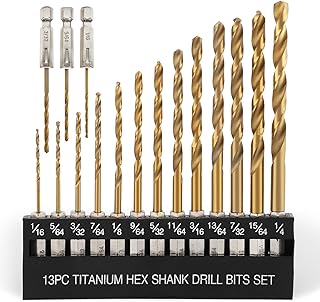

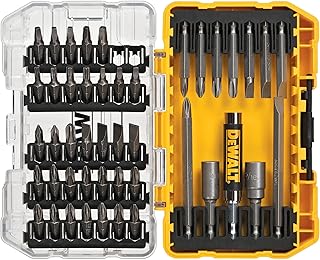


You do not need everything at once either. Three or four honest sets cover the overwhelming majority of home and site work. Knowing which three is what saves you from the giant assortment case that sits untouched in a drawer.
| Bit type | Material | Best for | Notes |
|---|---|---|---|
| HSS twist | Steel | General metal and wood | Cheapest, universal |
| Cobalt | Steel alloy | Stainless, hardened steel | Costs more, survives heat |
| Titanium coated | Coated HSS | Light metal, longer life | Coating wears at the edge |
| Black oxide | Treated HSS | General purpose | Mild corrosion resistance |
| Brad point | Steel | Clean holes in wood | No wandering |
| Spade | Steel | Fast rough holes in wood | Rough exit |
| Forstner | Steel/carbide | Flat-bottom, clean holes | Bench work |
| Hole saw | Bi-metal | Large holes | Slow, needs torque |
| Masonry | Carbide tipped | Brick, block, concrete | Needs hammer mode |
Read that as two questions rather than nine rows: what am I drilling, and will the hole be seen? Metal moves you along the HSS-to-cobalt line as the alloy gets harder. Wood moves you to brad point for small holes and Forstner for large ones. Masonry is a separate world that needs hammer mode at minimum. The “will it be seen” question is what decides how much you need to spend, because nobody inspects the hole inside a stud bay.
What You Are Actually Paying For
Bits that look identical from across the aisle can sit a long way apart on price. Four things account for most of that gap, and they are worth different amounts to different people.
The steel
Plain HSS is the baseline and it is genuinely fine for wood, plastic, aluminium and mild steel. Black oxide is HSS with a surface treatment that cuts friction slightly and resists rust in a damp box. Titanium nitride is a thin hard coating over HSS: it buys life on light work, but the coating is microns thick, and once the cutting lip wears through you are back to plain HSS. Cobalt is alloyed all the way through, so it holds an edge hot and can be resharpened without losing the advantage.
The grind
This is the detail almost nobody checks, and it changes results more than any coating. A standard 118-degree point is fine in wood and soft metal. A 135-degree split point self-centres on steel and starts without a punch mark, which is why it is worth paying for in a metal set. On brad points, check that the spurs stand proud of the cutting edges: they should sever the wood fibres before the flutes lift them, and that is what gives you a clean rim.
Straightness and shank
A bit that is not true orbits in the chuck, wanders at the start of the hole and cuts oversize. Test it the way you test a chuck: run it slow and watch the tip. Long cheap bits are the usual offenders. Shank type matters too, since a reduced shank lets a 1/2″ bit fit a smaller chuck, and a hex shank stops a large bit slipping under load.
The case
An index that holds bits by size, shows a gap when one is missing and closes without spilling is worth real money over a decade. A blister pack is not. It sounds like packaging, but it is the difference between owning a set and owning a drawer of loose bits.
Weighing them against each other: for wood, spend on the grind and ignore exotic steel. For stainless and hardened steel, spend on the steel first and the grind second. For anything you carry every day, the case outranks both.
For Wood: Brad Point Beats Twist
A brad point bit has a centre spur that stops the bit wandering and cuts a clean-edged hole. For dowels, hardware and anything visible, they produce a far better result than a general-purpose twist bit.
The reason is fibre direction. A twist bit tears the rim because its lips meet the surface at an angle, while the brad point’s spurs slice the perimeter before the flutes remove anything. Back the workpiece with scrap and the exit comes out as clean as the entry.
They suit anyone building furniture, hanging hinges, doweling or drilling shelf pins. Skip them if your wood drilling is occasional and always hidden behind a fitting, and never put one in metal: the fine tip rolls over or snaps immediately.
Brad point bit sets
Clean entry, no wandering, tidy hole walls. If you build furniture, these earn their keep immediately.
For Metal: Cobalt When It Matters
Regular HSS handles mild steel and aluminium. Once you hit stainless or hardened steel, heat kills standard bits fast. Cobalt bits are alloyed throughout — not coated — so they keep cutting at temperature.
Use cutting fluid, run slow, and apply steady pressure. Speed and dry drilling are what destroy metal bits.
The stainless failure mode is worth understanding, because it is unforgiving. A bit that rubs instead of cutting work-hardens the surface underneath it, and from that point nothing drills it easily. So commit: get it biting on the first turn, keep it fed, and do not lift off and restart into a polished spot. Curls of swarf mean it is cutting. Dust and smoke mean it is rubbing, and you have seconds to fix that.
Cobalt suits anyone who meets stainless, hardened fasteners or thick plate with any regularity. Skip it if your metal work is aluminium brackets and mild steel strap, where a good HSS or black oxide index does the same job and you will lose the bits long before you wear them out.
Cobalt drill bit sets
M35 or M42 cobalt. Slower speeds, cutting fluid, and they last far longer than coated bits in stainless.
Large Holes in Wood
Spade bits are cheap and fast but leave a rough exit — fine inside a wall. Forstner bits leave flat-bottomed, clean-walled holes and are what you want for visible work and hinge cups. Auger bits are for deep holes through framing.
What separates them is what guides the cut. A spade bit is steered by its point and torn out by its wings, so it grabs on exit and needs a firm grip. A Forstner rides on a continuous rim, which is why it can leave a flat bottom, overlap a previous hole and start on an angle. An auger pulls itself through on a lead screw, so it wants low speed and real torque; in a small cordless drill it will stall or twist your wrist.
Hole saws are top of the range for diameter and bottom for finish, so keep the speed down and clear the plug regularly. Roughly: spade bits for running cable, Forstners for the bench, augers for framing, hole saws for anything large enough that the edge will be hidden.
Forstner bit sets
Flat bottoms, clean edges, overlapping holes possible. Run them slow — they cut a lot of material.
Good and Bad at Each Price Band
At the bottom of the market you are buying loose tolerances and a case that breaks first. A good cheap set still exists: a small size range you will genuinely use, a stated steel spec on the packaging, and a rigid index. A bad one is the huge assortment with duplicate sizes, unnamed coating and a lid that will not shut. Cheap bits are the right answer for wood, for drilling into unknown material where you might hit a nail, and for sizes you need twice a year.
Mid-range is where most people should live. Ground flutes rather than rolled, a split point on the metal sets, honest cobalt content when it says cobalt, and a case worth keeping. One mid-range brad point set, one mid-range cobalt index and one Forstner set covers a very high proportion of real work.
Premium buys consistency and edge cases: M42 for stainless all day, carbide-tipped Forstners for hardwood production, hole saws with replaceable pilots. Worth it when the tool is earning. If you drill a dozen holes a month, those bits will be dropped in a joist bay long before the extra life pays back.
The Mistakes That Kill Bits
- Too much speed in large diameters. Big bits generate heat at the rim, where the surface speed is highest. Slow down as the bit gets bigger.
- Dry drilling metal. Fluid is coolant and lubricant. Without it, the edge anneals and the bit is finished in one hole.
- Side load. Holding the drill off square is the main cause of snapped small bits. Sight the drill from two directions before you start.
- No backing under the work. Blowout on exit ruins the face you were trying to protect. Clamp scrap underneath.
- Pushing harder on a blunt bit. Pressure does not restore an edge, it just adds heat. Sharpen or replace it.
One more that is not the bit’s fault: expecting a masonry bit and hammer mode to handle work that needs an SDS rotary hammer. In brick and block it will cope. In poured concrete or over larger diameters, you are punishing the drill and the bit for a job neither is built to do.
Bit Care
None of this takes long, and it is the difference between a set that lasts a decade and one that lasts a season.
- ✔ Slow speeds for large diameters, fast for small — the opposite of instinct
- ✔ Cutting fluid on all metal drilling
- ✔ Back the workpiece with scrap to prevent blowout
- ✔ Peck-drill deep holes to clear chips
- ✔ Store bits in an index so you can see what is missing
What Not to Buy
The traps are consistent, and nearly all of them are about paying for piece count instead of quality.
- ✘ 200-piece bargain sets — mostly filler you will never touch
- ✘ Coated bits sold as “titanium” at bargain prices — the coating is microns thick
- ✘ Masonry bits for concrete when you need SDS
- ✘ One “does everything” bit set for wood and metal
FAQ
Can I sharpen drill bits? Yes, twist bits sharpen well on a jig or a grinder with practice. Worth learning for larger sizes, where a single bit costs more than the jig amortised over a few resharpens. Coated bits lose their coating at the tip once you touch them, which is one more argument for cobalt.
What size set should I start with? A 1/16″–1/2″ HSS index for general work, plus a brad point set for wood. Add cobalt when a specific job demands it, rather than buying it in advance.
Why do my bits keep breaking? Usually side load — the drill is not being held straight — or too much speed with too little clearance. Deep holes that are never backed out to clear chips are the third cause: the flutes pack, the bit binds, and it snaps at the shank.
Can I use the same bits for wood and metal? HSS twist bits cross over happily in both directions. Nothing else does. Brad points, Forstners, spades and augers are wood-only, and masonry bits will not cut steel at all.
Compare drill bit sets →