What's inside
As an Amazon Associate I earn from qualifying purchases. This post may contain affiliate links at no extra cost to you.
The best ukuleles for beginners and performers are usually soprano models for portability and traditional brightness, concert models for the safest all-round choice, tenor models for fuller projection and stage work, and baritone models for guitarists who want familiar tuning and scale length.
As an Amazon Associate we earn from qualifying purchases at no extra cost to you.



What we cover
Our Top Picks
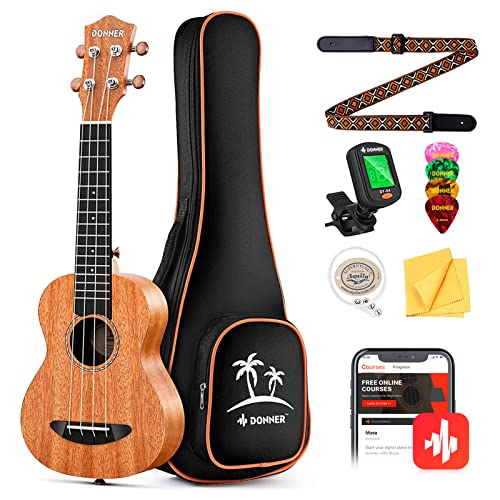
 ADM Ukulele for Beginners Hawaiian Wood Ukelele Kit21 Inch22 x 7.8 x 3 inches1.8 poundsCheck on Amazon

Quick picks by player and situation
| Player or situation | Best starting choice | Why it fits | Typical new price range |
|---|---|---|---|
| Child, traveler, or very small space | Soprano, 21-inch scale | Small body, light weight, traditional ukulele tone | $40–$150 |
| Most adult beginners | Concert, 23-inch scale | More fret room without becoming bulky | $80–$250 |
| Singer, performer, or fingerstyle player | Tenor, 26-inch scale | Stronger projection, wider working area, better stage presence | $150–$700+ |
| Guitarist wanting familiar chord shapes | Baritone, 30-inch scale | D–G–B–E tuning matches the highest four guitar strings | $150–$600+ |
These prices are broad market ranges rather than fixed recommendations. Construction quality, solid wood, electronics, included case, and the reputation of the maker can move a ukulele well outside them.
Which ukulele size should you choose?
Soprano: compact and unmistakably ukulele-like
A soprano is typically about 21 inches long, with a scale length near 13 inches and 12 to 15 frets. It produces the bright, quick response many players associate with the instrument. Its narrow fret spacing is convenient for smaller hands, but adults with large fingers may find crowded chords less comfortable.
Choose a soprano if you value portability, play mostly simple strumming patterns, or need an instrument that fits in a backpack. Its smaller soundbox usually has less low-end authority than a tenor, so it is not always the best choice for a singer competing with other instruments.
Concert: the safest all-purpose recommendation
Concert ukuleles generally measure about 23 inches overall and use a scale around 15 inches, often with 15 to 20 frets. The additional body volume gives them a little more warmth, while the longer neck provides noticeably more room for chord shapes and melodic playing.
For many beginners, concert is the best balance of comfort, sound, and future usefulness. It is still easy to carry, but it does not feel as cramped as some sopranos. A concert is also a sensible choice when more than one person may play the instrument, since it accommodates a wider range of hand sizes.
Tenor: the performer’s size
Tenors are commonly about 26 inches long with a 17-inch scale. The larger soundbox and longer strings can produce more volume, sustain, and bass response. That extra space benefits fingerstyle arrangements, single-note melodies, alternate tunings, and players who need clear notes through a microphone or pickup.
The trade-off is size and cost. A tenor can feel less immediately “traditional,” and its larger neck may be tiring for a young player. For regular performances, however, its projection and playing area often justify the increase.
Baritone: a different instrument, not simply a larger ukulele
Baritones typically use a 30-inch scale and are tuned D–G–B–E from low to high, usually with a re-entrant or linear arrangement depending on the string set. The tuning matches the top four strings of a guitar, making familiar guitar chord shapes transferable.
Baritone is a strong option for guitarists, low-voiced singers, and players who prefer a deeper, more guitar-like sound. It is less suitable if your goal is to play along with standard soprano, concert, or tenor chord charts without transposing. Baritone strings and chord diagrams are not interchangeable with standard G–C–E–A ukulele equipment.
Tonewood: what changes, and what does not
Wood affects resonance, weight, appearance, and how the instrument responds, but body shape, bracing, construction accuracy, strings, and setup matter at least as much. A more expensive wood does not automatically produce a better-playing ukulele.
- Mahogany: Often gives a warm, balanced sound with restrained brightness. It is a dependable choice for strumming and recording.
- Koa: Associated with Hawaiian ukuleles, with clear attack and attractive figuring. Solid koa instruments can be expensive; laminate koa mainly provides the appearance and consistent durability.
- Spruce: Often emphasizes projection and note definition, useful for fingerstyle and performers who need articulation.
- Maple: Can provide a crisp, focused response and visual character, although the final result depends heavily on construction.
- Laminate construction: Usually costs less and tolerates changes in humidity better than thin solid wood. It is often the practical beginner choice.
- Solid wood: May offer greater resonance and complexity, but it needs more careful humidity control and can be damaged by rapid environmental changes.
For a first instrument, prioritize a straight neck, accurately seated frets, stable tuning machines, a comfortable nut width, and clean fret ends before paying extra for a particular wood species.
Playability matters more than decorative features
A ukulele can be beautifully finished yet frustrating if its setup is poor. Check that the strings sit neither excessively high nor almost against the frets. A very high action makes chords tiring; action that is too low causes buzzing. Light fret sprout, sharp fret ends, a loose bridge, or tuning machines that slip are warning signs.
Nut width is another practical measurement. Many soprano and concert models fall near 35–36 mm, while some wider-neck instruments approach 38 mm or more. A wider nut gives fingerstyle players extra separation, but a smaller-handed beginner may prefer a narrower neck. If buying remotely, compare the stated nut width with an instrument you already find comfortable.
Low-G and high-G setups also change the experience. High-G uses a re-entrant fourth string and creates the familiar bright ukulele texture. Low-G replaces it with a wound or unwound lower string, extending the range and making melodic arrangements more guitar-like. Choose the setup that matches the music rather than assuming one is superior.
When are electronics worth paying for?
Built-in electronics are useful when you regularly perform through an amplifier, connect to a recording interface, or need quick volume control on stage. A common system combines a piezo pickup under the saddle with a preamp and tuner. The tuner is convenient, but the pickup does not reproduce exactly what the instrument sounds like acoustically; it senses vibration at the bridge area and may require equalization.
For occasional performance, a good acoustic ukulele with an external microphone can sound more natural. For frequent gigs, onboard electronics reduce setup time and avoid placing a microphone in front of the instrument. Electronics add cost, battery dependence, and another component that may eventually need service.
| Feature | Acoustic model | Electric-acoustic model | Best match |
|---|---|---|---|
| Typical added weight | None | About 50–150 g for pickup and preamp hardware | Players carrying the instrument often |
| Battery requirement | None | Usually one 9-volt battery or two coin cells, depending on preamp | Regular amplified use |
| Setup time | Microphone placement required | Plug in and check tuner or volume | Rehearsals and small stages |
| Failure points | Fewer electronic parts | Jack, cable, battery contact, pickup, or preamp | Players prioritizing long-term simplicity |
A practical buying decision
- Under $100: Look for a laminate concert or soprano with a padded gig bag and a basic setup. Avoid choosing solely by glossy finish.
- $100–$250: This is a useful range for a dependable concert, an entry-level tenor, or a better-finished soprano. Pay attention to fretwork and tuning stability.
- $250–$700: Consider a solid-top concert or tenor, a quality electric-acoustic model, or a baritone from an established maker.
- Performance first: Select tenor if you want projection and fingerstyle room; add electronics if amplification is routine rather than occasional.
- Limited storage: Choose soprano or concert and budget for a rigid or well-padded case instead of leaving the instrument exposed.
For example, a $150 concert used twice per week for three years gives roughly 312 playing sessions. Before strings and accessories, that is about $0.48 per session. A cheaper instrument that discourages practice is not necessarily the economical choice.
Ownership: strings, humidity, and common mistakes
Nylon and fluorocarbon strings gradually lose brightness and tuning stability. A frequent player may replace them every two to six months; an occasional player may go much longer. Changing string material or gauge can alter intonation and may require a fresh setup, especially on a baritone.
Wipe fingerprints from the strings and finish with a dry, soft cloth after playing. Do not use household furniture polish, alcohol, or abrasive cleaners. Keep the ukulele away from radiators, hot cars, direct sunlight, and damp bathrooms. Solid wood is particularly vulnerable to rapid humidity changes; a case humidifier can help in a very dry climate, but it should be used with a hygrometer rather than guesswork.
Other common mistakes include forcing the wrong string set onto a baritone, leaving a tuner clipped to the headstock for months, overtightening tuning pegs, and storing an electric-acoustic ukulele with a depleted battery inside. If buzzing, high action, or tuning problems persist after normal string changes, a qualified repair technician can assess the nut, saddle, neck relief, and frets.
Final recommendation
Choose a concert ukulele if you want one dependable instrument without a specialized requirement. Choose soprano for maximum portability and classic brightness, tenor for performing and melodic playing, and baritone if you already think in guitar shapes. Within any size, spend first on reliable construction and comfortable setup, then on solid wood, electronics, or decorative details.