What's inside
As an Amazon Associate I earn from qualifying purchases. This post may contain affiliate links at no extra cost to you.
What we cover
Best Impact Wrench Socket Sets for Automotive and Heavy-Duty Work
The best impact wrench socket set for most automotive work is a 1/2-inch-drive, impact-rated metric set covering roughly 10–24 mm, with a compact case and clearly marked sockets; add a 3/8-inch set for smaller fasteners or a 3/4-inch set for larger truck and equipment hardware.
Choose by the fasteners you actually service, not the number of pieces in the box. A broad set can still be a poor buy if its sizes skip common lug nuts, its sockets are too thick for wheel recesses, or it relies on adapters that reduce clearance. The comparison below focuses on coverage and practical fit rather than brand claims.
As an Amazon Associate we earn from qualifying purchases at no extra cost to you.


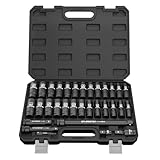

Compare by drive size and job
| Set type | Useful coverage | Typical socket construction | Best fit | Main trade-off |
|---|---|---|---|---|
| 3/8-inch impact | About 8–19 mm metric; 3/8–3/4 in. SAE | Shallow and deep sockets; often 6-point | Engine-bay work, compact cars, smaller fasteners | Less suited to high-torque lug nuts or large suspension hardware |
| 1/2-inch impact | About 10–24 mm metric; 3/8–1 in. SAE | Shallow sockets, commonly 6-point; optional deep sizes | General automotive repair and wheel service | May not reach some recessed fasteners without thin-wall or deep sockets |
| 3/4-inch impact | About 19–50 mm metric; roughly 3/4–2 in. SAE | Heavy-wall sockets, often with retaining-pin holes | Trucks, agricultural machinery, and industrial fasteners | Bulky, costly, and unnecessary for most passenger-car repairs |
Ranges are examples of useful coverage, not a promise that every set includes every size. Check the individual size list before buying. SAE and metric sizes are not interchangeable: a near-fit socket can round a fastener, especially under impact.
Best picks by situation
- For a first automotive set: Choose a 1/2-inch metric impact set with 10–24 mm coverage, 6-point sockets, and both shallow and deep sizes in the fasteners you encounter most. A small extension assortment is useful, but avoid paying extra for a large pile of duplicate adapters.
- For wheel and brake work: Prioritize a 1/2-inch set that includes the exact lug-nut sizes on your vehicles and at least one thin-wall socket if the wheels have narrow recesses. A protective sleeve can help reduce cosmetic damage, but it does not make an incorrect size safe.
- For tight engine bays: Add a 3/8-inch impact set rather than forcing a bulky 1/2-inch socket into a cramped space. Confirm the tool’s clearance and the set’s shallow-socket dimensions; drive size alone does not tell you whether a socket will fit.
- For trucks or frequent heavy equipment work: Consider 3/4-inch drive only when your fasteners and wrench are designed for it. Verify the wrench’s drive, rated capacity, and retaining method match the sockets. A 1/2-to-3/4-inch adapter does not turn a smaller-drive tool into a heavy-duty one.
- For occasional home repairs or limited storage: A compact 1/2-inch set with the common sizes you need is often more useful than a large mixed-drive kit. A molded case with labeled, size-specific slots helps keep missing sockets visible.
What matters beyond the size count
Impact-rated material and shape
Impact sockets are designed for repeated shock loading and are commonly made from chrome-molybdenum steel, often marked Cr-Mo. Chrome-vanadium (Cr-V) is common in conventional hand sockets; do not assume a socket is impact-safe just because it fits the drive. Look for explicit impact-use labeling and use impact-rated extensions and adapters as well.
For stubborn automotive fasteners, a 6-point socket generally bears on the flats more securely than a 12-point socket. The latter can be convenient for positioning in tight spaces, but the extra engagement points may be a disadvantage on a corroded or damaged fastener.
Wall thickness, depth, and access
Impact sockets need material to withstand repeated loading, so their walls are often thicker than those of hand sockets. That strength can become a clearance problem around recessed lug nuts or crowded suspension parts. Thin-wall designs address access, but have less material around the socket opening; use them only for suitable fasteners and inspect them for damage.
Deep sockets help reach nuts on long studs, while shallow sockets are shorter and easier to maneuver. A set that includes both can be more useful than one with many sizes in only one depth. Measure the available clearance when a specific wheel or component is the reason you are buying.
Case and markings
Size markings should be easy to read and durable enough to survive regular handling. Laser markings may be clear when new but can become harder to read with wear; stamped or deeply marked sizes can be easier to identify over time. In a case, each socket should have a labeled position that holds it securely without making removal awkward. Check whether the case is compact enough for your tool chest and whether its latches are robust.
Check coverage before you buy
Use this quick fit check for a vehicle or machine you service often:
- Find the fastener sizes in the service information or measure them with a proper wrench or socket.
- Write down the sizes you use most, including whether they are metric or SAE. Do not select by vehicle brand alone; models and repairs vary.
- Match the set’s drive size to the impact wrench. Confirm that any extension or adapter is also impact-rated.
- Check socket depth and outside diameter against the available access, especially for wheel recesses.
- Choose a set with a little useful coverage beyond your current list, rather than paying for dozens of sizes you are unlikely to use.
For example, if your regular jobs require 17, 19, and 21 mm lug-nut sockets, a set that stops at 19 mm does not cover the job, even if it advertises a high piece count. Confirm that all three sizes are included and that the 21 mm socket fits the wheel’s recess.
Durability and safe ownership
Socket sets usually show wear first at the working end: corners can round, markings can fade, and thin-wall sockets can crack or deform if overloaded. Stop using a socket that is visibly cracked, stretched, or loose on the fastener. Replace damaged accessories rather than relying on them for another high-load job.
Wipe sockets clean after use, especially after exposure to road salt, oil, or moisture. Dry them before returning them to the case, and occasionally check that every size is in its assigned slot. This simple habit helps prevent corrosion and makes a missing socket easier to spot.
Use the impact wrench for removal and controlled snugging, then tighten wheel fasteners to the vehicle manufacturer’s specified torque with a calibrated torque wrench. An impact wrench can over-tighten a fastener before you can judge it by feel. Avoid using hand-only chrome sockets on an impact wrench, and do not use a socket or adapter that does not match the drive and application.
Bottom line
For most passenger-car owners, a 1/2-inch metric impact set with 10–24 mm coverage, 6-point sockets, a useful mix of depths, impact-rated construction, and an organized case is the strongest starting point. Choose 3/8-inch for smaller, tighter work; move to 3/4-inch only for equipment that calls for the larger drive. Before deciding, verify the actual fastener sizes, socket outside diameter, and included depths—the details that determine whether a set works on your repairs.