What's inside
As an Amazon Associate I earn from qualifying purchases. This post may contain affiliate links at no extra cost to you.
What we cover
What matters when driving self-tapping screws into steel studs
For fastening drywall track, brackets, or light-gauge sheet metal to steel studs, a compact cordless impact driver is usually the quickest tool. Its short bursts of rotation help keep a screw moving when the tip starts cutting steel. But it is not automatically the best choice for every screw: thin steel can strip easily, and excess torque can spin a fastener without making a sound connection.
Most residential steel studs are around 20 to 25 gauge, roughly 0.5 to 0.9 mm thick, though heavier structural studs are available. Match the screw to the combined thickness of the materials and the stud, and follow the fastener maker’s guidance. A common mistake is choosing a long, coarse screw meant for wood; use a self-drilling or self-tapping screw specified for steel instead. Self-drilling screws have a drill-point tip, while self-tapping screws may need a pilot hole, depending on the steel thickness and screw design.
As an Amazon Associate we earn from qualifying purchases at no extra cost to you.



Choosing a driver
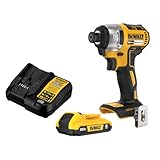
Look for a 1/4-inch hex chuck, variable-speed trigger, and at least two speed or power settings. A lower setting makes it easier to start a screw and avoid stripping the hole. Brushless motors generally improve runtime and tool life, but they are not essential for occasional household work. A compact 12V driver can handle many light-gauge-stud jobs; an 18V or 20V platform gives more headroom for repeated fastening and is often a better buy if you already own compatible batteries.
If you are buying into a battery platform, compare the bare tool price with the cost of a kit and spare batteries. An impact driver is useful beyond studs, but it is not a substitute for a drill when you need a controlled pilot hole. For a broad selection of compact options, compare variable-speed cordless impact drivers.
Impact driver or drill?
| Tool | Best use | Trade-off |
|---|---|---|
| 12V impact driver | Light-gauge studs, occasional work, tight spaces | Less reserve for thick material or long runs |
| 18V/20V impact driver | Frequent fastening and tougher assemblies | More weight and cost; easy to overdrive small screws |
| Drill/driver | Pilot holes and careful, low-speed fastening | Can stall more readily; needs a clutch and steady pressure |
The cheaper drill/driver you already own is fine for a few screws, especially with a clutch set low and a sharp, correctly sized bit. An impact driver earns its keep when you are driving many fasteners or working overhead. If the work involves frequent pilot holes, a drill/driver plus an impact driver is more versatile than buying a larger impact driver alone.
Bits and fasteners matter just as much
Use the exact drive type and size specified for the screw—often Phillips, square, or Torx—and replace worn bits. A slipping bit rounds the head, damages the finish, and can make a screw impossible to remove. Keep the bit aligned with the screw axis and press firmly enough to prevent cam-out, without leaning so hard that the tip wanders.
For jobs that need a pilot hole, check the screw manufacturer’s recommended diameter rather than guessing. A hole that is too small raises driving force and can snap the screw; one that is too large leaves weak threads that may pull out. For a few light-gauge fasteners, a basic set of impact-rated driver bits is adequate. For regular work, buy impact-rated driver bits in the drive sizes you actually use.
How to drive without stripping the stud
Clamp or hold the material firmly against the stud; a gap can let the screw pull the layers together unevenly or leave the joint loose. Start on the lowest speed, keep the driver square, and let the screw’s point establish its bite before increasing pressure. Stop as soon as the head seats. On thin steel, another fraction of a second can strip the hole, spin the screw, or dimple the attached material.
Do not rely on an impact driver’s clutch to protect the connection: many impact drivers have power modes rather than a true adjustable torque clutch. If you are new to the tool, practice on offcuts of the same material. A screw that spins freely after seating has likely stripped the steel; remove it and move to a fresh location or use a fastening method approved for the load. Do not simply install a larger screw without checking edge distance and the fastener specification.
A practical buying checklist
For occasional home projects, choose the less expensive 12V or entry-level 18V tool if it has a responsive trigger, a low-speed mode, and batteries that suit your other tools. You do not need the highest torque rating for small self-tapping screws; too much power makes overdriving easier. For daily installation work, prioritize a comfortable grip, useful speed control, a bright work light, and a battery platform with readily available replacement packs. A kit with one compact battery is easier to handle overhead, while a second battery prevents downtime on longer jobs.
Also consider a magnetic bit holder or a screw-holding attachment if access is awkward, but test it first: long holders can wobble and reduce control. If you need a dedicated compact tool for frequent steel-stud fastening, compare compact 18V impact-driver kits against the bare tools in the battery system you already own.