What's inside
As an Amazon Associate I earn from qualifying purchases. This post may contain affiliate links at no extra cost to you.
Large hole saws demand a different kind of cordless drill than ordinary drilling. A 2-inch hole saw through framing lumber can stall a compact drill, twist your wrist, or overheat the motor. The right tool has strong low-speed output, a rigid side handle, a two-speed gearbox, and enough battery capacity to finish the cut without repeated thermal shutdowns.
As an Amazon Associate we earn from qualifying purchases at no extra cost to you.
What we cover
What matters most for large hole saws
Ignore the drill’s maximum speed first. Large hole saws usually work best at roughly 200 to 600 RPM, depending on the material and diameter. A drill that spins at 2,000 RPM is useful for small bits, but that speed is excessive for a 3-inch bi-metal hole saw in wood.
Look for a genuine two-speed drill with a low range below about 600 RPM. A mechanical low gear is more useful than simply feathering the variable-speed trigger. The gearbox supplies more torque and stays cooler under load.
Torque figures are difficult to compare because manufacturers use different testing methods. As a practical guide, choose a full-size 18V or 20V class drill with at least about 500 inch-pounds of rated hard torque for routine 2- to 3-inch holes. For repeated 3- to 4-inch holes, especially in doubled lumber or wet wood, a high-torque drill with roughly 700 inch-pounds or more gives substantially more margin.
Use the 18V or 20V brushless cordless drill with side handle category as the baseline. Brushless motors generally run cooler and deliver better sustained performance than inexpensive brushed drills, though a brushed model can still be adequate for occasional work.
Which cordless drill type should you buy?
| Drill type | Best use | Large-hole-saw verdict |
|---|---|---|
| Compact 12V drill | Small holes, cabinets, light fastening | Fine up to about 1-1/2 inches in easy wood; limited reserve |
| Full-size 18V/20V drill | Most plumbing, electrical, and framing work | Best general choice for 2- to 3-inch hole saws |
| High-torque 18V/20V drill | Repeated large holes and dense material | Best for 3- to 4-inch saws, but heavier and harder to control |
| Right-angle drill | Tight framing and joist bays | Excellent access; choose one with a real low gear and auxiliary handle |
| Hammer drill | Concrete and masonry drilling | Hammer mode does not help wood hole saws; use it only as a dual-purpose tool |
A standard full-size drill is the best value for most homeowners and tradespeople. A high-torque model is worthwhile when you install large pipe penetrations regularly, cut through multiple layers, or use hole saws larger than 3 inches. It is not automatically better for every job: added weight can make overhead work tiring, and the extra torque increases the chance of binding injuries.
Features that prevent stalls and injuries
A side handle is essential once the hole saw exceeds about 2 inches. It gives you leverage and keeps the drill body from rotating if the saw catches. Prefer a handle that can mount on either side and locks firmly without flexing.
A metal chuck is desirable for heavy work. Keyless chucks are convenient, but cheaper chucks can loosen when the arbor repeatedly starts and stops under load. Tighten the chuck firmly by hand and check it after the first few cuts. An arbor with a pilot bit and properly sized mandrel matters just as much as the drill.
Electronic overload protection helps, but it is not a substitute for correct technique. A drill that shuts off repeatedly is being overloaded. Continuing to pull the trigger can heat the windings, battery, and gearcase. Two smaller batteries may be more useful than one large battery if you need to rotate packs while working.
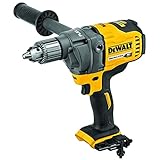
For repeated hole-saw work, consider a high-torque brushless cordless drill. Choose the tool platform you already use if possible. Batteries are a major part of the cost, and switching brands for a modest gain in torque rarely makes financial sense.
When the cheaper drill is good enough
A budget 18V or 20V drill can handle occasional 1-1/2-inch or 2-inch holes in ordinary pine, plywood, and soft construction lumber. Use the low gear, a sharp hole saw, and a fully charged battery. Let the saw cut rather than forcing it, and clear chips frequently.
Pay more for the stronger drill when you expect several large holes in one session, work in engineered lumber, cut through thick hardwood, or need to use a 3- to 4-inch saw. Dense material creates more resistance, and a weak drill will either stall or require long pauses to cool. If you only need one large opening, renting a heavy-duty drill may be cheaper than buying a high-torque cordless model and batteries.
How to use a cordless drill with a large hole saw
Start the pilot bit at low speed while holding the drill square to the surface. Once the teeth establish a circular groove, increase pressure gradually but keep the drill in low gear. For a 2-inch bi-metal saw in softwood, approximately 300 to 500 RPM is a useful starting range. Drop closer to 200 to 300 RPM for larger saws, hardwood, or metal.
Stop every few seconds to pull the saw back and clear chips. Packed chips make the saw bind and dramatically increase heat. If the saw locks, release the trigger immediately. Do not try to twist the drill free while it is running. Reverse the drill only after it has stopped, and use both hands on the side handle and main grip.
When cutting through a finished surface, drill from one side until the pilot bit appears on the other side. Then finish from the opposite face. This reduces breakout and lowers the chance of the plug jamming inside the saw. For a clean opening in plywood or trim, clamp a scrap backer behind the work.
A practical buying checklist
Before buying, verify that the drill has a mechanical low-speed range, a substantial side handle, a 1/2-inch chuck, and a battery system with readily available replacement packs. A two-speed cordless drill with a 1/2-inch chuck is usually the sensible middle ground.
For occasional work, prioritize price, warranty, and battery availability over the highest torque number. For production work, prioritize cooling, ergonomics, overload protection, and a comfortable auxiliary handle. Finally, buy a sharp hole saw matched to the material. A dull or clogged saw can make a capable drill look weak, while a sharp saw lets a reasonably priced drill complete the job safely.