What's inside
As an Amazon Associate I earn from qualifying purchases. This post may contain affiliate links at no extra cost to you.
What we cover
Choose the right anchor for the wall and cabinet
For a cabinet secured to a sound, solid concrete wall, concrete screws are usually the best starting point. They’re removable, widely available, and make a strong connection when installed in a correctly sized hole. For heavier cabinets, uneven walls, or installations where a failed fastener could cause injury, expansion anchors or adhesive anchors may be a better fit—but only when selected and installed for the actual load and concrete condition.
First confirm that the wall is solid concrete, not hollow block, brick veneer, or a thin concrete skin over another material. Anchor performance depends on the base material. Also check for plumbing, wiring, and reinforcement before drilling; a wall scanner can help, but it may not reliably detect every hazard.
As an Amazon Associate we earn from qualifying purchases at no extra cost to you.
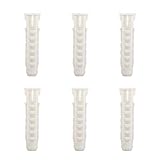


Anchor options compared
| Anchor type | Best use | Main trade-off | Typical drilling |
|---|---|---|---|
| Concrete screw | Most cabinet rails and brackets in sound concrete | Requires a precisely sized, clean hole; can lose grip if overtightened | Hammer drill and specified masonry bit |
| Wedge or sleeve anchor | Heavy brackets in solid concrete with enough edge distance | Permanent, and expansion force can damage weak concrete or cause cracking near an edge | Hammer drill and specified masonry bit |
| Adhesive anchor with threaded rod | High loads or situations where expansion pressure is undesirable | More steps, curing time, and careful hole cleaning are essential | Hammer drill, correct hole size, cleaning tools, adhesive |
| Plastic masonry plug | Light-duty attachments with low consequences if they loosen | Not a dependable choice for a loaded cabinet | Drill and matching masonry bit |
Concrete screws: the practical default
A concrete screw cuts or forms threads in a pilot hole. It’s a good choice for a cabinet mounting rail when the manufacturer allows it and the concrete is sound. Buy screws intended for concrete, not ordinary wood or drywall screws, and follow the fastener maker’s specified hole diameter, minimum embedment, and edge spacing. Those dimensions vary; there is no safe universal hole size.
Choose a length that passes through the rail, any spacer, and any wall finish before reaching the required embedment in concrete. A screw that is long enough overall may still have too little engagement if thick tile, furring, or plaster sits between the rail and the concrete. For a concrete screw selection, check the package instructions rather than relying on the screw’s outside diameter alone.
Concrete screws are often cheaper and easier to remove than adhesive anchors. Their common failure is a loose or spinning screw caused by an oversized, dusty, or damaged hole. If one spins, don’t keep turning it in the same hole; use a manufacturer-approved repair approach or move the fastener location while preserving the required spacing.
Drilling and installation
Use a hammer drill with a sharp carbide-tipped masonry bit when drilling ordinary concrete. A regular drill can work in soft material or for a small number of shallow holes, but it is slower and may overheat the bit. For many holes or harder concrete, a cordless hammer drill is more efficient. An SDS rotary hammer is faster for repeated holes, but may be unnecessary for a few cabinet anchors.
Mark the cabinet rail level, then transfer its mounting holes to the wall. Drill perpendicular to the concrete to the depth specified for the anchor, allowing for the screw or bolt length and any required clearance. A depth stop or tape marker helps prevent drilling too shallow. Keep the bit from wandering at the start, and pause if it overheats or the hole is producing little progress.
Clean each hole as directed by the anchor maker. Dust left inside can stop a concrete screw from engaging properly and can seriously reduce adhesive-anchor performance. Vacuuming and a suitable hole-cleaning brush are common methods; adhesive systems may specify a particular blow-brush-blow sequence. Don’t substitute casual blowing for the specified cleaning process.
Fasten the rail firmly without crushing it or stripping the hole. Use a hand tool for final tightening if you’re unsure of the torque; an impact driver can make it easy to overtighten a screw or damage the rail. Check that the rail does not shift, then mount the cabinet and secure it to the rail as designed. The cabinet’s hanging hardware and rail must also be rated for the load.
When to choose expansion or adhesive anchors
Wedge and sleeve anchors expand against the sides of the hole. They can make a robust connection in good concrete, but expansion puts pressure on the surrounding material. Avoid placing them too close to a concrete edge, joint, or another anchor; the required distances depend on the product. If the concrete is cracked, crumbly, or thin, an expansion anchor may split or break out the material rather than hold.
Adhesive anchors bond threaded rod inside a cleaned hole. They avoid expansion pressure and can suit demanding installations, but they are less forgiving: wrong hole dimensions, poor cleaning, expired adhesive, or loading before full cure can cause failure. Temperature affects cure time. Follow the cartridge’s instructions and use only a system approved for the concrete and load. For a heavy cabinet, adhesive anchor systems are worth considering when their extra steps are justified.
Think about the load and layout
A cabinet’s empty weight is only part of the load. Include stored contents, doors pulling outward when opened, and the leverage created by the cabinet’s depth. Don’t assume that a stated anchor capacity applies directly to your installation: published values depend on concrete strength, embedment, spacing, edge distance, and load direction. Use the fastener manufacturer’s data and the cabinet maker’s mounting instructions.
Use the specified number of fasteners across the rail, spaced as directed, and keep them away from weak edges. If the wall is uneven, use solid, noncompressible shims behind the rail so tightening does not bend it or leave sections unsupported. A plastic masonry plug is inexpensive and can be fine for a light accessory, but it is a poor economy for a cabinet where loosening could drop the load.
When to get help
Stop if the concrete is badly cracked, hollow-sounding, spalling, or unusually thin, or if you can’t confirm what is behind the drilling area. For a large, heavy, or overhead cabinet, use a qualified installer or an engineer to assess the wall and fastener layout. A stronger anchor cannot compensate for weak concrete, a poorly fixed rail, or an overloaded cabinet.