What's inside
As an Amazon Associate I earn from qualifying purchases. This post may contain affiliate links at no extra cost to you.
A cordless impact driver can make fastening subfloor panels quicker, especially when you are driving many screws into joists. But speed is not the only concern: a driver that sinks screws too aggressively can strip the head, break the screw, or pull the panel below the surface. For most DIY subfloor work, a compact 18V or 20V driver with variable-speed control is a practical choice; the battery platform you already own may matter more than the tool’s maximum torque claim.
As an Amazon Associate we earn from qualifying purchases at no extra cost to you.


What we cover
What subfloor fastening demands
Subfloor panels are commonly 3/4-inch tongue-and-groove plywood or oriented strand board (OSB), though thickness and framing vary. The fastener must pass through the panel and bite securely into the joist. A typical screw length is 2 to 2-1/2 inches for 3/4-inch panels, but check the panel and fastener manufacturer’s instructions and account for the joist beneath. Use screws rated for subfloor or structural fastening, not drywall screws; drywall screws are brittle and can snap under movement.
An impact driver delivers short bursts of rotational force. That makes it effective at driving long screws without the steady reaction torque that can twist your wrist with a drill. The trade-off is less fine control, particularly near the end of the drive. Use a slower trigger pull for the final turns and stop when the screw head is flush or slightly below the surface—not buried deep enough to crush the panel’s face.
Choosing a driver without overbuying
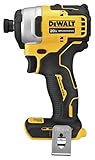
Look for a tool with a 1/4-inch hex collet, a variable-speed trigger, and at least two speed or drive modes. A low setting makes it easier to avoid overdriving; a high setting helps when there are hundreds of screws and the material is consistent. A compact tool is easier to use in corners and along wall edges, while a larger battery can add runtime but also weight.
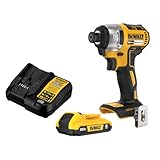
If you already have batteries from a major cordless platform, buying a bare tool is usually the economical choice. A homeowner fastening one room’s panels may be well served by a budget driver and a single battery. A contractor or anyone fastening an entire floor should consider a more durable tool, two batteries, and a charger that can keep pace. Compare 18V cordless impact drivers by kit contents and control features, not just advertised torque.
Impact driver or drill?
| Tool | Best use | Main advantage | Watch out for |
|---|---|---|---|
| Compact impact driver | Many subfloor screws | Fast driving with less wrist-twisting reaction | Easy to overdrive if you run the trigger wide open |
| Cordless drill/driver | Small jobs and careful finish work | More predictable speed and clutch control | Long screws can stall the drill or twist your wrist |
| Hammer drill | Masonry drilling | Impact action is designed for drilling in masonry | Hammer mode is unnecessary for wood screws |
A regular drill with a clutch can be a better choice if you are driving only a few screws and want a consistent stopping point. For a larger floor, an impact driver is generally faster, but it has no conventional clutch to limit screw depth. Some models offer an assist or fastening mode; these can reduce overdriving, but they do not replace watching the screw head.
Bits, screws, and setup
Use the bit type that matches the screw head—often a square-drive or star-drive bit for subfloor screws. A worn or poorly seated bit cams out, damaging the recess and leaving a screw difficult to remove. Keep a spare bit on hand, press firmly in line with the screw, and replace the bit when it no longer seats securely. If your fasteners use a common star drive, a set of impact-rated star-drive bits can be useful, but check that the included size matches your screws.
Follow the panel maker’s fastening schedule. A common layout is screws about 6 inches apart along panel edges and 8 to 12 inches apart in the field, with fasteners placed into the framing. Those figures are a starting point, not a substitute for project specifications, local code, or the adhesive manufacturer’s directions. Keep screws far enough from panel edges to avoid splitting, and make sure every fastener intended for a joist actually lands in one. A chalk line over the joists helps keep rows straight.
Where the installation calls for construction adhesive, apply the specified bead to the joist and place the panel promptly. Adhesive can reduce squeaks, but a panel left sitting too long may not bond as intended. Do not use adhesive to compensate for missed framing or incorrect screw spacing.
Avoid common fastening failures
Test your driver on an offcut or a hidden section before starting. Begin with the lower speed, then adjust until screws seat reliably without burying their heads. Keep the tool square to the panel; an angled screw is more likely to slip, strip, or miss the joist. If a screw spins without tightening, stop. It may have missed the joist, stripped its grip, or entered damaged material. Remove it if possible, find the framing, and install a replacement in sound wood without crowding the failed hole.
For a screw that will not advance, check for a dull or mismatched bit, a screw hitting a knot, or a fastener that is too long for the setup. More trigger pressure can make the problem worse by stripping the head or breaking the screw. Predrilling is rarely needed for routine panel fastening, but may help near an edge or in unusually hard material; follow the screw maker’s guidance.
If you need a complete kit rather than a bare tool, compare cordless impact driver kits with batteries against the cost of adding a battery to your existing platform. For a one-room repair, the cheaper kit is often enough. Paying more is worthwhile when the extra cost buys useful control, better battery availability, or a platform you will use across other tools—not simply a larger torque number.