What's inside
As an Amazon Associate I earn from qualifying purchases. This post may contain affiliate links at no extra cost to you.
The right bit set depends less on the drill than on the holes you need to make. Plumbing and electrical work can mean drilling small pilot holes, boring through framing for cable or pipe, or setting anchors in masonry. A compact twist-bit kit may handle the first jobs but stall in a stud; a large wood-boring set won’t help with tile or concrete. Buy for the materials and hole sizes you expect, and check the drill’s chuck before you spend extra on bits.
As an Amazon Associate we earn from qualifying purchases at no extra cost to you.


What we cover
Choose bits by material, not by set size
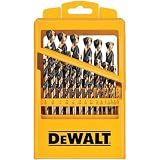
For common DIY work, a useful starting point is a set of high-speed-steel (HSS) twist bits for metal and small pilot holes, plus wood bits sized for the holes you actually need. HSS bits can drill thin sheet metal and make pilot holes in wood, but they’re slow and prone to overheating in thick steel. Cobalt bits cost more and are worth considering for repeated drilling in harder metal, not for an occasional hole in a junction-box bracket.
For cable or pipe routes through wood framing, spade bits are inexpensive and fast, but they can grab and leave rough holes. Auger bits cut more cleanly and clear chips well, though they’re longer and need a drill with enough torque. For a handful of holes in softwood, a spade-bit set is often the sensible buy. For larger holes in framing, consider an auger bit set for wood.
Neither type is a safe shortcut through every stud. Check for existing wires and pipes before drilling, keep holes centered in the framing, and follow local code for hole size and placement. Use a nail plate where a cable or pipe passes close to the face of a stud. A drill bit set doesn’t replace a cable or pipe locator, or careful inspection.
Masonry and tile need different bits
A carbide-tipped masonry bit is designed for brick, block, and concrete. In brick or block, a hammer drill can speed the work; in concrete, a standard cordless drill may make slow progress, especially with a larger hole. Use hammer action only with bits intended for it. Many ordinary masonry bits have round shanks and fit a standard three-jaw chuck; SDS bits require a compatible SDS drill and won’t fit a regular drill chuck.
Tile calls for a different approach. Use a tile-rated spear-point or diamond bit, turn off hammer mode, and drill slowly with light pressure. Let the bit cut rather than pushing hard; overheating or slipping can crack the tile. Once through the tile, switch to a masonry bit if the wall behind it is brick or concrete. For just a few tile holes, a small tile-bit pack is usually better value than a broad set you may never use.
What each set is good for
| Set type | Best use | Main limitation | Good buy when |
|---|---|---|---|
| HSS twist-bit set | Pilot holes, thin metal, small holes in wood | Small bits can snap; basic HSS wears quickly in hard metal | You need general-purpose bits in several small sizes |
| Spade-bit set | Fast, larger holes in wood framing | Can splinter wood or catch and twist the drill | You have a few cable or pipe holes in accessible wood |
| Auger-bit set | Deeper, cleaner holes in wood | Longer, costlier, and torque-hungry | You expect repeated framing work |
| Masonry-bit set | Brick, block, and some concrete | Slow in concrete without a suitable hammer drill | You’re installing wall anchors in masonry |
| Tile-bit pack | Careful drilling through ceramic tile | Specialized; not for wood or general masonry drilling | You need only a few tile holes |
Check shank fit and drill capacity
Most household drills have a 3/8-inch or 1/2-inch chuck. A 1/2-inch chuck accepts larger shanks, but the drill’s manual still sets the limits for bit size and material. Large auger and spade bits can stall a compact cordless drill, even when the chuck can hold them. A side handle and two hands help control reaction torque; stop if the bit binds instead of trying to muscle through it.
Impact drivers usually take 1/4-inch hex-shank accessories. Some drill bits are sold with hex shanks for use in an impact driver, but that does not make an impact driver the best tool for every hole. It can be noisy and harder to control for delicate tile or precise pilot holes. Check the bit packaging for impact-driver compatibility, and use a drill when controlled, steady rotation matters.
What to buy for common DIY jobs
For assembling cabinets, brackets, or electrical boxes, a modest HSS set with common sizes—roughly 1/16 to 1/2 inch—is useful, but don’t expect every kit to include every increment. A general-purpose HSS twist-bit set is a reasonable first purchase if you don’t already own one. Replace individual bits as they dull rather than buying an oversized kit for its piece count.
If your jobs mainly involve hanging fixtures or shelves in brick, choose a carbide-tipped masonry bit set with sizes matched to your wall anchors. Match the drilled hole to the anchor maker’s stated diameter; a hole that’s too large can make the anchor spin or pull out. For drywall, a masonry bit is unnecessary: use an anchor designed for the wall type and the screw load, and drill the specified pilot hole.
Use bits without wearing them out early
Mark the target depth with tape, clamp the work where practical, and start slowly to keep the bit from wandering. In metal, use cutting oil where appropriate and back off if the bit gets hot; heat dulls the cutting edge. In wood, withdraw a long bit periodically to clear chips. If a bit squeals, smokes, or takes much longer than it used to, stop and check for a dull edge, wrong material, or poor alignment.
Keep bits sorted by type and size. A labeled case saves time and prevents using a tile bit in wood or a wood-boring bit on metal. For most DIY plumbing and electrical repairs, a small, well-chosen collection beats a bargain box full of duplicates: buy the twist bits you use often, add wood-boring bits for framing, and buy masonry or tile bits only when the job calls for them.