What's inside
As an Amazon Associate I earn from qualifying purchases. This post may contain affiliate links at no extra cost to you.
What we cover
What drilling through floor joists demands
Floor joists are structural framing, so the drill is only part of the decision. You need a tool that can turn a large bit at low speed without stalling, a bit suited to the hole, and a hole location that does not weaken the joist. For ordinary wiring and plumbing runs, a compact drill may be enough. For repeated large holes or dense lumber, a drill with a side handle and more low-speed torque is safer and easier to control.
Before drilling, check local code and the joist manufacturer’s guidance. As a common rule for solid-sawn joists, holes belong near the neutral axis—the middle of the joist’s depth—and need to stay clear of the top and bottom edges and the supports. Engineered I-joists have specific manufacturer hole zones; do not apply solid-lumber rules to them. Never cut or notch a joist because a hole is inconveniently placed. If the framing type or allowable hole size is unclear, stop and ask a qualified professional.
As an Amazon Associate we earn from qualifying purchases at no extra cost to you.


Choose the right drill type
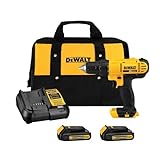
A standard 18V or 20V-class cordless drill with a two-speed gearbox is the practical choice for occasional holes up to about 1 inch, depending on the bit, wood, and drill. Use low gear for larger bits: high speed can cause a stall, overheat the tool, or twist your wrist when the bit catches. A clutch is useful for driving screws, but it is not a substitute for torque control while drilling.
For repeated holes with self-feed or auger bits, consider a heavy-duty drill with a side handle or a dedicated right-angle drill. The side handle gives you a better chance of controlling kickback. A hammer drill’s hammer mode is for masonry, not wood; switch it off when drilling joists. An impact driver is also not the first choice for boring large holes: its hammering action is designed for fasteners, and many drill bits do not have compatible hex shanks.
Cordless drill options compared
| Tool type | Best fit | Trade-off |
|---|---|---|
| Compact cordless drill | Occasional small holes and tight spaces | Can bog down on larger bits or hard lumber |
| Heavy-duty drill with side handle | Frequent holes and larger self-feed bits | Heavier and more expensive; needs careful two-handed control |
| Cordless right-angle drill | Joists in cramped bays or near obstructions | Specialized tool; may be unnecessary for a one-time job |
If you already own a capable drill and only need a few modest holes, try it with the correct bit before buying another tool. If the drill repeatedly stalls, gets unusually hot, or twists hard in your hands, stop rather than forcing it.
What to buy for occasional and frequent work
For general home use, compare 18V cordless drills with a side handle. Look for two mechanical speeds, a comfortable auxiliary handle, and a chuck that accepts the bit shanks you plan to use. Battery capacity matters less than tool control for a handful of holes; a healthy 2.0Ah or 4.0Ah pack may be sufficient. For a long run of large holes, a larger battery can reduce interruptions, but it also adds weight.
If access is the main problem, a cordless right-angle drill can fit between joists where a conventional drill cannot. It costs more and is less versatile for everyday drilling, so renting may make sense for a short project. Do not choose a tool by voltage or advertised torque alone: ergonomics, low-speed control, and a usable side handle matter when a bit binds.
Pick the bit and control the cut
For clean, moderate-size holes in framing, a wood auger bit set is a useful option. Self-feed bits can cut quickly but grab aggressively, making a side handle especially important. Spade bits are inexpensive and compact, but tend to cut rougher holes and can chatter. Match the bit’s shank to the chuck, and check its maximum recommended speed; larger bits generally call for slower drilling.
Mark the approved location and hole diameter before starting. Hold the drill square to the joist, use low gear, and apply steady pressure rather than leaning heavily on the tool. Keep both hands on the drill when using a large bit. If the bit binds, release the trigger, brace the tool, and back it out carefully. Do not reach into a joist bay with the drill running or try to stop a spinning bit by hand.
Check both sides of the joist for pipes, cables, and other hidden services before drilling. A stud finder may help, but it does not guarantee a clear path. Where practical, inspect the bay directly and use appropriate detection equipment. Keep the drill’s battery and vents clear of dust, and pause if the tool or bit becomes hot.
When a cheaper drill is enough
A budget drill is reasonable for a few small holes in accessible, solid-sawn joists, especially if you already own compatible batteries. Save money by buying a suitable bit rather than upgrading the drill automatically. Step up to a stronger drill or rent one when the holes are large, numerous, overhead, or in dense material; when the tool cannot maintain a controlled cut; or when access requires a right-angle body. The right choice is the lightest tool that can complete the approved hole safely without repeated stalling or uncontrolled kickback.