What's inside
As an Amazon Associate I earn from qualifying purchases. This post may contain affiliate links at no extra cost to you.
Deep holes expose the limits of ordinary drill bit sets. A standard 6-inch twist bit may reach through a 2×4, but it can fall short when drilling through thick framing, stacked lumber, masonry, or a wall cavity for wiring and plumbing. Long-length bits solve the reach problem, but they also flex more, wander more easily, and cost more when made from suitable steel.
The best set depends on the material, hole diameter, and drill you plan to use. A long wood bit is not a substitute for a masonry bit, and a thin 12-inch bit can snap if used like a short, rigid bit. Before buying, identify whether you need clean holes in wood, holes in brick and block, or clearance holes for long fasteners.
As an Amazon Associate we earn from qualifying purchases at no extra cost to you.
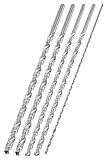
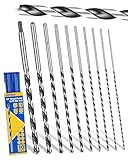


What we cover
What to Look for in a Long Drill Bit Set
Length is usually listed as overall length, not usable drilling depth. A 12-inch bit may have a shank and flute arrangement that gives you roughly 8 to 10 inches of useful reach. Check the working length when the manufacturer provides it.
For wood, look for brad-point, auger, or ship-auger bits. Brad-point bits start accurately and make clean holes, but their sharp center point can break if the bit is forced sideways. Auger bits pull themselves into lumber with a screw point and remove chips efficiently. Ship-auger bits are especially useful for deep holes because their long flutes clear wood chips better than a conventional twist bit.
For metal, choose cobalt or high-speed steel bits with a split point. Long metal bits are flexible, so they need a pilot hole and controlled pressure. Cobalt bits cost more but tolerate heat better than basic high-speed steel. They still are not intended for hardened steel, concrete, or hammer-drill impact mode.
For brick, block, and concrete, use carbide-tipped masonry bits. A standard masonry bit works with a regular drill for occasional holes, but a rotary hammer bit with an SDS shank is faster and more durable in concrete. Long masonry bits are prone to deflection, so start with a shorter bit if possible and extend the hole in stages.
Best Set Types Compared
| Set type | Best for | Typical useful length | Main limitation |
|---|---|---|---|
| Long brad-point wood set | Clean holes in studs, joists, and furniture | 8–12 inches | Can clog in wet or resinous wood |
| Ship-auger set | Deep holes through framing and heavy timber | 12–18 inches | Less suitable for thin stock or very small holes |
| Extended twist-bit set | Metal, plastic, and general-purpose drilling | 6–12 inches | Wanders and overheats more easily |
| Long masonry-bit set | Brick, block, and occasional concrete work | 8–16 inches | Slow in hard concrete; carbide can chip |
| SDS rotary-hammer bit set | Repeated deep holes in concrete | 6–18 inches | Requires an SDS-compatible rotary hammer |
Recommended Buying Options
For general woodworking, a long brad-point wood drill bit set is the most useful starting point. Choose a set covering approximately 1/8 to 1/2 inch if you drill pilot and clearance holes. A cheaper set is fine for occasional softwood work, especially if you can tolerate sharpening or replacing individual bits. For hardwood, framing lumber, or repeated deep drilling, pay for thicker shanks and better heat treatment.
If the job involves deep holes in beams or multiple holes through studs, a long ship-auger drill bit set is usually a better choice than extended twist bits. The screw point feeds the bit, while the open flute carries chips out of the hole. Do not use the feed screw to force the bit aggressively; it can pull the drill forward faster than you can control it.
For mixed materials, an extra-long high-speed steel drill bit set covers metal and plastic, but it is a compromise for wood. Look for a 135-degree split point, clearly marked sizes, and a case that prevents the thin bits from bending. A 1/4-inch hex shank can be convenient for an impact driver, but ordinary long twist bits are not automatically impact-rated. Use only bits specifically labeled for impact-driver use in an impact tool.
For masonry, buy a long carbide-tipped masonry drill bit set for brick and block. If you are drilling many holes deeper than about 4 inches in concrete, an SDS rotary hammer and SDS bits are a more sensible investment than pushing a cordless drill past its limits.
How to Drill Deep Holes Without Breaking Bits
Start slowly and keep the drill square to the surface. Long bits amplify small alignment errors: a one-degree angle at the entry can produce significant sideways movement at the tip. Clamp the work when possible, and use a guide block with a straight hole for repeatable drilling.
For wood, drill 1 to 2 inches, withdraw the bit to clear chips, and repeat. This matters particularly in deep holes where packed chips create friction and heat. If the bit stalls, stop rather than twisting harder. A stalled long bit can bend, snap, or damage the drill chuck.
For metal, make a pilot hole with a short bit first. Use cutting fluid, low speed, and steady pressure. A typical 1/2-inch bit should run far slower than a 1/8-inch bit; consult the bit maker’s speed chart, but roughly 400 to 800 rpm is a reasonable starting range for large holes in mild steel. Never use hammer mode.
For masonry, let the carbide tip do the work. Use moderate pressure, withdraw often to clear dust, and avoid levering the bit in the hole. In concrete, excessive pressure can overheat the motor and fracture the carbide. Wear eye protection and a respirator when drilling overhead or into dusty block.
Common Mistakes and Value Trade-Offs
Do not buy the longest set available simply because it offers more reach. A long bit is less rigid, and a shorter bit is normally faster and more accurate. Use the shortest bit that reaches through the material, then switch to a longer one only when necessary.
Cheap sets make sense for one repair, softwood, or occasional anchor holes. They are poor value when a broken bit can become trapped inside expensive timber or when inaccurate holes affect wiring, plumbing, or structural hardware. In those cases, buying fewer high-quality bits in the sizes you actually use is usually better than buying a large assortment.
Keep long bits clean and store them in a rigid case. Even a slight bend can make a bit wobble, enlarge the hole, and stress the drill chuck. Replace any bit with a visibly bent shank, chipped cutting edge, or discolored tip from overheating.