What's inside
As an Amazon Associate I earn from qualifying purchases. This post may contain affiliate links at no extra cost to you.
Choosing an anchor-setting tool starts with the fastener, not the drill. A small plastic plug in brick, a sleeve anchor in a garage floor, and a concrete screw all need different holes and different installation methods. The right setup helps you drill to the specified diameter and depth without loosening the anchor, stripping its threads, or cracking the masonry.
As an Amazon Associate we earn from qualifying purchases at no extra cost to you.


What we cover
Match the tool to the anchor
For occasional holes in brick or concrete, a cordless hammer drill and a sharp masonry bit cover most jobs. They use a chuck, so changing between a round-shank masonry bit and a driver bit is straightforward. A rotary hammer with SDS-Plus bits is a better choice for repeated holes, harder concrete, or larger diameters. Its hammering action is more effective in concrete and puts less pressure on your hands, but the tool and SDS bits cost more.
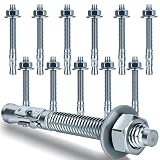
Concrete screws are usually driven with a hex or Torx bit after drilling a correctly sized pilot hole. Sleeve, wedge, and drop-in anchors need a hole first, then a setting method specific to the anchor. Some require only a wrench; others need a setting tool that expands the anchor inside the hole. An impact driver can drive compatible concrete screws, but it does not replace a setting tool for expansion anchors.
Compare a cordless hammer drill for concrete with an SDS-Plus rotary hammer based on how many holes you expect to drill and their diameter—not just battery voltage.
Which tool fits the job?
| Tool | Best suited to | Main trade-off |
|---|---|---|
| Hammer drill with masonry bit | Occasional small holes and light-duty anchors | Slower in hard concrete; more effort for larger holes |
| SDS-Plus rotary hammer | Many holes, hard concrete, or larger anchor holes | Higher cost; needs SDS bits, and can be rough for delicate masonry |
| Impact driver with correct driver bit | Driving compatible concrete screws into prepared holes | Does not drill the pilot hole or expand most mechanical anchors |
| Anchor-specific setting tool | Setting matching expansion anchors, such as drop-in types | Only works with compatible anchor sizes and designs |
Drill the hole to the anchor specification
Use the diameter and minimum embedment depth printed on the anchor package. Do not guess based on the screw’s outside diameter: a concrete screw, for example, needs a pilot hole matched to its own instructions. A common small masonry bit may be 1/4 inch, but that is not a universal anchor size. The wrong hole can make installation impossible or leave too little material for the anchor to grip.
Set a depth stop if your drill has one, or wrap a piece of tape around the bit as a visual marker. Drill straight, and keep the bit from wandering as it starts. If you hit reinforcing steel, stop rather than forcing the bit or switching to a larger one; check the location and anchor plan. Avoid drilling close to an edge unless the anchor’s required edge distance allows it. A hole too near an edge can split the concrete when the anchor expands.
For a few holes in softer brick or block, the cheaper hammer drill is often enough. Use its hammer mode in concrete, but consider rotary-only mode for softer or hollow masonry if hammering starts to break out the face. In hard concrete, a rotary hammer often finishes the hole faster and with less strain. Start with a bit specified for masonry or SDS concrete drilling; worn or overheated bits cut slowly and can leave an oversized, rough hole.
Clean holes and install the anchor correctly
Dust left in a drilled hole can keep an anchor from seating fully and reduce its grip. Follow the anchor instructions: many call for blowing or brushing the hole clean, and some specify a particular cleaning sequence. Wear eye protection; concrete dust is irritating and can contain respirable silica. Do not blow dust toward yourself or anyone nearby.
For a drop-in anchor, use the matching setting tool and strike it as directed until the anchor is set. A tool that is too small or too large may deform the anchor or fail to expand it properly. For wedge and sleeve anchors, tighten the nut to the specified torque if one is given. Over-tightening can damage threads, crush weaker masonry, or pull the anchor out. If the anchor spins while tightening, stop: the hole may be oversized, dusty, too shallow, or drilled in unsuitable material.
For concrete screws, use the specified bit and drive the screw steadily. An impact driver can be convenient, but high torque can strip the hole or damage the head, especially near the end of the drive. Finish with a hand tool if needed rather than forcing a spinning screw. If the screw will not seat, remove it and inspect the hole instead of repeatedly driving it.
What to buy—and what you can skip
Buy the anchor-specific setting tool only after confirming the anchor type and diameter. A generic punch or improvised drift may not expand an anchor evenly. For concrete screws, a masonry bit set for concrete screws is useful if it includes the exact pilot sizes you need; a large assortment is unnecessary for a single project.
For light home work—hanging a bracket or fastening a small fixture—there is little reason to buy a rotary hammer if you already own a hammer drill and the holes are small. Rent or borrow an SDS-Plus rotary hammer for a day if you have a run of holes in hard concrete, rather than struggling through each one. For a structural connection, overhead installation, or a fastener with a specified torque, follow the anchor manufacturer’s instructions and local requirements. Tool choice cannot compensate for the wrong anchor, a poor hole, or unsuitable masonry.