What's inside
As an Amazon Associate I earn from qualifying purchases. This post may contain affiliate links at no extra cost to you.
What we cover
What makes a Forstner bit set right for cabinet work?
A Forstner bit cuts a flat-bottomed hole with a relatively clean rim, which makes it useful for recessed hardware, shelf-pin jigs, and other cabinet work where a spade bit’s rougher cut won’t do. The bit’s center point still leaves a small mark in the bottom, so it is not a truly mark-free cut. For shallow holes in finished panels, test on scrap first and stop before breaking through.
For cabinet work, useful sizes matter more than a long list of rarely used diameters. A set covering roughly 1/4 to 2 inches handles many common woodworking jobs, but check the actual size increments before buying. Some sets include odd sizes; others jump by 1/8 inch. If you already know the hardware diameter, buy the correct bit rather than assuming a general-purpose set contains it.
As an Amazon Associate we earn from qualifying purchases at no extra cost to you.

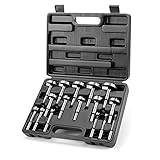


Set types compared
| Set type | Best for | Trade-off |
|---|---|---|
| Basic steel set | Occasional holes in softwood or plywood | Lower cost, but may dull sooner and cut less cleanly in dense hardwood |
| Midrange set with replaceable or sharpenable cutters | Regular cabinet and furniture work | Costs more; quality still varies, so inspect the rim and center point |
| Large-diameter or specialty set | Specific hardware recesses or wide holes | Bulky and unnecessary if you only need a few standard sizes |
For occasional use, a basic Forstner bit set for woodworking is often enough. If you drill frequently in hardwood or need repeatable, clean edges, look for a better-finished set rather than buying the largest assortment available.
What to check before buying
First, check the shank diameter and the chuck capacity of your drill. Many cordless drills accept a 1/2-inch shank, but compact models may have a 3/8-inch chuck. Large Forstner bits can also demand more torque than a small drill provides, especially in hardwood. A high-torque drill with a side handle is safer and less tiring for large holes; do not rely on an impact driver for controlled Forstner drilling.
Look at the cutting rim. A continuous, sharp rim helps score the hole perimeter before the inner cutters remove material. Poorly ground edges can wander, burn the wood, or leave a ragged rim. A set with a carrying case is convenient, but case quality is secondary to accurate sizing and a clean cut.
Diameter range is not the only useful specification. Check maximum drilling depth and overall bit length if you need a deep recess. Forstner bits have broad heads that clear chips less efficiently than twist bits, so deep holes need frequent withdrawal. A set advertised with many sizes may still be a poor fit if the few diameters you need are missing.
How to get a flat-bottomed hole cleanly
Clamp the work securely and mark the hole center. For repeatable cabinet holes, use a drill press where possible: it keeps the bit square and makes depth stops easier to set. A handheld drill can work, but start slowly and keep both hands on the drill when using a large bit. Set the clutch to drill mode, choose a low gear, and use steady pressure rather than forcing the cutters.
For a shallow recess, set a depth stop or wrap a visible tape marker around the bit. Stop to clear chips every few seconds, particularly in hardwood or at depths approaching the bit’s cutting head. Packed chips create heat and can scorch the bottom. If the bit begins to squeal, smoke, or burn, stop, clear the hole, and check that the edges are sharp. Continuing usually makes the finish worse, not faster.
When drilling near the face of a cabinet panel, support the work and keep the bit perpendicular. On veneered plywood, a sharp rim and moderate feed help limit tear-out, but test the same material and setup on an offcut. If drilling through a panel, clamp a sacrificial backer behind it; otherwise the exit side can splinter badly.
When a premium set is worth it
Price tends to matter most when a bit sees frequent use, cuts dense wood, or must produce a consistent edge. A dull or poorly balanced large bit can grab and twist the drill, while a clean, sharp bit removes material with less heat and effort. For occasional softwood holes that will be hidden by hardware, an inexpensive set can be perfectly serviceable.
If you only need one or two sizes, buying individual bits may cost less and avoid unused pieces. A selection of individual Forstner bits is also a sensible way to fill gaps in an existing set. For repeated cabinet work, a higher-quality Forstner bit set may pay off through cleaner cuts and less time spent sanding or correcting holes.
A practical buying checklist
Before ordering, match the set’s sizes to your hardware and jigs, confirm the shanks fit your drill, and consider whether you need a drill press for accuracy. Favor sharp, well-finished cutters over a high piece count. If you are making many identical holes, a depth stop and a stable setup will improve consistency more than an oversized assortment of bits.
For a single cabinet job, the cheapest set that includes the required diameter may be enough. For regular use, pay for better cutting quality and keep the bits clean and sharp. Either way, use a scrap test to confirm the diameter, depth, and edge quality before drilling a finished cabinet part.