What's inside
As an Amazon Associate I earn from qualifying purchases. This post may contain affiliate links at no extra cost to you.
Copper and brass are softer than steel, but they are not always easy to drill. Copper can smear and clog a bit, while brass—especially thin sheet brass—can grab the cutting edges and spin the workpiece. The best choice for most jobs is a sharp, general-purpose high-speed steel (HSS) twist bit, used in a regular drill with the hammer function turned off.
As an Amazon Associate we earn from qualifying purchases at no extra cost to you.



What we cover
The best drill bit types for copper and brass
For ordinary holes in copper pipe, brass fittings, bar stock, and hardware, start with a quality HSS twist bit set. HSS cuts these metals cleanly, is inexpensive, and is easy to replace or sharpen. A 118-degree point works well for general use. A 135-degree split point is helpful when you need the bit to start accurately on a flat surface without much pilot drilling.
For thin copper or brass sheet, a step bit is often easier than a conventional twist bit. Its multiple cutting diameters make clean holes with less snagging, provided the sheet is clamped firmly. Step bits are particularly useful for electrical boxes, plumbing panels, and enlarging existing holes. They are not the right choice for deep holes in thick brass or copper stock.
Brad-point bits can produce clean holes in thin, soft sheet or plastic-backed assemblies, but their center spur and outer cutters are not as versatile as HSS twist bits. They are more likely to be damaged if the material contains solder, scale, or a hard inclusion.
| Bit type | Best use | Main advantage | Limitation |
|---|---|---|---|
| HSS twist bit | Most copper and brass | Versatile and inexpensive | Can wander or grab if dull |
| HSS step bit | Thin sheet and enlarging holes | Clean, controlled hole sizes | Not suited to thick stock |
| Cobalt HSS bit | Frequent work or mixed metals | More heat resistance | Costs more and is more brittle |
| Carbide bit | Abrasive, hardened, or production work | Very hard cutting edge | Overkill and easy to chip for normal DIY work |
What to buy for a typical DIY job
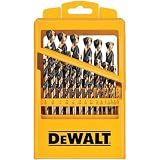
A standard HSS set covering 1/16 to 1/2 inch is enough for most household copper and brass work. Look for clearly ground flutes, a straight shank, and a case that keeps sizes organized. Black oxide or titanium-coated bits can last longer than plain bright HSS, but the coating does not make a poor cutting edge good. Sharp geometry matters more than color.
Cobalt bits are reasonable if you drill brass or copper regularly, work with thicker stock, or also drill stainless steel. They tolerate heat better, but they do not eliminate the need for correct speed and pressure. For one plumbing repair, the cheaper HSS option is normally fine. A complete cobalt HSS drill bit set is rarely a sensible upgrade for occasional copper drilling.
Avoid masonry bits. Their blunt carbide tips crush rather than cut metal. Wood auger bits are also a poor choice: the lead screw can pull the bit aggressively into soft metal, and the spurs can catch thin sheet. Metal-cutting hole saws work for large holes, but use a pilot bit and clamp the work securely.
Speed, pressure, and cutting technique
Use the drill’s normal rotation and turn hammer mode off. For small bits around 1/8 inch, roughly 1,500 to 2,500 rpm is a useful starting range. For 1/4-inch bits, use about 800 to 1,500 rpm. For 1/2-inch bits, slow to approximately 300 to 700 rpm. These are starting points, not rigid rules: hard brass may need less speed, while thin sheet needs enough speed to avoid dragging.
Clamp the material. Do not hold a loose fitting or sheet in your hand while drilling. Put a wood block behind thin material to prevent blowout, and mark the hole with a center punch. On larger holes, drill a 1/8-inch pilot first. A pilot hole reduces the force needed and prevents the larger bit’s tip from skating across the surface.
Apply steady feed pressure so the cutting edges make a continuous chip. Too little pressure makes the bit rub, creating heat and dulling the edge. Too much pressure can buckle thin sheet or make the bit seize as it breaks through. Ease off pressure during breakthrough; that is when the bit most often catches and twists the work.
Do you need cutting oil?
For small holes in thin copper or brass, drilling dry is often acceptable. A drop of light cutting oil helps on thicker material and reduces galling, especially with copper. Use a metal-cutting fluid rather than household penetrating oil when possible. Apply a small amount to the work, not enough to create a slippery mess.
Brass commonly drills well dry, and some brass alloys can become more prone to grabbing when lubricated. If the bit chatters or pulls the material upward, stop and change the technique: lower the speed, clamp the part, and use sharper geometry. Never add oil to a spinning bit with your fingers.
Common failures and how to prevent them
A dull bit produces a polished, overheated hole with little progress. Replace it or sharpen it rather than increasing drill pressure. Blue or darkened edges indicate excessive heat. Copper packed into the flutes means the bit is rubbing or the material is soft enough to smear; clear the flutes, reduce speed, and use a light cutting fluid.
Brass sheet may grab at the instant the bit exits. Backing the sheet with wood helps, but clamping is more important. For a clean large hole in thin sheet, use a metal-cutting step drill bit and stop as soon as the required step passes through. Continuing to the next step only enlarges the hole.
Choosing the drill
A cordless drill with a variable-speed trigger and a clutch is the best general tool. Use the low gear for large bits and thick stock, and high gear for small holes when the material is secure. An impact driver can turn hex-shank bits, but its hammering action can damage soft fittings, enlarge holes unpredictably, and increase the chance of grabbing. Use it only with a suitable bit and a very controlled trigger.
For repeated holes, a drill press gives better alignment and safer control. It is especially useful for brass blocks, copper bar, and parts that must accept a tap or a close-fitting fastener.