What's inside
As an Amazon Associate I earn from qualifying purchases. This post may contain affiliate links at no extra cost to you.
A toggle anchor can hold a heavy load in drywall only when the board is sound, the anchor is sized for the load, and the fastener is installed correctly. “Heavy” is not a single rating: a shelf bracket, a wall-mounted cabinet, and a person-supporting grab bar put different forces on the wall. Treat package ratings as a starting point, not a guarantee, and don’t use drywall anchors for safety-critical support.
As an Amazon Associate we earn from qualifying purchases at no extra cost to you.


What we cover
Choose the anchor for the load and the wall
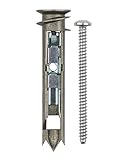
For substantial loads in hollow drywall, the main choices are traditional spring toggles, metal channel-style toggles, and strap toggles with a separate machine screw. All spread the load behind the board. Their capacities depend on drywall thickness, condition, anchor spacing, how far the load projects from the wall, and whether the force pulls straight out or downward.
For a picture or light-duty accessory, a plastic expansion anchor or self-drilling drywall anchor may be cheaper and quicker. Those are not substitutes for a toggle when a bracket or shelf can pull hard on the wall. For cabinets, long shelves, grab bars, or anything that could injure someone if it falls, fasten into studs or suitable blocking whenever possible.
Toggle anchor types compared
| Type | How it works | Advantages | Trade-offs |
|---|---|---|---|
| Spring toggle | Folding metal wings open behind the wall; a machine screw draws them forward. | Simple, widely available, often inexpensive. | Requires a relatively large hole; the wings can fall into the wall if the screw is removed. |
| Metal channel toggle | A metal bar or channel sits behind the drywall and engages a machine screw. | Broad bearing area; useful for brackets and repeated installation. | Requires a larger drilled hole and enough hidden space for the channel to turn. |
| Strap toggle | A metal channel is positioned behind the board with plastic straps; a separate screw passes through the fixture. | Easy to position and remove the screw without losing the channel; often convenient for one-person work. | Usually costs more than basic spring toggles; the straps are positioning aids, not the load-bearing part. |
For a general-purpose heavy-duty purchase, compare metal toggle bolts for drywall with strap-style toggle anchors. Check the screw diameter, the required hole size, and the listed wall thickness. Do not compare products by advertised maximum load alone; test methods and safety factors vary.
Check the wall before drilling
Confirm that the wall is hollow and identify what is behind it. Scan for studs, wiring, and plumbing with an appropriate detector, and avoid drilling directly above or below outlets and switches unless you know the cable route. A stud finder can help locate a stud, but it does not prove that a spot is clear of pipes or wires.
Measure the drywall if you can access an edge. Common interior drywall is 1/2 inch thick; some walls use 5/8-inch board or multiple layers. Match the anchor to the actual thickness. Check the cavity depth too: an obstruction, insulation, or a close-backed wall can prevent the toggle from opening. Avoid cracked, damp, crumbling, or previously damaged drywall. A toggle cannot restore strength to weak board.
Size for the real load
Weigh the item and think about how it will be used. A shelf load sits out from the wall, creating leverage that pulls on the upper fasteners. A coat hook may see a sudden tug rather than a steady load. A bracket with four holes does not automatically divide its load evenly across four anchors.
Follow the anchor maker’s rating for the specific board thickness and installation. Ratings may be stated per anchor and may assume ideal conditions; they are not permission to hang that exact weight in every wall. Leave a margin, spread fasteners across a sound area, and use more than one attachment point where the fixture allows. If the load is heavy, expensive, or likely to be pulled, hit studs or add blocking rather than relying on a higher advertised drywall rating.
Install without damaging the board
Use the hole diameter specified on the package. A cordless drill with a sharp bit is usually enough for drywall; a hammer drill is unnecessary and can make the opening ragged. Use a low or moderate speed and stop once the bit passes through the board. A clean, correctly sized hole helps the toggle pass through while leaving enough material for the anchor to bear against.
For a spring toggle, put the screw through the fixture first, thread on the wings, fold them, and push them through the hole. Pull the screw gently toward you as you tighten so the wings stay seated against the back of the board. For a strap toggle, follow its directions to set the channel behind the wall, remove or trim the positioning straps as instructed, then pass the fixture screw through the channel.
Tighten until the fixture is secure, not until the drywall dimples or crushes. Use a screwdriver or a drill on a low clutch setting for final tightening. If the anchor spins, the screw will not tighten, or the board starts to deform, stop. Continuing to turn can enlarge the hole and leave the fixture less secure.
Know when to choose another method
A toggle may fail because its wings never opened, the hole is oversized, the screw is too short, or the drywall is damaged. It can also loosen when a projecting load is repeatedly rocked or pulled. If an anchor spins in its hole, do not reuse that opening with a larger screw unless the manufacturer specifically allows it; the board around it may already be compromised.
For a heavy cabinet, long shelf, television mount, grab bar, or anything that supports a person, locate studs and use fasteners appropriate for the fixture and framing. If the mounting holes do not line up, a properly secured mounting board spanning multiple studs is usually a better solution than adding more toggles to drywall. A cheaper plastic anchor is fine for a small, light object with little chance of being pulled; for a high-consequence load, the right answer is often not a stronger hollow-wall anchor but a connection to framing.