What's inside
As an Amazon Associate I earn from qualifying purchases. This post may contain affiliate links at no extra cost to you.
Installing screws in a cabinet corner, between joists, or beside a pipe is less about raw power than getting the tool and bit in line. A bulky drill can fit the screw but leave no room to drive it straight. The best choice depends on clearance, screw size, and how many fasteners you need to install.
As an Amazon Associate we earn from qualifying purchases at no extra cost to you.



What we cover
Choose a tool by the clearance you have
Measure the space around the screw, not just the gap between surfaces. A right-angle drill may fit into a narrow opening, but its head still needs room to turn, and your hand needs room to hold the tool. For a single awkward screw, a short bit holder or manual driver can be a better buy than a specialty cordless tool.
For repeated work, a compact cordless drill or impact driver with a right-angle attachment is often the most useful setup. Check the tool’s head length and the attachment’s overall width before buying. Advertised “compact” dimensions may describe the bare tool, not the tool with a bit installed.
Fastening options compared
| Tool or setup | Best for | Main trade-off |
|---|---|---|
| Short bit holder in a compact drill | Moderate clearance; light or medium screws | Simple and inexpensive, but still needs room for the drill body |
| Right-angle drill | Repeated drilling or driving in tight spaces | Purpose-built reach, but costs more and may be awkward for ordinary work |
| Right-angle attachment | Occasional corner work with a drill or driver you own | More affordable, but adds length and can wobble if poorly made |
| Flexible shaft bit holder | Obstructed access where the tool itself can stay outside the corner | Useful for light-duty screws; not a good choice for high torque |
| Manual screwdriver or ratcheting driver | One or two small screws, delicate material | Slow, but offers good control and no battery or attachment to manage |
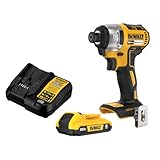
Compact drill or impact driver
A compact drill is a good general-purpose choice when you need to drill pilot holes and drive screws. It gives you a clutch to limit torque, which helps prevent stripped screw heads and crushed softwood. For occasional tight-corner work, pair it with a short, quality bit holder or a right-angle drill attachment.
An impact driver is better suited to driving longer or larger screws, especially in framing lumber. Its repeated impacts can make stubborn fasteners easier to drive, but they also make it easier to snap a small screw or damage a soft surface. Use a low-speed setting if available, keep the bit fully seated, and stop if the screw starts to cam out. An impact driver is not a substitute for a drill when you need a clean, accurate pilot hole.
Right-angle tools and attachments
A dedicated right-angle drill is worth considering if you regularly work between studs, inside cabinets, or under equipment. Its head is designed to sit close to the work, and it can be easier to control than a long attachment on a standard drill. The downside is cost: if the job is a few screws a year, a compatible attachment is usually enough.
Attachments vary in head size, gear smoothness, and how securely they hold bits. A loose attachment can twist under load or let the bit wander. Use it for ordinary screwdriving and drilling within its stated limits, not for forcing large structural screws. If the attachment makes the bit hard to keep square, back out and change the setup rather than leaning harder.
For very restricted access, a flexible shaft bit holder can reach around an obstruction. Treat it as a low-torque option: it may flex or wind up under heavy load, so it is best for small screws and light assembly, not deck or framing screws.
Choose the right bit and screw
A correctly sized bit matters more in a cramped corner because there is less room to recover from a slip. Match the driver bit to the screw recess and replace worn bits. For Phillips screws, a mismatched or rounded bit is prone to cam out. Square and star-drive screws generally hold the bit more securely, but they still need full engagement.
Use a pilot hole when the material, screw size, or location calls for one. In hardwood and near board edges, a pilot hole reduces splitting and driving effort. A countersink can help the head sit flush, but avoid removing so much material that the screw loses its grip. With wall anchors, drill the diameter specified on the package; an oversized hole can let the anchor spin or pull out.
A safer way to drive in a corner
Start the screw by hand for a few turns when possible, or use a low speed and light trigger pressure to establish the path. Keep the bit aligned with the screw axis. An angled screw is more likely to bind, strip, or split the workpiece. If the tool body will not clear the surface, use a shorter bit, a right-angle setup, or a manual driver instead of forcing the screw at an angle.
Set the drill clutch low and increase it only as needed. For an impact driver, use short bursts near the end of the drive and stop when the head seats. Overdriving can bury the head, break the fastener, or crack a cabinet panel. If a screw stalls, back it out and check for a pilot hole, an obstruction, or a damaged bit; more torque is not always the fix.
What to buy for your job
For occasional furniture or cabinet repairs, a compact drill with a short magnetic bit holder is often the cheapest sensible setup. Choose an attachment if the drill body is the obstacle; choose a dedicated right-angle drill if tight-access fastening is recurring work. A flexible shaft is a niche solution for light screws, while a manual ratcheting driver remains a reliable option when control matters more than speed.
Before purchasing, compare the complete working length, including the bit, and confirm that the attachment fits your tool’s chuck or hex interface. For the tightest corners, test the setup with the actual screw and material before committing to a full row of fasteners.