What's inside
As an Amazon Associate I earn from qualifying purchases. This post may contain affiliate links at no extra cost to you.
For thin sheet metal, the right “screw bit” is usually a nut setter, not a drill bit. A nut setter holds the screw head while an impact driver or drill turns it; the screw’s own cutting tip makes the hole. Choose the setter to match the screw head and drive style, and use a drill bit only when the fastener or job calls for a pilot hole.
As an Amazon Associate we earn from qualifying purchases at no extra cost to you.


What we cover
Choose the right bit for the fastener
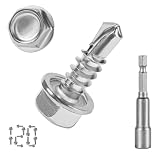
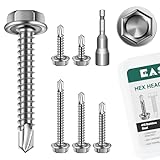
Most self-drilling sheet-metal screws have a hex washer head, so a magnetic hex nut setter is the practical choice. Common sizes include 1/4 inch, 5/16 inch and 3/8 inch. Check the screw packaging or measure across the flats of the head: a setter that is too loose can round the head, while one that is too tight may not seat fully.
For Phillips, square or Torx-drive screws, use the matching insert bit instead. Match the bit size exactly. A worn or undersized bit cams out, damaging the screw recess and sometimes the workpiece. If you are buying for a job with mixed fasteners, a magnetic nut-setter assortment is more flexible than a single size, but check that the set includes the sizes your screws actually use.
Bit options compared
| Type | Best use | Main trade-off |
|---|---|---|
| Standard magnetic nut setter | Hex-head self-drilling screws in light sheet metal | Affordable and quick; magnet may collect metal chips |
| Impact-rated nut setter | Repeated driving with an impact driver | Built for impacts; costs more than needed for occasional drill use |
| Insert driver bit | Phillips, square or Torx screw heads | Must match the recess precisely; does not hold hex heads |
| Twist drill bit | Pilot holes or screws without a drilling point | Requires a separate bit change and hole sizing |
Impact driver or drill?
A cordless drill gives you finer control and is often the better choice for thin material, especially if it has a clutch. Set the clutch low, start slowly, and raise the setting only if the screw stalls. An impact driver is faster for many repeated fasteners, but its sharp bursts of torque can strip the screw, tear the sheet, or snap a small screw if you drive too aggressively.
If you expect to use an impact driver regularly, buy impact-rated nut setters. A standard setter may work for light, occasional driving, but repeated impact loading can wear or break it. Impact-rated does not mean indestructible: keep the tool straight and stop as soon as the washer seats.
Pilot holes and screw choice
A self-drilling screw is designed to drill and fasten in one operation. For light sheet, roughly 24-gauge steel (about 0.6 mm) and similar thin stock, use the screw size and drilling-point range specified by its manufacturer. Do not assume every “self-tapping” screw drills its own hole: some have a sharp point that forms threads but need a pilot hole, while self-drilling screws have a drill-shaped point.
When a pilot hole is required, use the diameter listed for that screw and material. Too small a hole can make the screw bind or split a narrow flange; too large a hole leaves weak thread engagement. A basic HSS twist-bit set for metal is enough for occasional pilots. Cobalt bits are useful for tougher alloys or sustained drilling, but they are usually unnecessary for a few holes in thin mild steel.
Driving without tearing the sheet
Mark the location and support the sheet so it cannot flex away from the screw. Hold the driver perpendicular to the surface; a tilted screw can walk, enlarge the hole or seat unevenly. Start at low speed with steady pressure. Once the screw’s point catches, let it cut rather than forcing it through.
Stop when the washer or screw head is snug. Overdriving can crush a thin panel, strip the threads, or pull the screw through the metal. If the screw spins without tightening, the hole may be oversized or the threads may be stripped. Move to a suitable larger fastener or repair the hole rather than trying to tighten harder. If the screw will not advance, back it out and check that the bit fits, the point is appropriate for the material thickness, and the screw is not hitting a support or another layer.
What to buy
For occasional work with hex-head screws, a correctly sized standard magnetic nut setter is usually the economical choice. You do not need a premium impact-rated set for a handful of screws driven with a clutch-equipped drill. For frequent fastening, an impact-rated setter in the exact screw size is a sensible wear item; a short bit provides better clearance in tight spaces, while a longer one can help reach recessed fasteners but flexes more easily.
Keep the setter clean. Steel chips caught in its magnet can prevent the screw from sitting square, and a worn opening can slip on the head. Replace a bit that no longer fits snugly. The right size, controlled speed and a screw suited to the sheet thickness matter more than buying the most expensive bit.