Our Top Picks
 Milescraft DrillMate Portable Drill Guide Adjustable Precision DrillingEACH16.63 x 7.13 x 2 Inches0 poundsCheck on Amazon
 SpeTool Portable Drill Guide with Liner Ball Bearingsstandard14.19 x 6.69 x 12.17 Inches8.36 PoundsCheck on Amazon

What's inside
As an Amazon Associate I earn from qualifying purchases. This post may contain affiliate links at no extra cost to you.
The best overall drill guide for straight holes in this group is the Milescraft Drill Block PRO, because a single hardened-steel block gives you 25 guide holes from 1/8 to 1/2 inch in 1/64-inch steps and a V-groove that centers on flat stock, round stock and corners. A drill guide is a jig that keeps a hand drill square to the work so a hole goes in perpendicular instead of wandering. If you want a lighter block for common sizes, the Kreg KDG-6000 is the easier pocket tool, and if you want a mini drill press for your hand drill, the Milescraft DrillMate or SpeTool guide fits better.
What we cover
Quick List
- Kreg KDG-6000 Portable Drilling Guide – best for common bit sizes in a pocket-sized block
- 30/45/90 Degree Angle Drill Guide Jig – best for angled holes in stairs, handrails and similar work
- Milescraft 1307 Drill Block PRO – best for the widest range of bit sizes in one block
- Milescraft 1318 DrillMate – best for turning a hand drill into a stand-style guide with angle stops
- SpeTool Portable Drill Guide – best for a ball-bearing guide rail with an adjustable angle
- GOINGMAKE Portable Drill Guide – best for buyers who want a basic guide to try the idea
Which One Is Right for You?
| If you… | Choose |
|---|---|
| drill many different bit sizes in wood and metal | Milescraft 1307 Drill Block PRO |
| mostly drill 1/8 to 1/2 inch holes for dowels, screws and hardware | Kreg KDG-6000 |
| need perpendicular holes through thicker stock using a stand-style guide | Milescraft 1318 DrillMate |
| want a guide with ball-bearing rails and adjustable angle | SpeTool Portable Drill Guide |
| drill fixed-angle holes for railings or stairs | 30/45/90 Degree Angle Drill Guide Jig |
| want a basic portable guide without much investment | GOINGMAKE Portable Drill Guide |
The choice comes down to two styles. Block guides, like the Kreg and the Drill Block PRO, are small, fast and cheap to carry, and they rely on a hardened bushing to steer the bit. Stand-style guides, like the DrillMate and the SpeTool, hold the whole drill on rails and behave more like a miniature press. Think about the sizes you drill most before you decide, because a block with the exact bushing you need beats a fancy fixture you rarely set up.
All 6 Picks in Detail
1. Kreg KDG-6000 Portable Drilling Guide – Best for Common Bit Sizes in a Pocket-Sized Block
As an Amazon Associate we earn from qualifying purchases at no extra cost to you.
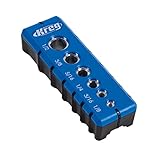
The Kreg KDG-6000 is a small handheld block with six hardened steel guide holes for 1/8, 3/16, 1/4, 5/16, 3/8 and 1/2 inch bits. It is made for carpenters, hobbyists and cabinet builders who drill dowel holes, hardware holes and pilot holes and want them square without hauling out a press. The body is polymer with hardened steel at the guide holes, and notches on the bottom help center it on the edge of 3/4 or 1/2 inch material. Kreg states that it is not recommended for use with an impact driver.
- Six hardened guides: 1/8, 3/16, 1/4, 5/16, 3/8 and 1/2 inch
- Built-in alignment marks and edge-centering notches
- Anti-slip gripping surfaces
- Works with twist and brad-point bits (per manufacturer)
- Very light, around a quarter of a pound as shipped
It is a good fit for woodworking, but the sizes stop at 1/2 inch, and a fine increment such as 17/64 is not available.
The block must be held by hand or clamped to the work, so its accuracy depends on how firmly you press it down. For doweling, shelf pins and hardware holes it is quick and repeatable, and the hardened bushings are designed to resist wear.
Pros
- Common woodworking sizes covered in a tiny package
- Hardened steel guide holes resist wear
Cons
- Limited to six fixed sizes
- Polymer body is less rigid than an all-metal block
Compared with the Drill Block PRO, it is lighter and simpler but offers far fewer bit sizes.
2. 30/45/90 Degree Angle Drill Guide Jig – Best for Angled Holes (Runner-Up for Straight Holes)

This jig is built around fixed angles of 30, 45 and 90 degrees. Its listing positions it for straight holes and for angled drilling, with uses such as stairs, handrails and similar construction jobs. It suits deck builders, stair installers and DIYers who need to drill the same angle repeatedly. We place it as a runner-up in a straight-hole guide because its strength is angle work and the listing name does not state bushing sizes, material or chuck compatibility.
- Fixed angle positions: 30, 45 and 90 degrees
- Designed for use with a hand drill
- Applications named in the listing: stairs, handrails and similar angled work
- Material, bit capacity and weight: confirm on listing
- Bushing sizes: confirm on listing
Before buying, check the bit diameter range, because angled drilling on railings often uses larger spade or auger bits that a small jig may not support.
When you use any angled jig, clamp the work securely and start the hole slowly. Bits tend to skate off a sloping surface, and a center punch dimple helps the tip bite before the guide takes over.
Pros
- Fixed stops make repeat angles easy
- One jig covers three common angles
Cons
- Fewer stated specifications than the better-documented guides
- Not a precision press substitute for straight holes in thick stock
Next to the SpeTool guide, it is simpler and fixed-angle only, while the SpeTool offers continuous adjustment.
3. Milescraft 1307 Drill Block PRO – Best for the Widest Range of Sizes in One Block

The Drill Block PRO is an all-metal handheld guide with 25 guide holes covering 1/8 to 1/2 inch in 1/64-inch increments. A dual V-groove design lets each guide center on flat stock, round stock or a 90-degree corner, and each hole has a centering line. It is the best choice for makers, machinists and woodworkers who drill many different diameters and want one tool that handles all of them. Milescraft describes the steel as hardened and heat-treated.
- 25 guide holes from 1/8 to 1/2 inch
- 1/64-inch size increments
- Dual V-groove base for flat, round and corner work
- All-metal hardened-steel construction
- Roughly 1.2 pounds as published by the manufacturer
The wide body gives you a good clamping surface, and the metal construction handles shop use better than a plastic block.
For metal drilling, mark the spot with a center punch, add cutting oil and use the correct speed, because the guide keeps the bit square but does not make the cut easier. It is also a useful way to drill straight holes in round dowels and tubing that are hard to hold flat.
Pros
- Exact size guides in fine increments
- V-groove centers on round stock and corners
Cons
- Heavier and bulkier than the Kreg block
- Still relies on your hand pressure for squareness
It beats the Kreg on range and rigidity, and the Kreg beats it on weight and convenience.
4. Milescraft 1318 DrillMate – Best for a Stand-Style Guide with Angle Stops

The DrillMate is an adjustable portable drill guide for a hand drill with a 3/8 inch chuck on the output side. It has fixed angle settings at 45, 60, 75 and 90 degrees, a self-centering base for round stock, a depth stop and a spring-return head. It is best suited to hobbyists who need to drill perpendicular holes in thicker stock, tubes and dowels, and who would like press-like behavior without buying a bench drill.
- Output chuck compatible with 3/8 inch accessories
- Angle settings: 45, 60, 75 and 90 degrees
- Centering base for round stock (up to roughly 3 inches)
- Adjustable depth stop and spring-action head
- Not intended for impact-rated tools
The guide weighs a few pounds, so it is more of a workshop fixture than a pocket tool.
Setup takes longer than a drill block, but the result is more repeatable on deeper holes because the drill moves along fixed guide bars. Do not use it with an impact driver, and keep drill speeds moderate with larger bits.
Pros
- Guides both straight and angled holes
- Depth stop and spring return improve repeatability
Cons
- Bulkier and slower to set up than a block
- Chuck limited to 3/8 inch accessories
Compared with the SpeTool, it offers fixed angle stops and a smaller chuck, while the SpeTool lists continuous angle adjustment and a 1/2 inch chuck.
5. SpeTool Portable Drill Guide – Best for Ball-Bearing Rails and Adjustable Angles

The SpeTool guide is a portable drill-press-style attachment with linear ball-bearing guide poles, an adjustable angle range of 0 to 60 degrees and a chuck listed at 1/2 inch. It suits woodworkers and builders who want a smoother action than a bushing-based guide and the flexibility to drill at an angle without a fixed stop. The listing mentions multi-purpose use for a hand drill, but treat motor and chuck compatibility as something to confirm on the product page.
- Ball-bearing guide poles for smooth travel
- Angle adjustable from 0 to 60 degrees
- 1/2 inch chuck (per listing)
- Portable drill press format for a hand drill
- Travel, base size and weight: confirm on listing
Because the angle is adjustable, check the angle scale and locking mechanism, and verify perpendicular with a small square before drilling real parts.
Use a clamp to hold the guide base or the workpiece. A guide on rails is only as accurate as its mounting, and a wobbling base defeats the whole point.
Pros
- Larger 1/2 inch chuck listed
- Adjustable angle without fixed stops
Cons
- Setup is more involved than a block
- Less published detail than the Milescraft options
It sits above the GOINGMAKE guide in documented features and below the DrillMate in brand track record.
6. GOINGMAKE Portable Drill Guide – Best for a Basic Guide to Try the Idea

The GOINGMAKE listing describes a drill guide for straight holes and a portable format, but the listing name gives few details. It is aimed at homeowners and hobbyists who want to try a guide before investing in a larger system. Because specifics such as capacity, material and bushing sizes are not stated in the listing name, confirm everything on the product page and compare it to the better-documented guides before you decide.
- Positioned for straight-hole drilling with a hand drill
- Portable format
- Material and construction: confirm on listing
- Bit capacity and chuck size: confirm on listing
- Angle range and depth stop: confirm on listing
If the page does not show metal guide bushings or a rigid base, treat it as a light-duty aid rather than a precision tool.
Run a quick check when it arrives: drill into a piece of scrap, then place a small square against the hole to see whether it is perpendicular. A guide that cannot hold that, or that flexes noticeably, is better returned than used.
Pros
- Simple concept for first-time guide buyers
- Portable and easy to store
Cons
- Few stated specifications in the listing name
- Unknown wear resistance compared with hardened-steel blocks
Next to the Kreg block, it offers less documented build quality, so it works best as a budget experiment.
Specs Compared
| Model | Style | Guide sizes / capacity | Angles | Material | Chuck |
|---|---|---|---|---|---|
| Kreg KDG-6000 | Handheld block | 6 sizes, 1/8 to 1/2 inch | 90 degrees | Polymer body, hardened steel guides | Not applicable |
| 30/45/90 Angle Jig | Fixed-angle jig | confirm on listing | 30, 45, 90 degrees | confirm on listing | Not applicable |
| Milescraft Drill Block PRO | Handheld block | 25 sizes, 1/8 to 1/2 inch, 1/64 steps | 90 degrees | Hardened steel | Not applicable |
| Milescraft DrillMate | Stand-style guide | Round stock up to about 3 inches | 45, 60, 75, 90 degrees | Aluminum head, metal build (confirm on listing) | 3/8 inch |
| SpeTool Portable Guide | Ball-bearing rail guide | confirm on listing | 0 to 60 degrees adjustable | confirm on listing | 1/2 inch |
| GOINGMAKE Portable Guide | Portable guide | confirm on listing | confirm on listing | confirm on listing | confirm on listing |
How We Chose These
We built this list from the six guides in the current catalog set and judged them on documentation rather than bench work. For each product we looked at what the listing says about guide sizes, angle range, material and chuck compatibility, then compared those fields with manufacturer specification pages for the brands that publish them, such as Kreg and Milescraft. We favored guides with hardened steel bushings or rail systems, clear capacity ranges and honest limits, like warnings against impact drivers. Where a listing did not state a number, we marked it for confirmation instead of estimating. The angled jig is flagged as a runner-up because it is primarily an angle tool.
What to Look For
Block guides versus stand-style guides
A drill block is a metal or polymer body with precision holes; you press it on the work, push the bit through the matching hole and drill. It is quick, cheap and good for holes up to 1/2 inch. A stand-style guide clamps the drill into a carrier that slides on rails, like a miniature drill press, and it keeps the drill square along the entire stroke. Blocks excel at shallow holes and tight spaces. Stand-style guides are better for deeper holes, larger bits or when you need to repeat the same depth. The best guide for you depends on the depth of your holes and the space you have around them.
Guide hole sizes and hardness
Match the guide size to the bit diameter with minimal clearance. Too tight and the bit binds; too loose and the guide loses accuracy. A guide with 1/64-inch steps lets you match a bit within a very small tolerance, which matters for dowels and hardware that need a snug fit. Hardened steel holes resist wear from spinning bits, while soft metal or plastic will oval out over time. If a listing does not state the material, treat it with caution, and avoid pushing hot, dull bits through any guide because friction will wear the bushing and ruin the hole.
Angle capability
Many guides focus on 90 degrees, and that is what you want for dowels, shelf pins and through-holes. Fixed angle stops, such as 45, 60 and 75 degrees, make repeating an angle easy. Continuously adjustable guides give flexibility but require a good scale and a solid lock. As a rule of thumb, check the result with a small machinist or combination square: place it against the finished hole with a bit inserted, and look for gaps. A deviation of even one or two degrees over a 1/2 inch deep hole is visible when you assemble a joint.
Compatibility with your drill
Block guides work with any drill. Stand-style attachments have additional limits: they usually specify the drill’s collar or chuck size, and many state they are not meant for impact drivers. Make sure your drill has a straight, round neck or an accessory handle mount if the guide uses one, and confirm the maximum bit length the guide can hold. A worked example: if you drill 3/8 inch holes 2 inches deep in hardwood, you need a bit at least 3 inches long, and the guide must allow that much travel with the spring and depth stop in place.
Technique tips that matter more than the guide
Use sharp bits, mark the center with a punch or awl, clamp the work, and let the bit cut at a moderate speed. Start the drill before the bit touches the surface and keep a steady pressure instead of leaning on the tool. Back the bit out periodically to clear chips, especially in deep holes. A guide improves accuracy only if everything else is steady. Wear eye protection, since fine chips and metal shavings can fly out of the guide hole.
Workholding, depth control and bit selection
The guide only solves half of the problem; the workpiece must stay still. Clamp thin boards to a sacrificial backer so the exit side does not tear out, and use a stop collar or a strip of tape on the bit to mark the depth you want. For blind holes, measure from the tip of the bit to the guide face, then add the thickness of the stock you intend to drill; that gives you the length of bit to expose. Brad-point bits center well in wood and pair naturally with block guides, while twist bits are better for metal and plastic. Keep the guide holes clean: a bit of dust or resin can make the bit stick, so a quick wipe with a dry cloth and a drop of light oil on steel guides extends their life.
Questions
Do drill guides really make holes straight?
They help considerably, but accuracy depends on how firmly the guide is held and how rigid it is. Block guides are only as square as your pressure on the base, while rail-based guides keep the drill aligned more consistently.
Can I use a drill guide with an impact driver?
Generally no. Several manufacturers, including Kreg and Milescraft, say their guides are not intended for impact drivers, because the hammering action can damage the guide and ruin accuracy.
What is the best drill guide size range for woodworking?
Most woodworkers use bits from 1/8 to 1/2 inch for dowels, pilot holes and hardware, which is why both the Kreg and Drill Block PRO focus on that span. For larger holes, a drill press or Forstner bit setup is more appropriate.
How do I keep the bit from wandering on metal?
Make a small dimple with a center punch, start with a small pilot bit, and apply cutting oil. The guide keeps the bit square, but the punch mark gives the tip a place to start.
Are metal guides better than plastic ones?
Metal guide holes resist wear and keep tolerances longer. A plastic or polymer body can still work if the guide holes themselves are hardened steel, as with the Kreg block.
How do I check that a hole is square?
Drill into a scrap piece, leave a bit in the hole and hold a small combination square against it. Any gap between the square and the bit shows how far off perpendicular the hole is, and it tells you whether the guide needs firmer clamping.
Update History
- October 20, 2026 – Initial publication; product set drawn from current catalog listings.
- Check the product page for current specifications and availability before buying.
Sources
- Manufacturer product and specification pages for Kreg and Milescraft
- Retailer listing titles and specification fields for each guide