What's inside
As an Amazon Associate I earn from qualifying purchases. This post may contain affiliate links at no extra cost to you.
Mounting a shelf to brick is mostly a matter of matching the anchor to the brick, the shelf load, and the bracket holes. A fastening system that works well in solid brick can fail badly in hollow brick, while an anchor rated for heavy concrete may be unnecessary for a small spice shelf.
For most household shelves, the best choices are masonry screws, sleeve anchors, or chemical anchors. The right drill bit and drilling technique matter just as much. Even a strong anchor can pull out if the hole is oversized, drilled into a weak mortar joint, or filled with drilling dust.
As an Amazon Associate we earn from qualifying purchases at no extra cost to you.


What we cover
Choose the Right Anchor for the Brick
First determine whether the wall is solid brick, hollow brick, or mostly mortar. Tap the wall with a screwdriver handle or knuckle. Solid brick gives a fairly consistent, hard sound. Hollow clay brick may sound noticeably lighter or vary across the surface. Also inspect the hole location: brick is generally stronger than mortar, but very old or soft brick can crumble under expansion pressure.
| Anchor type | Best use | Typical load range | Main trade-off |
|---|---|---|---|
| Masonry screw | Light and medium shelves in sound brick | About 25–75 lb per anchor, depending on size and brick | Fast to install, but depends heavily on a good pilot hole |
| Sleeve anchor | Heavier brackets in solid brick | About 50–150 lb per anchor | Strong expansion, but can crack weak brick |
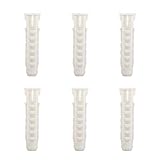
| Plastic masonry plug and screw | Small, lightly loaded shelves and accessories | About 10–30 lb per anchor | Cheap and forgiving, but limited holding power |
| Chemical anchor with threaded rod | Heavy shelves, cabinets, and uncertain masonry | High capacity when correctly installed | More expensive, slower, and less convenient |
Best General Choice: Masonry Screws
For most shelves holding books, dishes, or tools, masonry screws are the practical starting point. They cut threads directly into a drilled hole and do not require a separate plug. A 1/4-inch or 5/16-inch screw is usually suitable for common shelf brackets, with the length selected so at least 1 1/2 to 2 inches enters the brick after passing through the bracket.
Shop for masonry screws for brick in a pack that includes the correctly sized carbide bit. The bit size is not interchangeable: a hole that is too large gives the threads little material to grip, while a hole that is too small can prevent the screw from seating or split the brick.
Use a hammer drill only if necessary. A standard cordless drill with a carbide masonry bit is often better for old or fragile brick because it removes material more gently. If using hammer mode, keep pressure moderate and stop if the brick begins to crumble. Do not use an impact driver to drill the hole. Use it only for final tightening, and keep the torque low enough that you do not strip the masonry threads.
When to Use Sleeve Anchors
Sleeve anchors are a better choice for heavy-duty brackets in solid, structurally sound brick. The anchor consists of a bolt, nut, and expanding sleeve. As the nut tightens, the sleeve presses against the hole walls. A 5/16-inch or 3/8-inch sleeve anchor is common for substantial shelving, but the bracket and the brick must be strong enough to use it.
Expansion anchors create outward force. That is useful in solid brick but risky near an edge, near a mortar joint, or in brittle old masonry. Keep the hole at least 2 inches from a free edge where possible, and avoid placing the anchor within the mortar joint unless the manufacturer specifically allows it. A sleeve anchor that spins while tightening has either an oversized hole, insufficient embedment, or damaged masonry.
For a shelf loaded with heavy tools, use multiple brackets and spread the anchors vertically and horizontally. Do not assume four anchors rated at 75 pounds each will safely hold 300 pounds. Shelf leverage pulls the top anchors outward, and the bracket itself may bend before the anchors reach their published rating.
Hollow Brick and Old Masonry
Standard sleeve anchors and ordinary masonry screws are poor choices for hollow brick if the fastener expands inside an empty cavity. They may feel tight during installation but pull out when the shelf is loaded. In this situation, use an anchor designed for hollow masonry, or locate the bracket over a solid section, such as a filled cell or a structural pier.
Chemical anchors are useful when the wall is irregular, the load is high, or the fastener must resist repeated pulling. The system uses a two-part resin and threaded rod. The hole must be brushed and blown clean, then filled according to the resin instructions. Dust left in the hole is a common failure mode. Chemical anchors also need curing time, often from roughly 30 minutes to several hours depending on temperature and product.
For a normal household shelf, chemical anchoring is usually unnecessary. It becomes worthwhile for a wall-mounted cabinet, a deep shelf carrying dense books, or a bracket that cannot be relocated if a mechanical anchor fails.
Drilling and Installation Technique
Use a sharp carbide masonry drill bit set sized for the anchor. Mark the holes through the bracket, then remove the bracket before drilling if its holes make alignment awkward. Drill perpendicular to the wall to the specified depth, adding about 1/4 inch for dust at the bottom.
- Check for electrical cables and plumbing before drilling.
- Mark the hole positions on the brick, not directly over a weak mortar joint.
- Drill slowly at first to prevent the bit from skating.
- Clear the dust with a vacuum, brush, or compressed air.
- Install the anchor with the bracket flat against the wall.
- Tighten until snug, then stop before crushing the brick or deforming the bracket.
For masonry screws, the screw should enter smoothly and become firm near its final depth. If it spins without tightening, remove it and move the hole at least an inch away; do not simply use a longer screw in the same damaged hole. For sleeve anchors for solid brick, follow the required hole diameter and minimum embedment exactly.
Load and Safety Checks
Keep heavy loads close to the wall. A 12-inch-deep shelf creates substantially more leverage than an 8-inch shelf, even if the total weight is identical. Use a bracket at each end and another every 24 to 32 inches for long shelves. Test the installation gradually: add a small load first, then inspect for anchor movement, cracking brick, bracket bending, or a shelf that begins to sag.
If the brick crumbles while drilling, the anchor hole is close to an edge, or the shelf will hold unusually heavy or valuable items, stop and use a different location or a stronger engineered fastening system. The cheaper plastic plug is perfectly adequate for a small decorative shelf. For a heavily loaded shelf, saving a few dollars on anchors is rarely worth repairing damaged brick or replacing the contents.