What's inside
As an Amazon Associate I earn from qualifying purchases. This post may contain affiliate links at no extra cost to you.
Engineered lumber such as LVL, PSL, LSL and I-joists is not ordinary framing stock. A hole in the wrong place, or one that is too large, can weaken a beam or joist and create a repair problem that costs more than the drill bit. Choose the bit for the hole size and material, but check the product’s hole-placement rules before drilling any structural member.
As an Amazon Associate we earn from qualifying purchases at no extra cost to you.


What we cover
Check the member before drilling
Engineered wood products have different rules for holes and notches. The permitted diameter and location depend on the product, its dimensions, its span and the load it carries. I-joist web openings, for example, are not governed by the same rules as holes through an LVL beam. Follow the manufacturer’s guide for the exact product; if you cannot identify it or the proposed hole falls outside its published limits, ask a structural engineer or building professional before proceeding.
Do not cut an I-joist flange. Avoid drilling through a beam near a support or in a high-stress area unless the manufacturer’s instructions explicitly allow it. A sharp bit and a clean hole do not make an impermissible hole safe.
Choose the bit by hole size
For small holes, a sharp brad-point bit makes a clean, accurate start and is easy to control. It works well for pilot holes and light wiring or fastening tasks, but its short cutting edges and limited chip clearance make it a poor choice for deep, large holes. A standard twist bit is a budget-friendly alternative for small holes that do not need a particularly clean finish.
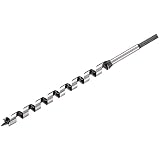
For larger holes, an auger bit is often the practical choice. Its threaded tip pulls the cutter into the wood, while the flutes carry chips back out. That self-feeding action is useful, but it can grab abruptly, especially in a powerful drill or near the end of a through-hole. Keep a firm two-handed grip, use a drill with a side handle when available, and reduce pressure as the tip approaches the far face.
A spade bit costs less and can bore larger holes quickly in accessible framing, but it tends to leave a rougher exit and can twist hard if it catches. It is fine for occasional holes where appearance is unimportant and access is good. For repeated holes, deeper boring or a cleaner result, compare wood auger drill bits before buying.
Bit comparison
| Bit type | Best use | Trade-off |
|---|---|---|
| Brad-point | Small, accurate holes | Not ideal for large or deep boring |
| Twist bit | Small holes on a budget | Can wander more in wood; chip clearing varies |
| Auger bit | Deeper, larger holes in framing | Self-feeding tip can pull hard and catch |
| Spade bit | Occasional large holes where finish is secondary | Rougher exits and more grabbing |
| Hole saw | Large-diameter openings with a defined edge | Slower, needs a pilot and can bind as the plug forms |
Large-diameter holes and cleaner edges
For a large, round opening, a hole saw can be a better fit than a spade bit. It removes a ring rather than the whole center, which is useful for cable pass-throughs and similar openings. The trade-off is slower cutting and a plug that can bind inside the saw. Back the cut out periodically to clear sawdust, and stop if the saw begins to overheat or the drill bogs down. A wood hole saw kit is usually more useful than a single large cutter if you expect to make several different-sized openings.
Engineered lumber can be dense and resin-rich, so dull teeth, excess pressure and packed flutes make heat and burning more likely. Use a sharp bit and clear chips during deeper cuts. If a hole must be neat on both faces, drill from one side until the pilot point appears, then finish from the other side. This reduces breakout, but only use that method if the layout permits accurate alignment.
Match the bit to the drill and technique
A regular cordless drill is generally the right tool for boring wood. Start in low gear for larger bits and keep the drill speed moderate; high speed can overheat a large cutter, while low speed with excessive force can stall the drill. Follow the bit maker’s speed guidance when available. Use a side handle for demanding holes, and remove gloves near rotating parts because loose material can snag.
Do not use hammer mode for wood boring. An impact driver is also a poor first choice for large bits: its pulsing action offers less control and can make a self-feeding auger feel unpredictable. It may drive a suitable hex-shank bit for light work, but a drill with a chuck and variable speed is the safer, more versatile buy for this job.
What to buy for the job
If you only need a few small holes, a basic sharp twist-bit set or one brad-point bit is enough; there is little reason to buy a premium auger set. For repeated framing holes within the member’s allowed zones, a quality auger set is a sensible step up. Check the shank size against your drill chuck, the maximum hole diameter your drill can handle, and whether the set includes the diameters you actually need.
For a few large, noncritical openings, a spade bit can save money. For cleaner, repeatable large holes, choose a hole saw sized to the opening. In every case, the bit is secondary to placement: confirm the engineered-lumber manufacturer’s limits, mark the hole carefully, and stop if the work does not match those instructions.