What's inside
As an Amazon Associate I earn from qualifying purchases. This post may contain affiliate links at no extra cost to you.
Oak is hard, dense wood, so a bit that cuts cleanly in softer lumber can heat up, scorch the hole, or wander when drilling it. The fix is not simply buying the most expensive bit: match the bit to the hole, keep it sharp, clear the chips, and avoid excessive speed or pressure.
As an Amazon Associate we earn from qualifying purchases at no extra cost to you.


What we cover
Choose the bit for the hole
For ordinary holes for screws, dowels, or hardware, a sharp brad-point bit is a reliable choice. Its center point helps locate the hole, while the outer spurs score the wood fibers before the cutting edges remove material. That usually gives a cleaner entrance than a basic twist bit. A brad-point bit set for wood is a useful general purchase if you regularly drill several sizes.
For deep holes or larger diameters, an auger bit clears chips more effectively. Its screw tip pulls the bit into the wood, so use a steady grip and moderate pressure; it can grab abruptly, especially as it breaks through. For a wide, shallow hole such as a hinge recess, use a Forstner bit. It cuts a flat-bottomed hole, but it needs a drill with enough torque and benefits from chip-clearing pauses.
A standard twist bit can work for occasional small holes, particularly if it is sharp and you already own it. It is less likely to leave a clean, accurately located opening in oak, and a dull general-purpose bit is more prone to rubbing than cutting.
Bit types at a glance
| Bit type | Best use in oak | Trade-off |
|---|---|---|
| Brad-point | Clean, accurately placed holes, commonly up to about 1/2 inch | Good control; deep holes need frequent chip clearing |
| Auger | Deeper holes and larger bores | Fast chip removal, but the screw tip can pull hard |
| Forstner | Flat-bottomed holes and larger shallow recesses | Clean results, but demands torque and careful heat control |
| Twist | Small, occasional holes when a suitable sharp bit is on hand | Can wander and leave a rougher opening in wood |
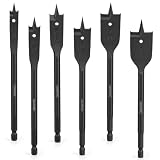
| Spade | Quick rough holes where finish quality is unimportant | Inexpensive and fast, but more likely to tear out or burn |
Set speed and pressure
Use a drill, not an impact driver, for clean holes in oak. An impact driver’s rapid impacts make it harder to control the cut and can damage the hole or the bit. A cordless drill with a variable-speed trigger and a clutch is suitable for most small and medium holes. For large Forstner or auger bits, a corded drill or a robust low-speed cordless drill can be a better fit if your current drill stalls.
Start slowly to keep the point from skating, then increase speed only until the bit cuts smoothly. There is no single rpm that suits every bit diameter and drill: large bits need lower speed than small ones. On a two-speed drill, use the low gear for large bores and high gear for small holes. Apply firm, steady pressure, but do not lean your full weight on the drill. If progress stops while the motor runs, pressing harder often creates more friction and heat, not faster cutting.
Use the bit maker’s speed guidance when available. If the bit begins to squeal, smoke, or leave a dark ring, stop. Those are signs of heat or rubbing, not normal evidence that oak is simply “hard.” Let the bit cool, inspect its cutting edges, and adjust speed, pressure, or chip clearance before continuing.
Clear chips before they burn
In a deep hole, oak chips can pack into the flutes and trap heat. Drill a little at a time, then withdraw the bit to clear the chips. For a small brad-point hole, withdrawing every roughly 1/4 to 1/2 inch of depth is a practical starting point; clear more often if chips stop emerging. Keep the bit straight while pulling it out, and don’t run it against the sides of the hole to grind away packed sawdust.
When drilling through a board, clamp scrap wood beneath the exit face. This backing reduces breakout as the bit emerges. For a large hole, drill partway through from one face, then finish from the other using the center mark as a guide. This takes a little longer but often leaves a cleaner exit.
Oak dust is an irritant. Wear eye protection, and use dust extraction or a suitable mask when making many holes. Secure the workpiece with clamps; holding a small piece by hand is risky if a large bit catches.
What to buy—and when to save
For most homeowners, a sharp brad-point set covering the common small sizes is the sensible first purchase. You do not need premium bits for an occasional pilot hole. A budget set is fine if the edges are clean, the sizes are accurate enough for your work, and you replace or sharpen bits when they stop cutting. Very cheap sets may arrive dull, wander more, or lose their edge sooner in dense hardwood.
If you regularly bore deep holes for wiring or furniture work, consider a quality wood auger bit in the sizes you actually use rather than buying a large assortment. For repeated flat-bottom recesses, buy individual Forstner bits for the required diameters. A few good bits are more useful than a broad set of sizes that sit unused.
Before drilling, mark the center, clamp the oak, and check that the bit is sharp and suitable for the hole. Start at low speed, keep the drill square, clear chips regularly, and stop at the first sign of scorching. Those habits matter as much as the label on the bit.