What's inside
As an Amazon Associate I earn from qualifying purchases. This post may contain affiliate links at no extra cost to you.
A cordless drill’s chuck determines which bits it can hold, how securely it holds them, and how quickly you can swap them. If you move between round-shank drill bits and hex-shank driver bits, a standard keyless chuck is usually the simplest answer. Other setups can be faster or more secure for particular jobs, but each comes with limits worth understanding before you buy.
As an Amazon Associate we earn from qualifying purchases at no extra cost to you.
What we cover
Start with the tool you already own
Most cordless drills and hammer drills use a three-jaw keyless chuck. Turn the sleeve by hand to open or close the jaws; no chuck key is needed. A typical 3/8-inch chuck accepts bits with shanks up to 3/8 inch, while a 1/2-inch chuck accepts larger shanks and is common on full-size drills. The chuck capacity is not the same as the hole size the drill can make: the motor, bit type, and material set that limit.
Check the drill’s manual before replacing its chuck. Many chucks attach to a threaded spindle and are held by a retaining screw, but thread direction and removal procedures vary. Some compact drills have a 1/2-inch chuck; others have a 3/8-inch chuck. Buying by appearance alone can lead to a part that will not fit.
Chuck options for round and hex shanks
For a drill that regularly swaps between ordinary twist bits and hex-shank driver bits, a quality keyless chuck is the most flexible option. It grips round shanks directly and generally accepts standard 1/4-inch hex shanks too. Use the chuck’s printed capacity as your guide, and make sure the bit is inserted far enough for the jaws to grip its smooth shank rather than the flutes.
A quick-change 1/4-inch hex holder is faster for swapping driver bits, but it is not a replacement for a drill chuck. Most holders are intended for 1/4-inch hex accessories, not round-shank bits. Some accept only short insert bits; longer hex-shank drill bits may need a holder specifically designed to retain them. A drill-chuck adapter can add flexibility, but it also adds length and another connection that can wobble or loosen.
| Setup | Best for | Main trade-off |
|---|---|---|
| 3/8-inch keyless chuck | Light drilling and driving with smaller bits | Cannot hold shanks larger than 3/8 inch |
| 1/2-inch keyless chuck | General-purpose drilling, including larger-shank bits | Can be bulkier on small drills |
| 1/4-inch hex bit holder | Fast swaps among driver bits | Does not directly grip ordinary round-shank bits |
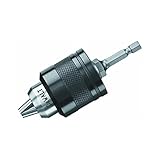
| Hex-to-chuck adapter | Using a chuck accessory in a compatible hex drive | Extra length, runout, and a less rigid connection |
What to buy for common jobs
If you have one cordless drill and switch between drilling pilot holes and driving screws, keep the drill fitted with its keyless chuck and buy driver bits with 1/4-inch hex shanks. The hex shank fits the chuck, so you can use both types of bit without changing hardware. A 1/2-inch keyless drill chuck makes sense if your drill has a compatible spindle and you need to hold bits with shanks larger than 3/8 inch. It is not automatically an upgrade for every compact drill.
If you use an impact driver for screws and a drill for holes, leave them set up for their strengths. Impact drivers accept 1/4-inch hex accessories and are convenient for repeated screw driving, but they are not a direct substitute for a drill chuck when using round-shank bits. A quick-change hex bit holder is a practical addition for the impact driver; choose drill bits rated for impact use if you plan to drill with it.
For occasional work, a chuck adapter can be cheaper than buying another tool. A hex-shank-to-chuck adapter can hold round-shank bits in a compatible 1/4-inch hex drive, but expect a longer, less rigid setup. It is fine for light, low-speed drilling when convenience matters more than precision. For deep holes, large bits, or frequent use, the drill’s own chuck is the better choice.
Prevent slipping and wobble
Before tightening a chuck, open the jaws enough to center the bit, then close them firmly by hand. On a three-jaw chuck, the jaws should meet the shank evenly. A bit held too close to its tip, or on the fluted section rather than the shank, can slip under load. If a bit is not seated straight, it may wobble even when the chuck feels tight.
Slipping often shows up as a polished ring on the bit shank, a bit that stops turning while the drill keeps running, or a chuck sleeve that loosens during use. Stop and reseat the bit; do not compensate by applying more force to the drill. If the chuck repeatedly loosens, inspect it for damage and check the manual for the correct tightening method. Some drills have a spindle lock or brake that helps during tightening, but the chuck should still be secured by its intended procedure.
Wobble can also come from a bent bit, a damaged chuck, or an adapter with poor concentricity. Test a suspected bit at low speed with the drill pointed away from you. If the bit visibly circles rather than spinning true, replace or test it separately before drilling a precise hole. Small runout may be tolerable for rough pilot holes, but it can make a clean hole difficult and cause larger bits to wander.
A short buying checklist
Confirm whether you need a replacement chuck or an accessory holder, then check the drill’s chuck capacity and spindle compatibility. For general home use, a sound 3/8-inch chuck is enough for many common pilot bits and driver bits. Choose 1/2 inch when you need larger shanks or the drill is designed for that capacity. Buy a hex holder for fast screw-bit changes, not as a universal chuck replacement.
Finally, match the accessory to the tool: use a drill for controlled hole-making, an impact driver for fastening, and adapters only when their added length and movement are acceptable. The cheapest setup is often perfectly adequate for occasional work; paying more is worthwhile when you need repeatable alignment, frequent bit changes, or a secure grip under sustained load.