What's inside
As an Amazon Associate I earn from qualifying purchases. This post may contain affiliate links at no extra cost to you.
Thin copper sheet is easy to drill, but it is also easy to dent, grab, and leave with a ragged hole. The best bit depends on the sheet thickness and the hole size. For most small holes, a sharp high-speed-steel (HSS) twist bit is inexpensive and works well. For larger holes or cleaner edges, a step bit is usually easier to control.
As an Amazon Associate we earn from qualifying purchases at no extra cost to you.


What we cover
Choose the right bit for the hole
| Bit type | Best for | Trade-offs |
|---|---|---|
| HSS twist bit | Small holes, roughly 1/16 to 1/4 inch | Cheap and widely available; can grab thin sheet if pushed hard or used without backing. |
| Step bit | Round holes from about 1/8 to 3/4 inch, depending on the bit | Controlled enlargement and generally clean edges; costs more and is less useful for very small holes. |
| Unibit-style sheet-metal bit | Repeated holes in sheet metal | A good step-bit choice for sheet work, but check that its steps include your target diameter. |
| Brad-point bit | Occasional small holes when already on hand | Can locate accurately, but the center spur and outer points are not a special advantage in thin copper; it may tear or catch. |
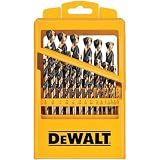
A sharp HSS twist bit set is the sensible budget buy for small holes. Look for ordinary HSS bits rather than assuming cobalt or titanium-coated bits will solve a setup problem. Cobalt bits are intended mainly for tougher metals and cost more; titanium-nitride coating does not make a dull or poorly supported bit cut cleanly.
For a larger opening, consider a step drill bit for sheet metal. Its progressively larger cutting diameters let you stop at a marked step instead of forcing a large twist bit through a thin panel. Confirm the bit’s diameter range and step increments before buying. If the required hole falls between steps, a twist bit or another hole-cutting method may be needed.
Why copper needs support
Copper is soft and ductile. When a twist bit breaks through thin sheet, its cutting lips can catch the unsupported edge and pull the sheet upward. The result may be a burr, a distorted hole, or a piece of sheet spun around the bit. A cordless drill’s low-speed setting helps, but backing and clamping matter more than buying an expensive bit.
Put the copper flat against a scrap of plywood or another sacrificial backing board. Clamp both layers securely to a bench, keeping clamps clear of the hole. Do not hold the sheet by hand: a small sheet can rotate suddenly if the bit catches. Wear eye protection, and keep fingers away from the underside where the bit will emerge.
Drilling small holes with a twist bit
Mark the hole and use a center punch lightly to make a starting dimple. Thin copper can deform under a heavy blow, so a sharp punch and a gentle tap are enough. For especially delicate or very thin sheet, a piece of masking tape over the mark can help the bit stay put, though it is not a substitute for clamping.
Fit a sharp bit close to the hole size, set the drill to its low gear, and use a moderate trigger speed with light, steady pressure. There is no single correct RPM for every drill and sheet thickness; the practical rule is to let the bit cut without squealing, polishing the surface, or heating the copper. If the bit skates, stop and improve the starting point rather than leaning harder.
When the bit is nearly through, ease off the pressure. This reduces the chance of the cutting edges grabbing as they break through. A pilot hole is useful when opening a larger hole with a twist bit, but avoid jumping from a tiny pilot straight to a large diameter in one pass. Step up through intermediate sizes while keeping the work backed and clamped.
Making larger holes with a step bit
Start with a small pilot hole if the step bit’s tip needs one, and check the manufacturer’s instructions. Hold the drill perpendicular to the sheet and advance only until the desired step cuts through. Mark the target diameter on the bit with tape if the engraved markings are hard to see. Pushing past the target step enlarges the hole quickly.
A step bit is often the easier choice for a single hole around 3/8 inch or larger, particularly when a neat circular opening matters. It can still catch, so use backing, clamping, and light pressure. A cheap step bit is fine for occasional work if it is sharp and its steps match the job. For repeated holes, a better-finished bit can be worth buying because it tends to cut more consistently and hold up longer.
Deburr and check the hole
After drilling, remove the sheet from the backing and feel for a sharp lip without dragging a finger across it. Knock down the burr with a hand deburring tool, a fine file, or a larger twist bit turned gently by hand. Do not use the drill to grind aggressively around the opening; that can make the hole uneven or thin the edge. For parts that will be handled, carry current, or sit against a gasket, inspect both faces and remove all sharp edges.
Common mistakes to avoid
Do not use hammer mode on copper sheet. Impact and hammer actions are for other tasks, not for making a controlled hole in thin metal. An impact driver can accept suitable hex-shank bits, but its fast impacts make delicate sheet work harder to manage; a regular drill with a clutch or low-speed control is the better tool.
Also avoid drilling unsupported sheet, using a dull bit, or forcing the tool when the cut stalls. Those choices cause more trouble than using a basic bit instead of a premium one. For a few holes in thin copper, a sharp HSS bit and scrap backing are usually enough. Spend extra on a step bit when the hole is larger, repeated, or needs a cleaner edge—not simply because copper is metal.