We research everything we recommend. When you buy through our links, we may earn a commission. As an Amazon Associate we earn from qualifying purchases.
Best Extension Cords for Workshops, Yards and Heavy Loads
Compare the best extension cords for workshops and yards, from heavy-duty 12-gauge outdoor cords to flat-plug indoor cords, plus gauge and safety basics.
Compare the best extension cords for workshops and yards, from heavy-duty 12-gauge outdoor cords to flat-plug indoor cords, plus gauge and safety basics.
As an Amazon Associate I earn from qualifying purchases. This post may contain affiliate links at no extra cost to you.
⭐ Key Takeaways
Quick answer: Our top pick is Southwire Heavy Duty Extension Cord, 50 Ft, 12/3 SJTW, with Iron Forge Cable Outdoor Extension Cord, 50 Ft, 10/3 SJTW as a strong alternative.
An extension cord looks like the simplest purchase in the workshop, but the wrong one quietly starves a tool of power, overheats under load, or fails the first time it rains. A table saw running at the end of a long, thin cord loses voltage, works harder, and wears out sooner, while a properly sized cord delivers full power and stays cool in your hand.
The five cords below cover the main jobs most households and workshops face: a contractor-grade 12-gauge cord for heavy tools, an extra-thick 10-gauge cord for the hardest pulls, a cold-weather cord that stays flexible in winter, a long light-duty cord for yard tools, and a short flat-plug cord for tight indoor spots.
As an Amazon Associate, we earn from qualifying purchases.
For most workshops, the Southwire 50-foot 12/3 cord is the best all-around pick because its 12-gauge wire, lighted end, and weather-resistant jacket suit nearly any tool. Choose the Iron Forge Cable 10/3 cord for the heaviest loads, the U.S. Wire and Cable Extreme cord for winter work, the Amazon Basics 100-foot cord for light yard duty, and the FIRMERST flat-plug cord for short indoor runs behind furniture.
Southwire Heavy Duty Extension Cord, 50 Ft, 12/3 SJTW
Top Pick
Southwire Heavy Duty Extension Cord, 50 Ft, 12/3 SJTW
Best for: the main workshop and jobsite cord for power-hungry tools like saws, compressors, and planers.
This is the cord that matches what most contractors reach for: 12-gauge copper wire in a 50-foot length, rated for 15 amps at 125 volts. That combination handles the tools that actually strain a cord, including table saws, air compressors, miter saws, and shop vacuums, without the voltage sag that makes motors run hot and sluggish on thinner wire.
The SJTW jacket is rated for outdoor use and resists moisture, abrasion, and sunlight, so the cord can live in the garage or run across a driveway without cracking after one season. The female end lights up when power is present, which sounds minor until you are troubleshooting a dead tool at dusk and can see at a glance whether the cord or the tool is at fault.
When a 12-gauge cord is not quite enough, this 10-gauge cord is the step up. The thicker 10/3 wire carries the full 15-amp rating over the whole 50-foot run with minimal voltage drop, which matters for tools with big startup surges, such as larger compressors, welders on household circuits, and electric log splitters that bog down on lesser cords.
The bright yellow SJTW jacket is easy to spot in grass, snow, or a cluttered garage, which reduces the odds of nicking it with a mower. The jacket is weatherproof and stays reasonably flexible in cold weather for a cord this thick. It is noticeably heavier and stiffer than a 12-gauge cord, so it is not the one you grab for a quick trim job, but for a dedicated heavy-load run it earns its place.
U.S. Wire and Cable 14/3 Extreme Cold Weather Extension Cord, 50 Ft
Most vinyl cords turn into stiff, uncooperative coils in freezing weather. This cord uses an SJEOOW jacket rated to stay flexible from deep sub-zero cold up to high heat, so it unrolls flat on a winter morning instead of fighting you. That makes it the natural pick for snow blowers, engine block heaters, outdoor holiday setups, and unheated barns or garages.
At 14 gauge and 50 feet, it is a medium-duty cord, well matched to lighter loads like drills, sanders, hedge trimmers, and work lights. The lighted plug shows when power is live, and the blue-and-red jacket is easy to see against snow. If your heaviest tool is a big compressor, step up to the 12-gauge Southwire instead, but for cold-climate general use this cord solves the problem that frustrates people most.
Specs:
– Length: 50 feet
– Wire: 14/3 (14 AWG, 3 conductors)
– Jacket: SJEOOW, extreme temperature rated, flexible in severe cold
– Ends: lighted plug
– Use: indoor and outdoor, cold-weather rated
Best for: winter yards, snow blowers, block heaters, and anyone tired of cords that freeze into stiff coils.
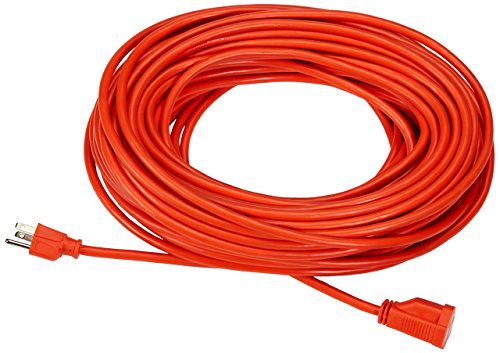
Sometimes the job is simply reach. At 100 feet, this cord gets power to the far corner of a yard for a leaf blower, string trimmer, electric mower, or a string of work lights, and its vinyl jacket resists moisture for indoor and outdoor use. It is a light-duty cord, rated at 10 amps and 1250 watts, and it should be matched to loads that size or smaller.
That rating is the honest trade-off for the length: this is not a cord for a table saw or space heater, and running a heavy tool at the end of 100 feet of light wire is exactly the overheating scenario the How to choose section warns about. Used within its limits, it is a practical cord with a grounded 3-prong plug that covers the everyday yard tasks most people need a long cord for.
Not every cord problem is outdoors. This short 6-foot cord solves the indoor version: an outlet hidden behind a couch, bed, or workshop bench. The low-profile flat plug hugs the wall so furniture can sit nearly flush, and the cord exits at an angle instead of sticking straight out where it gets bent and loosened.
Despite the compact size, it is built with 14-gauge wire rated for the full 15 amps and 1875 watts, and it is UL listed, so it can safely serve a workbench, a microwave cart, or a home office setup where a longer cord would just become a tripping coil. It is a single-outlet cord with no outdoor rating, so keep it inside and dry.
Start with wire gauge, because it decides what the cord can safely carry. Gauge numbers run backwards: the lower the number, the thicker the wire and the more current it handles. A 12-gauge cord is the right default for heavy tools such as table saws, compressors, and planers. A 14-gauge cord suits medium loads like drills, sanders, and snow blowers. A 16-gauge cord is light duty, fine for lamps, phone chargers, and small fans, but it has no business powering a space heater or a big saw.
Length matters just as much. Electricity loses voltage as it travels, and the loss grows with distance and shrinks with thicker wire. A tool that runs fine on a 25-foot cord may labor on a 100-foot cord of the same gauge. Buy the shortest cord that comfortably reaches, and step up one gauge size when you must go long: working 100 feet from an outlet with a heavy tool calls for 10 or 12 gauge.
Read the jacket letters before using a cord outdoors. A W in the rating, as in SJTW or SJEOOW, means the jacket is rated for outdoor use and weather resistance. Cords without that marking belong indoors. Cold-rated jackets, such as the SJEOOW on the U.S. Wire and Cable pick, add flexibility in garages and winter conditions. A lighted end is worth having too: it confirms power is reaching the cord before you blame the tool.
Then follow the safety rules without exception. Never daisy-chain extension cords together; each connection adds resistance, heat, and a point of failure, so buy one cord of the right length instead. Never run a cord under a rug or carpet, where heat builds up unseen and foot traffic damages the insulation. Always match the cord rating to the tool: check the amp draw on the tool’s label and use a cord rated at or above it. Uncoil a cord fully before heavy use, since a coiled cord traps heat, and retire any cord with cuts, cracked insulation, or a damaged plug rather than taping it.
Who should skip
Skip the light-duty Amazon Basics cord if your main tools are saws, compressors, or heaters; its 10-amp rating is for yard tools and lights, and the 12-gauge Southwire is the safer match. Skip the Iron Forge 10-gauge cord if you mostly run small tools, since its weight and stiffness buy capacity you will never use. Skip the FIRMERST flat-plug cord for anything outdoors or damp, because it is an indoor cord only.
More broadly, skip extension cords entirely where a permanent outlet is the real answer. A cord is a temporary solution, not a substitute for wiring: if the same cord lives in the same spot year-round, an electrician installing a receptacle is the safer long-term fix. Powering a whole room during an outage calls for a properly installed generator transfer setup, never cords run through windows and doors.
FAQ
Can I plug a space heater into an extension cord?
It is best avoided, because heaters draw heavy current continuously and overwhelm light cords. If there is no alternative, use only a short 12-gauge cord rated above the heater’s draw, keep it fully uncoiled, and never leave it unattended.
What gauge cord do I need for a table saw or air compressor?
Choose 12 gauge for runs up to about 50 feet, and consider 10 gauge for longer runs or especially large motors. The thicker wire limits voltage drop so the motor starts cleanly and runs cooler.
Can I leave an outdoor extension cord outside all year?
A cord with a W-rated jacket tolerates weather, but constant sun, moisture, and temperature swings still age it. Store cords coiled in a dry place when not in use, and inspect the jacket and plugs before each season.
Why does my tool run weakly at the end of a long cord?
That is voltage drop: the wire resists the current over distance, so the tool receives less than full voltage. Shorten the run or switch to a thicker, lower-gauge cord, and the tool should recover its normal power.
Final verdict
Match the cord to the load and the length, and every pick here does its job well. The Southwire 12/3 is the one cord most workshops should own first, the Iron Forge 10/3 covers the heaviest pulls, the U.S. Wire and Cable Extreme cord wins winter, the Amazon Basics 100-foot cord handles light yard reach, and the FIRMERST flat-plug cord fixes the indoor outlet problem. Buy the shortest, thickest cord your task honestly needs, and it will serve safely for years.
M
Miller the Driller Editorial Team
We compare specs, warranty terms, long-term owner feedback and street pricing before anything earns a spot. Rankings are never paid.
Affiliate disclosure. As an Amazon Associate we earn from qualifying purchases at no extra cost to you. Prices accurate as of the date shown.
Three wireless routers for small offices compared on device capacity, network separation, wired speed, and coverage, with specs taken from their Amazon listings.
Compare 5 mechanic tool sets for car repairs: a 247-piece DEWALT kit, a 450-piece CRAFTSMAN set, a drawer-box GEARWRENCH set, a 170-piece Crescent set and a 450-piece WORKPRO set.
Four splitting axes and mauls that actually split firewood: a long 36-inch axe for tall users, a shorter 28-inch option, and two 8 lb mauls for knotty rounds.
Learn whether a 20V rechargeable drill battery can be repaired, which faults you can check safely at home, and when replacing the pack is the safer choice.
A specs-based review of the officially licensed Retro-Bit Sega Saturn 2.4 GHz wireless controller: dual receivers, Genesis Mini and Switch support, battery, layout, limits, and FAQs.
Find the best drill battery for Power Wheels ride-on toys for families, with DeWalt, Milwaukee and Ryobi adapters, voltage and safety guidance in this guide.
Find the best hole saw for noching dom pipe: bi-metal saws, deep cups, and the right sizes for clean, tight notches in DOM tube for fabrication shops today.
Find the best diy tile saws for home tiling projects. Compare wet tile saws by blade size, cutting capacity, and features for ceramic and porcelain tile.


 FIRMERST Flat Plug Extension Cord, 6 Ft, 14 AWG









