We research everything we recommend. When you buy through our links, we may earn a commission. As an Amazon Associate we earn from qualifying purchases.
Best Aviation Snips for Sheet Metal, Ducts and Clean Cuts
Find the best aviation snips for ductwork and sheet metal, with forged offset picks, color-code basics, gauge ratings, and safety tips for clean cuts.
Aviation snips are the hand tool that turns flat sheet metal into duct runs, flashing, patch panels, and gutter sections. Their compound-action handles multiply hand pressure, so a controlled squeeze shears through stock that would defeat ordinary scissors-style cutters. Choosing well matters, because blade steel, jaw geometry, and handle shape decide whether a cut finishes clean or curls into a jagged edge that fights every fold and seam that follows it down the line.
This guide compares five widely sold aviation snips and sets, from a forged offset pair built for daily duct work to a budget three-piece kit meant for occasional repairs. Each pick is matched to the jobs it suits best, with the cut direction, gauge capacity, and grip style spelled out, plus a buying section that explains the handle color code and the safety habits that keep cuts clean and fingers intact.
As an Amazon Associate, we earn from qualifying purchases.
The Midwest Snips MWT-6510C offset set is the strongest all-around pick for duct and sheet metal work, with forged blades and an 18-gauge rating. The Milwaukee three-piece set covers left, right, and straight cuts in one kit, while the Crescent Wiss M3R remains the classic straight-cut choice for general shop use.
Midwest Snips Aviation Snip Set MWT-6510C
Top Pick
Midwest Snips Aviation Snip Set MWT-6510C
Best for: HVAC installers and sheet metal workers who make long offset cuts every day.
Midwest builds this two-piece offset set in Michigan, pairing a left-cut and a right-cut snip with red and green KUSH’N-POWER grips. The offset jaw design keeps hands above the sheet while the blades travel below it, which is exactly the geometry wanted for long rips down a duct blank or a wide flashing strip. Forged chrome molybdenum blades hold an edge through repeated cuts in galvanized stock.
Each snip is rated for 18-gauge cold-rolled steel, and the 1-3/8 inch length of cut gives a good balance between bite and control on curves. There is no straight-cut snip in the box, so straight-only work calls for a separate tool, but for installers who spend most cuts turning left or right around fittings, this is the pair that covers the working day.
Specs:
– Includes: left-cut and right-cut offset snips
– Blade material: forged chrome molybdenum alloy steel
– Cut capacity: 18-gauge cold-rolled steel
– Length of cut: 1-3/8 inches
– Grips: KUSH’N-POWER comfort grips
– Made in the USA
Crescent Wiss MetalMaster M3R
Runner-Up
Crescent Wiss MetalMaster M3R
Best for: General-purpose straight cutting in duct, flashing, and light fabrication.
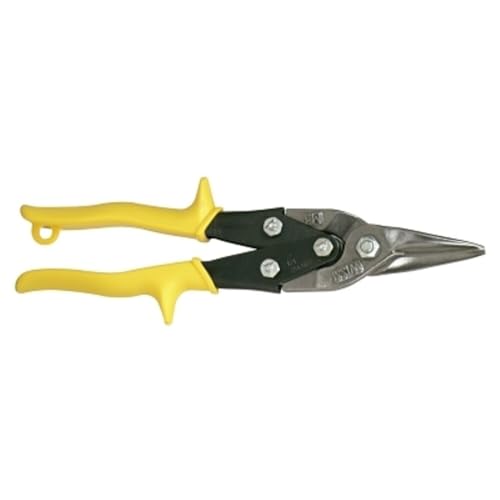
The M3R is the yellow-handled straight snip that has lived in tool bags for decades. Its jaws cut straight lines and wide, gentle curves to either side, and the serrated molybdenum steel blades grip the sheet instead of pushing it forward, which keeps the cut line honest on slippery galvanized surfaces.
At 9-3/4 inches overall, it is compact enough for tight duct branches yet still delivers compound leverage rated for 18-gauge low-carbon steel. A spring latch locks the jaws shut for storage, and the textured grips resist twisting in the hand during long cuts. As a single-pattern tool it cannot replace a left or right snip for tight circles, but as a straight cutter it is hard to beat.
Specs:
– Cut pattern: straight, plus wide curves left or right
– Blade material: serrated molybdenum steel
– Cut capacity: 18-gauge low-carbon steel
– Overall length: 9-3/4 inches
– Handle color: yellow
– Latch: spring-loaded locking latch
Milwaukee 3-Piece Aviation Snip Set 48-22-4533
Milwaukee 3-Piece Aviation Snip Set 48-22-4533
Best for: Buyers who want one complete kit for ductwork, roofing, and general repairs.
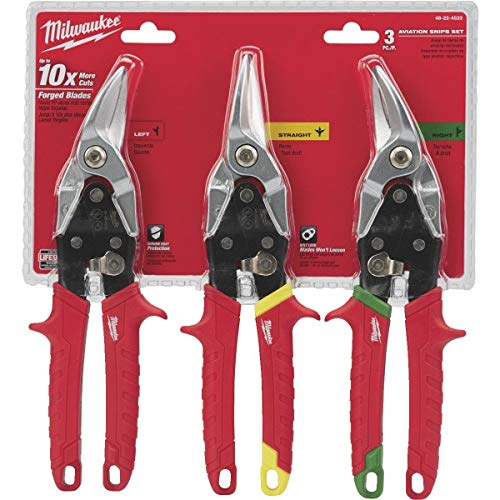
Milwaukee’s three-piece set covers every direction in one purchase: left, right, and straight snips with color-coded handles and forged alloy steel blades. The blades are machined for precise alignment, so the two cutting edges meet cleanly instead of folding thin stock into the gap between them, a common failure on cheaper snips.
A one-handed locking mechanism keeps each snip closed in a pouch or toolbox, and the handles are shaped to reduce hand fatigue across a long run of cuts. The set is rated for 18-gauge cold-rolled steel and 22-gauge stainless steel, which covers most residential duct gauges with room to spare. For a first complete snip kit, this is the straightforward recommendation.
This single offset left-cut snip carries red handles and an offset head that drops the blades below the handle line, so knuckles clear the sheet on long left-hand curves. It is rated to cut 18-gauge cold-rolled steel and 22-gauge stainless steel, matching the capacities tradespeople expect for duct and flashing work.
The cutting edges are hardened to stay sharp and well aligned, and the tool is backed by a full lifetime warranty, which softens the risk of adding a single-pattern snip to an existing kit. Pair it with right-cut and straight snips over time, or buy it alone when left curves around round duct fittings are the cuts that keep coming up on the job.
The HURRICANE set is the low-commitment way to own all three cut directions at once: straight, left, and right snips with yellow, red, and green TyreGrip handles. Chrome vanadium blades with a serrated edge bite into sheet metal, aluminum, and vinyl, and each snip carries a safety latch and a hang hole for storage on a pegboard.
Capacity is rated up to 20-gauge mild steel and 22-gauge stainless steel, a step below the trade sets above, and the maker is clear that the set is aimed at home and hobby work rather than industrial use. For gutter patching, craft metal, chicken wire, and the occasional duct repair, that capacity is enough, and having the correct direction on hand beats forcing the wrong snip through a curve.
Specs:
– Includes: straight, left-cut, and right-cut snips
– Blade material: chrome vanadium steel, serrated edge
– Cut capacity: up to 20-gauge mild steel, 22-gauge stainless steel
– Handles: ergonomic TyreGrip with hang hole
– Safety: locking latch on each snip
– Overall length: 10 inches
How to choose
Start with the color code. Red handles cut left, green handles cut right, and yellow handles cut straight. The direction describes the way the tool naturally turns and which side the waste curls toward, so a red snip travels comfortably through left curves while a green snip handles right curves. Buying the color that matches the cut keeps edges smooth and reduces hand strain.
Offset versus straight handles. Straight-pattern snips keep the handles in line with the blades and work well for short cuts and notches. Offset snips drop the blades below the handles, which keeps knuckles above the sheet and the cut line visible on long rips. Anyone cutting full duct blanks or long flashing runs should lean offset, while anyone mostly trimming small pieces can stay with a straight pattern.
Serrated versus smooth jaws. Fine serrations grip the metal and stop the tool skating forward, which helps hold a line on galvanized stock. Smooth jaws slide through the cut with less marking and suit finish work on visible surfaces. Either style needs sharp, well-aligned edges, because a dull or sprung jaw folds metal instead of shearing it.
Respect the gauge rating. Every snip is rated for a maximum thickness of cold-rolled steel, commonly 18 gauge for trade tools, with a thinner limit for stainless steel. Exceeding the rating strains the pivot and chips the edges. Aviation snips are not wire cutters: never use them on hardened wire, bolts, or rod, which will notch the blades in a single squeeze.
Springs, latches, and sets versus singles. A spring that opens the jaws between cuts speeds repetitive work, and a latch keeps the edges closed and protected in storage, so always store snips latched. A three-piece set costs less than three separate singles and guarantees every direction is on hand, while singles let you replace or upgrade one direction at a time.
Cut safely. Freshly cut sheet metal edges are razor sharp, and the thin waste strip curls into a blade of its own. Wear work gloves, keep the waste side falling away from your body rather than pulling it toward you, and support long sheets so they do not flop mid-cut. Never pry, twist, or hammer with snips; they are shearing tools, and side loads bend the jaws out of alignment.
Who should skip
If the work involves plate steel, thick stainless, or hardened fasteners, aviation snips are the wrong tool entirely; a nibbler, a powered metal shear, or an angle grinder belongs on that job. Shops cutting the same gauge all day at production speed will also outgrow hand snips quickly and should look at powered shears instead. And if only one or two short cuts are planned in thin craft metal, a basic pair of straight snips is enough, with no need for a full three-direction set.
Frequently Asked Questions
What do the handle colors on aviation snips mean?
Red means the snip cuts left curves, green means it cuts right curves, and yellow means it cuts straight. The color describes the direction the tool is designed to turn and which side the waste material curls toward. Matching the color to the cut gives smoother edges and less wrist strain.
Can aviation snips cut stainless steel?
Yes, within the stainless rating printed for the tool, which is usually a thinner gauge than its cold-rolled rating. A snip rated for 18-gauge cold-rolled steel commonly handles 22-gauge stainless. Forcing thicker stainless dulls and chips the edges, so step up to a heavier shear for thick stainless stock.
What is the difference between aviation snips and tin snips?
Traditional tin snips use long, simple-pivot handles and rely on hand strength alone, which suits straight cuts in thin material. Aviation snips add a compound-action linkage that multiplies force, plus shorter jaws and color-coded directions, making curved cuts in thicker duct and sheet metal far more manageable.
How should aviation snips be stored and maintained?
Wipe the blades clean after use, add a drop of oil at the pivot now and then, and always close the latch before putting the tool away. Storing snips latched protects the edges from nicks and keeps the closed tool from springing open in a crowded toolbox and catching on other gear.
Final verdict
For daily sheet metal and duct work, the Midwest offset pair is the pick to beat, with forged blades and the geometry that long cuts demand. The Milwaukee three-piece set is the best first kit, the Wiss M3R remains the dependable straight cutter, the CRAFTSMAN offset left fills a single-direction gap with a lifetime warranty behind it, and the HURRICANE set covers all three directions for lighter home use. Match the handle color to the cut, stay inside the gauge rating, and any of the five will leave clean edges.
M
Miller the Driller Editorial Team
We compare specs, warranty terms, long-term owner feedback and street pricing before anything earns a spot. Rankings are never paid.
Affiliate disclosure. As an Amazon Associate we earn from qualifying purchases at no extra cost to you. Prices accurate as of the date shown.
Three wireless routers for small offices compared on device capacity, network separation, wired speed, and coverage, with specs taken from their Amazon listings.
Compare 5 mechanic tool sets for car repairs: a 247-piece DEWALT kit, a 450-piece CRAFTSMAN set, a drawer-box GEARWRENCH set, a 170-piece Crescent set and a 450-piece WORKPRO set.
Four splitting axes and mauls that actually split firewood: a long 36-inch axe for tall users, a shorter 28-inch option, and two 8 lb mauls for knotty rounds.
Learn whether a 20V rechargeable drill battery can be repaired, which faults you can check safely at home, and when replacing the pack is the safer choice.
A specs-based review of the officially licensed Retro-Bit Sega Saturn 2.4 GHz wireless controller: dual receivers, Genesis Mini and Switch support, battery, layout, limits, and FAQs.
Find the best drill battery for Power Wheels ride-on toys for families, with DeWalt, Milwaukee and Ryobi adapters, voltage and safety guidance in this guide.
Find the best hole saw for noching dom pipe: bi-metal saws, deep cups, and the right sizes for clean, tight notches in DOM tube for fabrication shops today.
Find the best diy tile saws for home tiling projects. Compare wet tile saws by blade size, cutting capacity, and features for ceramic and porcelain tile.


 CRAFTSMAN Aviation Snips, Offset Left CMHT73559
 HURRICANE 3 pc Aviation Tin Snips Set









