What's inside
As an Amazon Associate I earn from qualifying purchases. This post may contain affiliate links at no extra cost to you.
What we cover
Start with the load, not the package
A light-duty storage bracket might hold a small basket, a few cleaning supplies, or a short shelf. The bracket’s label is only part of the calculation: the load sticks out from the wall, creating leverage, and people may tug on it or set heavier items down than intended. A bracket rated for 25 pounds does not mean any one drywall anchor can safely carry 25 pounds in every installation.
First look for a stud. If a bracket’s mounting holes can line up with one, drive an appropriately sized screw into the stud; that is generally more dependable than relying on drywall alone. If the holes miss the studs, use an anchor suited to the drywall thickness and the bracket’s hole pattern. For a small bracket with modest, static loads, a properly installed self-drilling anchor or expansion anchor may be enough. For a bracket that projects far from the wall, gets bumped, or will hold valuable or heavy items, choose a metal toggle or mount into framing instead.
As an Amazon Associate we earn from qualifying purchases at no extra cost to you.


Which anchor type fits the job?
| Anchor type | Best fit | Trade-offs |
|---|---|---|
| Plastic expansion anchor | Very light loads and occasional-use brackets | Inexpensive and simple, but less resistant to pull-out and repeated movement |
| Self-drilling plastic or metal anchor | Light-duty brackets where there is no stud | Fast to install; can strip, spin, or damage drywall if overtightened |
| Toggle bolt or strap toggle | Higher loads or brackets that see leverage | Spreads load behind the drywall; needs a larger hole and clearance in the cavity |
| Stud screw | Any bracket hole that can reach framing | Strong, but the screw must penetrate the stud—not just the drywall |
Plastic expansion anchors are the cheap option, and they are fine for a very light bracket in sound drywall when failure would not cause a problem. They rely on the anchor expanding in the hole, so an oversized hole, crumbly drywall, or a screw that is too large can make them unreliable. Do not treat the package’s maximum load figure as a guarantee for a projecting bracket.
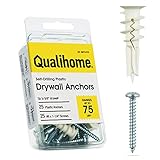
Self-drilling anchors avoid a separate pilot hole in many installations. They are convenient for a small bracket, but the broad threads can tear up the paper face if you keep turning after the anchor is seated. A stripped anchor that spins in the wall is not fixed by driving the screw harder. For a modest bracket, compare self-drilling drywall anchors with the bracket’s screw size and the drywall thickness before buying.
Toggle-style anchors clamp against the back of the drywall, spreading the load over a wider area. They are a better choice when a bracket will be pulled on or carries a heavier load, but they require a hole large enough for the toggle and a clear wall cavity. Pipes, wiring, insulation, and framing can block installation. A metal toggle bolt is not automatically stronger in every wall: it still depends on intact drywall and correct installation.
Check the wall and bracket before drilling
Most interior drywall is 1/2 inch thick; some walls use 5/8-inch board, and ceilings or older construction may differ. Check the anchor packaging for an accepted thickness range. An anchor that is too short may not engage correctly, while one that is too long can protrude or fail to clamp. Avoid mounting into a damaged, damp, or previously patched area if another location is available.
Use a stud finder, then confirm likely stud positions with a small test hole or by checking where a screw bites. Studs are commonly spaced 16 inches apart, though that is not universal. Before drilling, look for nearby outlets and plumbing fixtures, and avoid blindly drilling above or below them. If you cannot confirm what is behind the wall and the location may contain wiring or pipes, stop and choose a safer location or method.
Count the bracket’s holes and follow its instructions. If two anchors share the load, they still may not carry exactly half each: uneven spacing, a crooked bracket, or one loose screw can leave the other anchor doing most of the work. Use anchors in every intended mounting hole, and avoid substituting a screw whose diameter or length falls outside the anchor maker’s instructions.
Install without damaging the drywall
Mark the holes with the bracket level, then drill the specified hole size if the anchor requires one. A cordless drill with a normal twist bit is usually sufficient; a hammer drill is not needed for drywall and can make a sloppy, oversized hole. For self-drilling anchors, start them square to the wall and turn slowly with a screwdriver or drill on a low setting. Stop when the flange sits flush. If the anchor spins, cracks the drywall, or will not seat firmly, remove it and relocate the hole rather than trusting it.
For a toggle, make the hole to the stated diameter and check that the toggle opens behind the wall before tightening. Keep the bracket flat against the surface as you tighten, but do not crank down until the drywall crushes or the bracket bends. A hand screwdriver gives better control at the final stage than a high-torque impact driver. If you use a drill, use a low clutch setting and finish by hand.
Once mounted, apply a gentle downward and outward test before loading the bracket. Watch for movement, a growing gap, cracking, or a screw that loosens. These are signs to unload it immediately. Do not “test” an anchor by hanging your full body weight from the bracket.
What to buy for a typical light-duty bracket
For a small bracket holding a few lightweight items, a quality self-drilling anchor is a reasonable balance of speed and cost, provided the drywall is sound and the load is modest. If the bracket has a long arm, will be bumped, or carries heavier objects, use a toggle-style anchor or find a stud. A basic plastic expansion anchor is acceptable for a low-consequence, very light load; spending more on a toggle is unnecessary if a small bracket simply supports a lightweight item close to the wall.
Buy anchors that match the bracket screws rather than assuming the included hardware is right for every wall. If the package gives a load rating, treat it as guidance for its stated installation conditions, not a universal safe working load. When a failed bracket could hurt someone or damage something valuable, use framing or get advice from a qualified installer rather than relying on a drywall-only rating.