We research everything we recommend. When you buy through our links, we may earn a commission. As an Amazon Associate we earn from qualifying purchases.
Best Miter Saws for Woodworking: Five Picks Compared
Compare the best miter saws by blade size, bevel range, cut capacity, and glide system, with five picks for trim, framing, and home shop work.
A miter saw is the tool that turns a pile of lumber into finished work, and it does it by answering one question with repeatable accuracy: can this cut land at exactly the angle the joint needs, every time, without a second pass. A circular saw cuts a board to length, and a table saw rips it to width, but neither one sets a 45 degree miter for a picture frame, a 31.6 degree compound cut for crown molding, or a clean square crosscut on a 2 by 12 with the same speed and the same repeatability. A miter saw does all three, because the blade rides on a fixed pivot with detents at the common angles, a fence that holds the workpiece square, and a sliding head on the larger models that carries the blade across wide stock. The right miter saw for a workshop is not the biggest one on the shelf. It is the one whose blade size matches the stock the shop actually cuts, whose bevel range covers the joints the buyer actually makes, and whose sliding system fits the bench depth the shop actually has. A 10 inch dual-bevel slider is the right call for a small shop and a buyer who carries the saw to the job, and a 12 inch dual-bevel slider is the right call for a shop that cuts wide trim, thick framing lumber, and nested crown molding in the same week. This guide compares five miter saws currently sold on Amazon and judges them on blade size, motor and speed, bevel and miter range, cut capacity, sliding system, cut-line guidance, and weight, using each maker’s published specifications and the Amazon listing for each product.
The short answer is that the DeWalt DWS780 is the most balanced pick here, a 12 inch dual-bevel sliding compound saw with a 15 amp motor, an XPS shadow-line cut guide, and the widest crosscut capacity in this guide, that covers trim, framing, and deck work without demanding a second saw. The DeWalt DWS779 answers with the same 12 inch sliding capacity and the same motor at the mid-range tier, for buyers who can read a standard blade-and-fence reference mark instead of a projected shadow line. The Bosch GCM12SD is the glide pick, a 12 inch dual-bevel saw with a patented Axial-Glide system that slides without rear rails, for shops where the saw must sit against a wall. The Makita LS1219L is the crown and trim pick, a 12 inch dual-bevel slider with a two-steel-rail system, a laser guide, and the deepest nested crown capacity here, for buyers who cut molding all day. The SKIL MS6305-00 is the value pick, a 10 inch dual-bevel sliding saw with a 15 amp motor and an LED shadow line at the budget tier, for small shops and first-time buyers who want sliding capacity without a 12 inch saw. Every figure below comes from the maker’s published specifications and the Amazon listing for each product, and where those sources disagree, the disagreement is flagged rather than smoothed over.
As an Amazon Associate, we earn from qualifying purchases.
Makita LS1219L Dual-Bevel Sliding Compound with Laser
12 in
Crown molding and all-day trim work
5
SKIL MS6305-00 Dual Bevel Sliding Compound
10 in
A compact sliding saw at the budget tier
Tier key: the DeWalt DWS780, the Bosch, and the Makita sit in the premium tier of this group, the DeWalt DWS779 is mid-range, and the SKIL is the budget pick. Tier here describes where each saw sits in this lineup on motor, capacity, glide system, and included guidance, not a promise about what any seller charges on a given day.
Miter saws for woodworking come with 10 inch and 12 inch blades in this guide, and the blade size decides the widest board the saw can crosscut in one pass more than it decides how well the saw cuts. A 12 inch blade on a sliding saw crosscuts up to 2 by 14 lumber at 90 degrees on the DeWalt models here, and up to 2 by 16 on the DWS780 with a special setup, because the longer blade reaches further across the board and the sliding head carries it further still. A 10 inch blade on a sliding saw crosscuts up to 2 by 12 at 90 degrees on the SKIL here, which covers most trim, baseboard, and framing work, but it stops short of the widest deck boards and the thickest beams. The practical rule is to match the blade to the widest stock the shop cuts between saw changes, not to the biggest blade that fits the budget. A 12 inch saw is also heavier and wider than a 10 inch saw, and a buyer who carries the saw to a jobsite will feel every pound of the difference. Four of the five picks here have 12 inch blades, and one has a 10 inch blade, and the guide names the blade size for each so a buyer can match it to the stock.
Sliding, compound, and dual bevel, and what each one buys
A miter saw that does not slide cuts only as wide as the blade reaches in one plunge, which is why a non-sliding 12 inch saw crosscuts about 8 inches and a sliding 12 inch saw crosscuts 14 inches or more. Sliding is the feature that turns a miter saw from a trim tool into a framing tool, because it carries the blade across wide boards instead of asking the buyer to flip the board and finish the cut from the other side. Compound means the head tilts for bevel cuts as well as swinging for miter cuts, which is what a crown molding joint needs: a miter angle and a bevel angle in the same cut. Dual bevel means the head tilts both left and right, so a buyer can cut a bevel on either side of the board without flipping the workpiece, which matters on long trim runs where flipping a 12 foot board is slow and error-prone. All five picks here are dual-bevel sliding compound saws, and the guide names the bevel range for each, because a saw that bevels to 49 degrees covers more crown work than a saw that stops at 45 degrees, and a saw that bevels to 48 degrees with detents at the common angles sets up faster than a saw with no bevel detents at all.
The sliding system and the bench behind the saw
The sliding system decides how much bench depth the saw needs, and it is the feature that catches buyers who measure the saw but not the space behind it. A conventional sliding saw rides on two rear rails, and the head travels back past the fence as it slides, which means the saw needs a foot or more of clear space behind it, and it cannot sit against a wall. The Bosch GCM12SD in this guide uses an Axial-Glide system instead of rear rails, so the head folds forward on hinged arms and the saw can sit flush against a wall, saving about 12 inches of bench depth. The Makita LS1219L uses a two-steel-rail system that also keeps the footprint compact enough to work flush against a wall, with a single smooth glide instead of the two-rail travel of a conventional slider. The DeWalt models here use conventional rear rails, and they need the bench depth behind the saw, which is the trade for their wider crosscut capacity. A buyer with a shallow bench or a saw that lives against a wall should weigh the glide system first. A buyer with a deep bench and a dedicated miter station should weigh crosscut capacity first.
Cut-line guidance: shadow line, laser, or blade and fence
A miter saw is only as accurate as the cut line the buyer can see, and the five picks here guide that line three different ways. The DeWalt DWS780 projects an XPS shadow line from an LED, which shows the true kerf of the blade with no calibration, because the shadow is cast by the blade itself, and it does not drift when the blade is changed. The SKIL MS6305-00 uses an LED shadow line on the same principle. The Makita LS1219L uses a built-in laser, which draws a bright line on the workpiece but needs the laser to stay aligned with the blade, and a laser that drifts reads true on the line and wrong on the cut. The DeWalt DWS779 and the Bosch GCM12SD use no projected guide at all, and the buyer reads the cut from the blade and the fence, which is accurate when the fence is square and the blade is sharp, and slower than a shadow line when the cut must land on a pencil mark. The guide names the guidance for each pick, because a shadow line is worth more to a buyer who cuts to pencil marks all day, and a laser is worth more to a buyer who works in dim light, and neither one replaces a square fence and a sharp blade.
Motor, speed, and weight, and why they do not compare directly
Every pick in this guide runs a 15 amp motor on household current, and the no-load speeds run from 3,800 RPM on the 12 inch saws to 4,800 RPM on the 10 inch SKIL, because a smaller blade spins faster to keep the same cutting speed at the tooth. A 15 amp motor is the standard for a full-size miter saw, and it is the figure that decides whether the saw holds speed through dense hardwood or bogs down in a thick beam. Weight runs from about 39 pounds on the SKIL to about 65 pounds on the Makita, and the weight decides whether the saw rides in a truck or lives on a bench. A buyer who carries the saw to a jobsite should weigh weight first, because a 65 pound saw is a two-person lift up a flight of stairs. A buyer whose saw lives on a miter station should weigh capacity first, because a heavy saw that never moves is a stable saw. The guide states the weight for each pick, and where sources disagree on a weight figure, the disagreement is flagged rather than smoothed over.
The DeWalt DWS780 is the 12 inch dual-bevel sliding compound miter saw, and it is the most balanced pick in this guide because it pairs the widest crosscut capacity here with the most useful cut-line guidance and the most forgiving setup. The saw runs a 15 amp motor at 3,800 RPM, spins a 12 inch blade, and bevels from 0 to 49 degrees in both directions, with a miter range of 50 degrees left and 60 degrees right and a stainless steel detent plate with 10 positive stops. The XPS cross-cut positioning system projects a shadow line from an LED, which shows the true kerf with no calibration, and the tall sliding fences handle nested crown molding up to 7 and 1 half inches. The back fence design cuts up to 2 by 16 dimensional lumber at 90 degrees and 2 by 12 at 45 degrees, and the dust collection system captures over 75 percent of the dust generated, per DeWalt. The saw weighs about 56 pounds, and it ships with one carbide blade, a blade wrench, a dust bag, and a vertical material clamp.
The DWS780 earns its place on balance rather than on any single figure. Sixteen inches of crosscut at 90 degrees is the widest capacity in this guide, and it is the deciding detail: a saw that crosscuts 2 by 16 in one pass never asks the buyer to flip a board and finish the cut from the other side, and a flipped board is a board that can wander off the line. The XPS shadow line is the other strength, because it shows the true kerf with no calibration, and a guide that cannot drift is a guide the buyer can trust on every cut. The tall sliding fences are the third strength, because nested crown molding up to 7 and 1 half inches is the cut that separates a trim saw from a framing saw, and this saw handles it. The limitations are the ones that follow any full-size sliding saw. At about 56 pounds it is heavy to carry, and the conventional rear rails need bench depth behind the saw, so it cannot sit flush against a wall. One listing note is worth stating plainly: an older Amazon listing crawl showed the recurring “No featured offers available” wording in the listing summary area, while a fulfillment mirror crawled 9 days before writing showed the saw in stock and fulfilled by Amazon, and a deal listing from October 26, 2026 showed a live Amazon offer, so buyers should glance at the live offer before ordering, as with any listing whose summary area shows that wording. For the buyer who wants one saw that handles trim, framing, and deck work without a second thought, this is the pick the rest of the group is measured against.
2. DeWalt DWS779 12-Inch Double Bevel Sliding Compound Miter Saw — The Value 12-Inch Pick
Runner-Up
2. DeWalt DWS779 12-Inch Double Bevel Sliding Compound Miter Saw — The Value 12-Inch Pick
The DeWalt DWS779 is the 12 inch dual-bevel sliding compound miter saw, and it is the value 12 inch pick of this guide because it carries the same motor, the same blade, and nearly the same capacity as the DWS780 at the mid-range tier, with one feature removed. The saw runs a 15 amp motor at 3,800 RPM, spins a 12 inch blade, and bevels from 0 to 49 degrees in both directions, with a miter range of 50 degrees left and 60 degrees right and a stainless steel detent plate with 10 positive stops. It cuts up to 2 by 14 lumber at 90 degrees and 2 by 10 at 45 degrees, and the tall sliding fences handle nested crown molding up to 7 and 1 half inches, the same crown capacity as the DWS780. The difference is the cut-line guidance: the DWS779 has no XPS shadow line, and the buyer reads the cut from the blade and the fence, which is accurate when the fence is square and slower than a shadow line when the cut must land on a pencil mark. The saw weighs about 56 pounds, and it ships with a 32 tooth blade, a blade wrench, and a clamp.
The DWS779 earns its place on capacity per dollar rather than on features. Two by 14 crosscut capacity at 90 degrees covers nearly every board a shop cuts, and the same 15 amp motor and the same 49 degree dual bevel as the DWS780 mean the saw cuts the same joints with the same power. The stainless steel detent plate with 10 positive stops is the other strength, because a detent that locks at the common angles is a cut that lands true without a protractor, and this plate is the same one on the DWS780. The limitations are the ones that follow a saw without a projected cut line. Reading the cut from the blade and the fence is accurate, but it is slower on pencil-mark cuts, and a buyer who cuts to marks all day will feel the difference by the end of the week. One listing note is worth stating plainly: a roundup updated in September 2026 noted that the DWS779 standalone listing has gone in and out of stock on Amazon even while other retailers carry the saw, so buyers should glance at the live offer before ordering, and a buyer who cannot wait should check the DWS780 instead. For the buyer who wants 12 inch sliding capacity and can read a blade and fence, this is the pick.
The Bosch GCM12SD is the 12 inch dual-bevel glide miter saw, and it is the wall-flush pick of this guide because its patented Axial-Glide system slides without rear rails, so the saw can sit against a wall and save about 12 inches of bench depth. The saw runs a 15 amp motor at 3,800 RPM, spins a 12 inch blade, and bevels to 45 degrees in both directions, with bevel detents at 0, 33.9, and 45 degrees left and right for accurate crown cuts. The glide system allows wider crosscuts and better alignment while staying compact, with an expanded cutting capacity of 14 inches horizontal and 6 and 1 half inches vertical against the fence, and a crown capacity of 6 and 1 half inches against the fence at a 45 degree spring angle. The saw has a large, easy-to-read bevel scale and a stainless steel miter scale with marked detents and roof pitch angles, a dust collection chute with a vacuum adapter, and a 60 tooth blade. The saw weighs about 60 pounds.
The GCM12SD earns its place on the glide system rather than on raw capacity. An Axial-Glide saw that sits flush against a wall is the saw for a shallow bench, a garage shop, and a miter station built into a wall, because the 12 inches of bench depth it saves is the difference between a saw that fits the shop and a saw that forces the shop to move. The glide itself is the other strength, because hinged arms move smoother than sliding rails when the rails are dusty, and a smooth glide is a straight cut. The bevel detents at 33.9 degrees are the third strength, because 33.9 degrees is the bevel angle for standard crown molding, and a detent at that angle sets the cut without a protractor. The limitations are the ones that follow a glide saw. Fourteen inches of horizontal crosscut is less than the 16 inches of the DWS780, and the bevel range stops at 45 degrees where the DeWalt models reach 49 degrees, so a buyer who cuts extreme bevels will reach for another saw. The listing evidence is the freshest in this guide: a price-tracking record showed an Amazon price in March 2026, and a product record crawled 1 day before writing showed the saw in stock on Amazon. For the buyer whose saw must sit against a wall, this is the pick.
4. Makita LS1219L 12-Inch Dual-Bevel Sliding Compound Miter Saw with Laser — The Crown and Trim Pick
4. Makita LS1219L 12-Inch Dual-Bevel Sliding Compound Miter Saw with Laser — The Crown and Trim Pick
The Makita LS1219L is the 12 inch dual-bevel sliding compound miter saw with a laser, and it is the crown and trim pick of this guide because it pairs a two-steel-rail sliding system with a laser guide and the deepest nested crown capacity here. The saw runs a 15 amp motor, spins a 12 inch blade, and bevels to 48 degrees in both directions, with a miter range of 60 degrees left and 60 degrees right. The unique two-steel-rail sliding system offers a reduced footprint for operation flush against a wall, with a single smooth glide instead of the two-rail travel of a conventional slider, and the built-in laser helps the buyer line up accurate cuts quickly. The saw crosscuts 15 inches at 90 degrees, handles nested crown molding up to 8 inches against the fence, and carries an electric brake, a dust bag, a vertical vise, a triangle rule, and wrenches in the box. The saw weighs about 65 pounds per Makita.
The LS1219L earns its place on crown capacity and trim accuracy rather than on portability. Eight inches of nested crown is the deepest crown capacity in this guide, and it is the deciding detail: a trim carpenter who cuts crown molding all day needs a saw that swallows the molding without a second setup, and this saw does. The two-steel-rail system is the other strength, because a single smooth glide with a wall-flush footprint is the system for a dedicated trim bench, and the laser is the third strength, because a bright line on the workpiece is fast to read in dim light. The limitations are the ones that follow a heavy stationary saw. At about 65 pounds it is the heaviest saw in this guide, so it lives on a bench rather than riding in a truck, and a buyer who carries the saw to jobsites should choose a lighter pick. One weight note is worth stating plainly: some roundups print a heavier figure for this saw, while Makita’s own specification is 65 pounds, and this guide uses the maker’s figure. The listing evidence is solid but older: a price-tracking record showed an Amazon price in February 2026 and a scan 1 hour before writing, so buyers should glance at the live offer before ordering. For the buyer who cuts crown molding and trim all day on a dedicated bench, this is the pick.
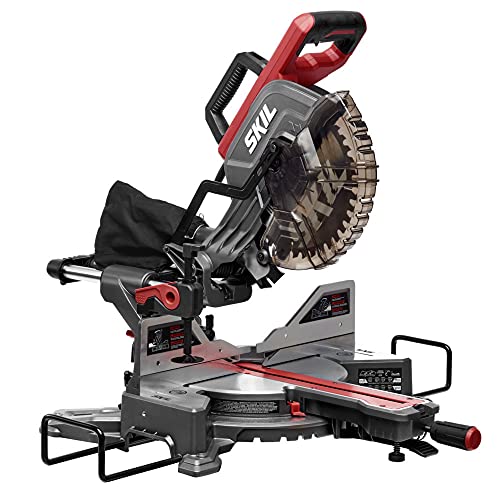
5. SKIL MS6305-00 10-Inch Dual Bevel Sliding Compound Miter Saw — The Value Pick
5. SKIL MS6305-00 10-Inch Dual Bevel Sliding Compound Miter Saw — The Value Pick
The SKIL MS6305-00 is the 10 inch dual-bevel sliding compound miter saw, and it is the value pick of this guide because it delivers sliding capacity, dual bevel, and a shadow-line guide at the budget tier in a saw light enough to carry. The saw runs a 15 amp motor at 4,800 RPM, spins a 10 inch blade, and bevels with positive stops at 48 and 45 degrees left, 0 degrees, and 45 degrees right, with a miter range of 50 degrees left and right and 11 positive stops. The LED shadow line marks the cut line, and the saw crosscuts lumber up to 2 by 12 at 90 degrees and 2 by 8 at 45 degrees, which covers most trim, baseboard, and framing work. The saw weighs about 39 pounds per the listing, and SKIL covers it with a three-year warranty.
The SKIL earns its place on honest value for a small shop. Two by 12 crosscut capacity at 90 degrees is the capacity most buyers actually use, and a 10 inch saw that reaches it with a 15 amp motor and a shadow line is a saw that does the work of a 12 inch saw on the boards that matter. The weight is the other strength: at about 39 pounds it is the lightest saw in this guide by a wide margin, and a saw that one person can carry up a flight of stairs is a saw that gets used on the job instead of left in the truck. The LED shadow line is the third strength, because a projected cut line on a budget saw is rare, and it is the feature that makes pencil-mark cuts fast for a first-time buyer. The limitations are the ones that follow any 10 inch saw. It stops at 2 by 12 where the 12 inch saws reach 2 by 14 and 2 by 16, and the bevel stops at 48 degrees left where the DeWalt models reach 49 degrees, so a buyer who cuts the widest stock and the steepest bevels will reach for a 12 inch saw. One weight note is worth stating plainly: some sources print a heavier figure for this saw, while the listing figure is about 39 pounds, and this guide uses the listing figure. The listing evidence is the freshest in this guide: a price-tracking record from November 11, 2026 showed a current Amazon offer, and a deal record from November 19, 2026 showed the saw in stock at Amazon. For the buyer who wants a sliding dual-bevel saw at the budget tier, this is the pick.
Mistakes to Avoid With a Miter Saw
The most common mistake is buying blade size by the biggest number. A 12 inch saw is the right choice for wide trim, thick framing lumber, and nested crown molding, but it is heavy and wide, and a buyer who cuts mostly baseboard and 2 by 6 framing will reach for the light 10 inch saw more often and finish the job faster. Match the blade to the widest stock the shop cuts between saw changes, not to the biggest blade that fits the budget. The second mistake is buying a sliding saw without measuring the bench behind it. A conventional sliding saw needs a foot or more of clear space behind the fence for the rails to travel, and a buyer who sets it against a wall will find the head hitting the wall on every wide cut. Measure the bench depth before ordering, and choose a glide or two-rail saw if the saw must sit against a wall.
Third is trusting a cut line that has drifted. A laser guide that is out of alignment reads true on the line and wrong on the cut, and a buyer who never checks the laser against a test cut will chase a line that lies. Check any laser against a scrap cut after a blade change, and trust a shadow line over a laser when the two disagree, because a shadow line is cast by the blade itself and cannot drift. Fourth is cutting with a dull blade. A dull blade burns the cut, tears the fibers, and pushes the workpiece, and a buyer who blames the saw for a rough cut is usually blaming a blade that should have been changed a month ago. Change the blade when the cut starts to burn or tear, and match the tooth count to the work: fewer teeth for framing, more teeth for trim. Fifth is skipping the clamp. A miter saw spins a blade at thousands of revolutions per minute, and a workpiece held by hand alone can kick, twist, or lift, and a clamp costs nothing compared to a ruined board or a hurt hand. Clamp every cut, keep hands clear of the blade path, and let the blade stop before lifting the head. Sixth is ignoring dust. A miter saw throws fine dust into the shop air with every cut, and a buyer who cuts without a bag or a vacuum will breathe it all day. Connect the dust bag or a vacuum adapter, and wear eye and hearing protection on every cut.
Care, Setup, and Safety Checks
A miter saw asks for little maintenance, and most of it is inspection. Before each session: check that the blade is sharp and the teeth point the right way, since a blade mounted backward cuts poorly and dangerously; check that the fence is square to the blade with a square, since a fence that has drifted will cut every angle wrong; check that the bevel and miter locks hold at the detents, since a lock that slips will move mid-cut; confirm the blade guard moves freely and snaps back, since a guard that sticks open leaves the blade exposed; and run the saw briefly with no workpiece to confirm the motor and the brake behave normally. Clean sawdust from the slide rails and the detent plate after each session, because dust in the rails makes the glide rough and dust in the detents makes the stops vague. Lubricate the slide rails lightly when the glide stiffens, and replace a blade that burns or tears rather than forcing it through the cut. Store the saw with the head locked down, the blade covered, and the cord wrapped, so it is ready the next time the shop needs it.
The recall history of this product class is worth knowing precisely, because the largest record touches two of the five picks in this guide, and the rest sit one step to the side. On August 4, 2022, DeWalt recalled about 1,364,000 12 inch sliding compound miter saws in the United States, plus about 118,600 in Canada, under CPSC recall number 22-196, because the rear safety guard could break or detach, posing a projectile hazard to bystanders and a laceration hazard to the user. The recall covers DeWalt models DWS779, DWS780, and DHS790 with date codes from 2019 04 through 2022 04, and DeWalt received 571 reports of the rear guard breaking or detaching, including nine reports of laceration injuries. Only saws without a green dot on the nameplate or a black dot on the arm of the saw are included, and the remedy is a free repair kit or a free repair at a DeWalt service center. A new DWS779 or DWS780 bought today falls outside the recalled date-code window, so the recall does not touch a new saw, but a buyer shopping for a used DWS779 or DWS780 should check the date code on the black plastic motor end cap next to the nameplate and look for the green or black dot before first use, and should stop using the saw and contact DeWalt if it falls inside the window without the dot. The DHS790 is a cordless 12 inch model that is not a pick in this guide.
The records that sit one step to the side should also be read with their scope intact. In December 2007, about 346,000 DeWalt XRP cordless drills, models DC920, DC930, DC935, DC936, and DC940, were recalled because the trigger switch could overheat, and those are NiCd-era drills, not miter saws. In December 2000, about 1.7 million DeWalt and Black and Decker battery chargers were recalled because a charger could fail to shut off, and in January 2012, about 111,800 Rayovac-brand replacement nickel-cadmium battery packs sold by BatteriesPlus were recalled because the packs could explode, and both are charger and battery records, not saw records. In March 2017, Rexon-made Craftsman 10 inch portable table saws were recalled, and those are table saws, a different product from a miter saw. In September 2018, Emerson Tool Company recalled about 210,000 RIDGID NXT wet and dry vacuums, models HD06000 and HD09000, because the on and off switch could become dislodged and expose energized wiring, and those are shop vacuums, not saws. Buyers shopping used saws should run the model and date code against the CPSC database before first use, as with any secondhand power tool, and should retire any saw whose guard sticks, whose brake fails, or whose lock slips rather than trusting it on the next cut.
Frequently Asked Questions
What size miter saw do I need for woodworking?
A 10 inch saw covers most trim, baseboard, and framing work, because it crosscuts up to 2 by 12 at 90 degrees on the SKIL here, and it is light enough to carry to the job. A 12 inch saw covers wide trim, thick framing lumber, and nested crown molding, because it crosscuts up to 2 by 14 or 2 by 16 at 90 degrees on the DeWalt models here, and it handles 8 inch nested crown on the Makita. Match the blade to the widest stock the shop cuts between saw changes, and remember that a 12 inch saw is heavier and wider than a 10 inch saw, so a buyer who carries the saw should weigh weight first.
Should I buy a sliding or a non-sliding miter saw?
A sliding saw carries the blade across wide boards, which is why a sliding 12 inch saw crosscuts 14 inches or more while a non-sliding 12 inch saw crosscuts about 8 inches. Sliding is the feature that turns a miter saw from a trim tool into a framing tool, and every pick in this guide slides. The trade is bench depth: a conventional sliding saw needs clear space behind the fence for the rails to travel, while a glide saw like the Bosch and a two-rail saw like the Makita sit flush against a wall. Measure the bench depth before ordering, and choose a glide or two-rail saw if the saw must sit against a wall.
What is the difference between a single bevel and a dual bevel miter saw?
A single bevel saw tilts the head in one direction only, so a bevel cut on the other side of the board means flipping the workpiece, which is slow on long trim runs and error-prone on heavy boards. A dual bevel saw tilts the head both left and right, so a buyer can cut a bevel on either side without flipping the workpiece, which matters on long trim runs and crown molding. All five picks here are dual bevel, and the guide names the bevel range for each, because a saw that bevels to 49 degrees covers more crown work than a saw that stops at 45 degrees.
Can a miter saw cut metal or masonry?
A miter saw with a wood blade is built for wood, and cutting metal or masonry with a wood blade will dull the blade, throw sparks, and risk kickback. Abrasive and carbide-tipped blades made for metal exist, and some saws accept them, but the buyer should confirm the blade is rated for the material and the saw is rated for the blade before cutting anything but wood. Never cut masonry with a woodworking miter saw, and never cut metal without the right blade, a clamp, and eye protection. For occasional metal cuts, a dedicated metal-cutting saw is the safer tool.
Conclusion
The right miter saw for a workshop is the one whose blade matches the stock the shop cuts, whose bevel range covers the joints the buyer makes, and whose sliding system fits the bench the shop has, with a cut-line guide the buyer can trust. The DeWalt DWS780 is the most balanced pick, a 12 inch dual-bevel sliding saw with a 15 amp motor, an XPS shadow line, and the widest crosscut capacity here, for buyers who want one saw that handles trim, framing, and deck work without a second thought. The DeWalt DWS779 is the value 12 inch pick, the same motor and nearly the same capacity at the mid-range tier, for buyers who can read a blade and fence. The Bosch GCM12SD is the wall-flush pick, a 12 inch glide saw with an Axial-Glide system and a detent at 33.9 degrees, for shallow benches and crown work. The Makita LS1219L is the crown and trim pick, a 12 inch slider with a two-steel-rail system, a laser guide, and 8 inch nested crown capacity, for trim carpenters on a dedicated bench. The SKIL MS6305-00 is the value pick, a 10 inch dual-bevel sliding saw with a 15 amp motor and an LED shadow line at the budget tier, for small shops and first-time buyers. Whichever saw you choose, match the blade to the stock, measure the bench depth before ordering, check the fence square before the first cut, clamp every workpiece, and check the date code on any used DeWalt saw against the 2022 guard recall before first use. A miter saw rewards setup more reliably than any other cutting tool in the shop.
M
Miller the Driller Editorial Team
We compare specs, warranty terms, long-term owner feedback and street pricing before anything earns a spot. Rankings are never paid.
Affiliate disclosure. As an Amazon Associate we earn from qualifying purchases at no extra cost to you. Prices accurate as of the date shown.
Three wireless routers for small offices compared on device capacity, network separation, wired speed, and coverage, with specs taken from their Amazon listings.
Compare 5 mechanic tool sets for car repairs: a 247-piece DEWALT kit, a 450-piece CRAFTSMAN set, a drawer-box GEARWRENCH set, a 170-piece Crescent set and a 450-piece WORKPRO set.
Four splitting axes and mauls that actually split firewood: a long 36-inch axe for tall users, a shorter 28-inch option, and two 8 lb mauls for knotty rounds.
Learn whether a 20V rechargeable drill battery can be repaired, which faults you can check safely at home, and when replacing the pack is the safer choice.
A specs-based review of the officially licensed Retro-Bit Sega Saturn 2.4 GHz wireless controller: dual receivers, Genesis Mini and Switch support, battery, layout, limits, and FAQs.
Find the best drill battery for Power Wheels ride-on toys for families, with DeWalt, Milwaukee and Ryobi adapters, voltage and safety guidance in this guide.
Find the best hole saw for noching dom pipe: bi-metal saws, deep cups, and the right sizes for clean, tight notches in DOM tube for fabrication shops today.
Find the best diy tile saws for home tiling projects. Compare wet tile saws by blade size, cutting capacity, and features for ceramic and porcelain tile.


 4. Makita LS1219L 12-Inch Dual-Bevel Sliding Compound Miter Saw with Laser — The Crown and Trim Pick
 5. SKIL MS6305-00 10-Inch Dual Bevel Sliding Compound Miter Saw — The Value Pick









