We research everything we recommend. When you buy through our links, we may earn a commission. As an Amazon Associate we earn from qualifying purchases.
Best Coping Saws for Trim, Molding and Fine Woodworking Cuts
Compare the best coping saws for trim and molding, with picks for throat depth, blade TPI, frame tension, handles and spare blades included today.
A coping saw is the hand tool that finishes what a miter saw starts. When two pieces of baseboard or crown molding meet at an inside corner, a coped joint cut with a thin, turning blade hugs the profile of the adjoining piece and stays tight even when the corner is not square. The same saw trims door casing, scribes cabinet fillers, cuts tight curves in thin stock, and removes waste from dovetails.
The five saws below cover the main frame styles worth buying: a flat-bar shop staple, a traditional European pattern, a classic steel frame, a deep-frame Japanese set with spare blades, and a bundled kit for mixed materials. All take standard 6-1/2 inch pin-end blades, so replacements are cheap and plentiful. What separates them is throat depth, frame stiffness, handle comfort, and how the blade is tensioned and turned.
As an Amazon Associate, we earn from qualifying purchases.
For most trim work, the IRWIN Tools ProTouch Coping Saw is the easiest recommendation: a stiff flat-bar frame, a comfortable grip, and a fine 17 TPI high-speed steel blade. The Bahco 301 suits woodworkers who prefer a traditional beechwood handle, the Kakuri set reaches deeper across wide boards, and the IVY Classic kit adds assorted blades for wood, plastic, and light metal work.
IRWIN Tools ProTouch Coping Saw (2014400)
Top Pick
IRWIN Tools ProTouch Coping Saw (2014400)
Best for: trim carpenters and DIYers coping baseboard, casing, and crown molding regularly.
The ProTouch is the coping saw most often found in trim carpentry tool bags. Its flat-bar steel frame resists the sideways flex that makes round-wire frames wander off a line, and DuraSteel pins hold the blade ends securely while still letting the blade rotate for angled cuts. The included high-speed steel blade has 17 teeth per inch, a fine pitch that leaves a clean edge on painted molding and softwood trim.
The ProTouch handle is the other draw. The ergonomic grip fills the palm better than a turned wooden knob, and twisting the handle sets blade tension in seconds. With a 5-1/2 inch frame depth, the saw reaches across most baseboard and casing profiles.
The Bahco 301 follows the traditional European pattern many fine woodworkers grew up with. A nickel-plated steel frame provides the rigidity, the lacquered beechwood handle provides the feel, and the blade turns a full 360 degrees so the frame stays clear of the work while the teeth follow a curve. The plating also shrugs off garage and site humidity better than painted frames.
Its hardened and tempered carbon steel blade runs 14 teeth per inch, a middle pitch that balances speed in pine against smoothness on the visible face of a molding. At just over nine ounces, the saw is light enough for long scribing sessions, and the screw tensioning has very little to wear out.
Eclipse has made saws in Sheffield, England for more than a century, and the 70-CP1R is its classic coping pattern: a black steel frame, a polished wooden handle, and straightforward screw tensioning. Its 5-1/8 inch frame depth suits cabinet work and general bench cutting.
The blade swivels 360 degrees in its holders, so angled and reverse cuts are available without removing the blade, and the holders accept standard 6-1/2 inch pin-end blades. The steel frame is heavier than the lightest rivals, and that weight helps the teeth track through hardwoods without extra downward pressure.
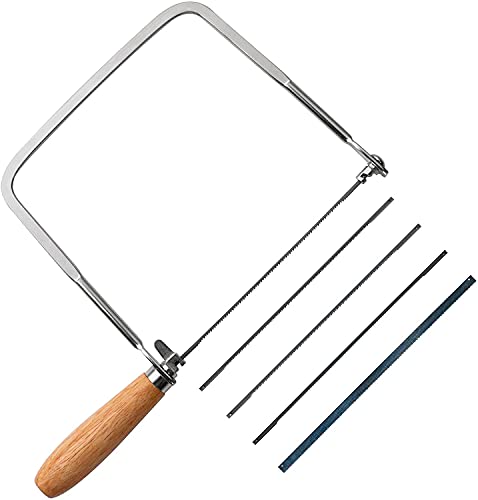
Kakuri builds this saw in Japan, and the set format is the appeal: the frame arrives with five replacement blades in assorted sizes, so a snapped or dulled blade does not end a project. The 6.3 inch frame depth is deeper than most standard coping saws, extending the reach across wide boards and larger molding profiles.
The wooden handle and light weight keep the saw easy to steer through interior cutouts, where the blade is threaded through a drilled starter hole and the frame works inside a cabinet or panel. The assorted blade sizes also handle small scroll and craft cuts a general-purpose blade would chew up. Tension is set at the handle, and the frame accepts standard pin-end blades once the included set runs out.
Specs:
– Frame depth: 6.3 inches
– Handle: wood
– Blades included: 5 assorted replacement blades
– Overall length: 11.8 inches
– Weight: about 7.4 ounces
– Origin: made in Japan
IVY Classic 11110 6-1/2 Inch Coping Saw
IVY Classic 11110 6-1/2 Inch Coping Saw
Best for: first-time buyers, craft and hobby work, and mixed materials including plastic and light metal.
The IVY Classic 11110 is a kit rather than a bare saw. Alongside the hardwood-handled frame it bundles five assorted blades: fine blades for veneers and thin wood, a medium blade for hardwood, a coarse blade for fast work in softwood, and a hacksaw-style blade for light metal. That spread suits a homeowner unsure which blade a project needs.
The hardwood handle doubles as the tensioning control, turning to draw the blade tight, and the blade rotates to any angle for intricate shapes. The cutting depth is 4-3/4 inches, the shallowest here, so keep this frame for trim, craft stock, and sheet goods near an edge rather than deep cuts into wide boards. For mixed household work, from PVC trim to thin aluminum angle, the blade assortment covers the common cases.
Specs:
– Blade length: 6-1/2 inches, pin-end
– Cutting depth: 4-3/4 inches
– Handle: hardwood, turn to tension
– Blades included: 5 assorted, including a hacksaw blade for metal
– Blade rotation: turns to any angle
How to choose
Start with throat depth, because it sets the largest work the saw can handle. Depth is the distance from the blade to the back of the frame, and it limits how far from an edge a cut can start. Around 4-3/4 to 5-1/2 inches covers baseboard, casing, and most furniture parts. For wide crown molding or curves in the middle of boards, a deeper frame near 6-1/4 inches, like the Kakuri set, keeps the frame from fouling the work.
Next, consider frame tension and blade twist. A blade that rings with a clear, high note when plucked is tensioned well enough to track straight; a dull thud means wander and snapped blades ahead. Most coping saws tension by twisting the handle, and better frames hold that tension without creeping loose. The blade holders should also rotate, so the blade can be twisted to an angle and the frame can swing clear while the teeth follow the line. Flat-bar frames, like the IRWIN, resist flex under high tension; round-wire frames are lighter but give up stiffness on demanding cuts.
Blades are the third decision. Nearly every saw here uses standard 6-1/2 inch pin-end blades, sold cheaply in multi-packs, so confirm pin-end compatibility and move on to tooth count. Finer blades around 18 to 24 TPI leave smooth edges in hardwood, veneer, and plastic but cut slowly. A 14 to 17 TPI blade is the trim carpentry standard. Coarser blades near 10 TPI clear softwood waste quickly, and a hacksaw-style blade handles thin metal. Spare blades included with the saw, or a mixed pack added to the order, avoids a stalled project when a blade snaps.
Technique matters as much as the tool. Fit the blade with its teeth pointing toward the handle to cut on the pull stroke, as most trim carpenters do, or away from the handle for a push cut, and work on the stroke the blade is set for. Always clamp the work to a bench or sawhorse; never hold trim in your hand against the cut, because a blade that jumps the kerf has nowhere safe to go. Start with a few short, gentle pulls to establish the kerf, then lengthen the stroke and let the blade do the work; forcing the saw sideways is what kinks and snaps blades. Wear eye protection, and slacken the tension before storing the saw so the frame keeps its spring.
Who should skip
Skip a coping saw if your work is mostly long, straight cuts in lumber or sheet goods; a circular saw, table saw, or full-size hand saw will be faster and straighter. If you cut curves in thick hardwood all day, a bandsaw or a quality jigsaw will outpace any hand frame, and for metal bar or tube, a hacksaw is the correct tool. A coping saw earns its drawer space only when trim, molding, or fitted woodwork is on the project list.
FAQ
Which blade TPI is best for coping baseboard and crown molding?
A blade in the 14 to 18 TPI range is the practical choice for trim. It is fine enough to leave a clean edge on the painted face of the molding, yet coarse enough to clear waste quickly on the back cut. Go finer, toward 20 TPI or more, for hardwood trim and veneer.
Should the teeth point toward or away from the handle?
Either setup works, and the saw cuts on the stroke the teeth are angled for. Most trim carpenters mount the blade with teeth toward the handle and cut on the pull stroke, which gives fine control at the start of a coped profile. If you learned on a push stroke, mount the teeth away from the handle instead.
How deep a cut can a coping saw make?
Reach is set by throat depth, the gap between the blade and the frame’s back bar. Common frames run from about 4-3/4 inches to roughly 6-1/4 inches, and a cut can start no farther from the edge than that depth allows. For deeper cuts, drill a starter hole, thread the blade through, and work from inside the opening.
Why do coping saw blades snap, and how can it be avoided?
Blades usually snap from side force: twisting the frame while the blade is deep in a kerf, forcing the stroke, or running too little tension. Clamp the work, keep the blade pluck-tight, use relief cuts before tight curves so the blade never has to turn in a slot narrower than itself, and ease off when the cut starts to bind.
Final verdict
For one saw that handles most trim and molding work, choose the IRWIN Tools ProTouch for its rigid flat-bar frame, comfortable handle, and fine stock blade. Pick the Bahco 301 for a traditional beechwood feel, the Kakuri set when depth and included spares matter, the Eclipse 70-CP1R for a classic all-steel workshop saw, and the IVY Classic kit when one purchase must cover wood, plastic, and light metal. Whichever frame you choose, add a mixed pack of pin-end blades and clamp the work every time.
M
Miller the Driller Editorial Team
We compare specs, warranty terms, long-term owner feedback and street pricing before anything earns a spot. Rankings are never paid.
Affiliate disclosure. As an Amazon Associate we earn from qualifying purchases at no extra cost to you. Prices accurate as of the date shown.
Three wireless routers for small offices compared on device capacity, network separation, wired speed, and coverage, with specs taken from their Amazon listings.
Compare 5 mechanic tool sets for car repairs: a 247-piece DEWALT kit, a 450-piece CRAFTSMAN set, a drawer-box GEARWRENCH set, a 170-piece Crescent set and a 450-piece WORKPRO set.
Four splitting axes and mauls that actually split firewood: a long 36-inch axe for tall users, a shorter 28-inch option, and two 8 lb mauls for knotty rounds.
Learn whether a 20V rechargeable drill battery can be repaired, which faults you can check safely at home, and when replacing the pack is the safer choice.
A specs-based review of the officially licensed Retro-Bit Sega Saturn 2.4 GHz wireless controller: dual receivers, Genesis Mini and Switch support, battery, layout, limits, and FAQs.
Find the best drill battery for Power Wheels ride-on toys for families, with DeWalt, Milwaukee and Ryobi adapters, voltage and safety guidance in this guide.
Find the best hole saw for noching dom pipe: bi-metal saws, deep cups, and the right sizes for clean, tight notches in DOM tube for fabrication shops today.
Find the best diy tile saws for home tiling projects. Compare wet tile saws by blade size, cutting capacity, and features for ceramic and porcelain tile.


 Kakuri Coping Saw Set
 IVY Classic 11110 6-1/2 Inch Coping Saw









