We research everything we recommend. When you buy through our links, we may earn a commission. As an Amazon Associate we earn from qualifying purchases.
Best Fence Tools for Building and Repairing Wire Fences
Compare the best fence tools for wire fence work: fencing pliers, a post puller, a come-along and a wire stretcher for building and repairing fences.
Wire fence work punishes general-purpose tools. Staples need a claw that fits them exactly, barbed wire needs cutters that bite without twisting, and a leaning T-post needs steady vertical pull rather than a pry bar and guesswork. Fencing pliers combine several of those jobs in one head, which is why they have barely changed in a century, but pliers alone cannot tension a long run or pull a post out of packed ground.
The five tools below cover the whole job cycle: two fencing pliers for the everyday cut, grip, hammer and staple work, a dedicated post puller for removals, a come-along for controlled tensioning, and a compact stretcher for solo repairs far from the truck. Together they form a kit that builds new fence and fixes old fence without improvising.
As an Amazon Associate, we earn from qualifying purchases.
Start with fencing pliers: the IRWIN VISE-GRIP 2078901 is the proven all-rounder, and the Bates 10.8-inch pliers are a lighter alternative. Add the Hi-Lift Post-Popper for pulling T-posts, the Maasdam Pow’R Pull 144SB-6 come-along for tensioning long runs, and the Saddlebag Solutions stretcher for portable solo repairs.
How to Choose
Start with the pliers head. A fencing plier earns its place by combining a staple puller claw, a hammer face, wire gripping jaws and two cutters in one tool. Check that the claw geometry suits the staples you drive and that the cutters are rated for the wire you run, because barbed and high-tensile wire are far harder on edges than smooth wire.
Match the pulling tool to the task. Post pullers use a lever and a jaw or chain to lift posts straight up, which saves the post for reuse and leaves a cleaner hole. Come-alongs tension wire between an anchor and the run, and their cable length and lift figures tell you how much slack you can take up in one setup. Stretchers and splicers clamp both ends of a break and draw them together so your hands stay free to tie the splice.
Weight matters on a fence line. Repairs happen hundreds of yards from the truck, so a tool that rides on your belt or in a small bag gets used, while a heavy one gets left behind. Compare overall length and weight honestly against how far you walk your fences.
Steel and pivot quality. Fencing pliers live outdoors and get dropped in dirt. Nickel chromium and high-carbon steels resist the bending loads of staple pulling, and machined jaws grip wire without the slip that mangles a splice.
IRWIN VISE-GRIP Fencing Pliers, 10-1/4 Inch (2078901)
Top Pick
IRWIN VISE-GRIP Fencing Pliers, 10-1/4 Inch (2078901)
The IRWIN 2078901 is the reference fencing plier that most others are measured against. Its head combines a staple starter and puller, a hammer face for driving staples, gripping jaws for stretching and splicing, and cutters positioned for both the wire you are holding and wire already on the line. At 10-1/4 inches it has the leverage to pull driven staples without a second tool.
IRWIN makes the tool from nickel chromium steel with machined jaws, and the ProTouch grips stay comfortable and secure when your hands are cold or gloved. It is the plier that shows up in truck boxes and barn tool rolls everywhere because it covers the four jobs you repeat all day: pull a staple, cut a strand, grip and twist a splice, drive the staple home. If you buy one fencing plier, this is the safest choice.
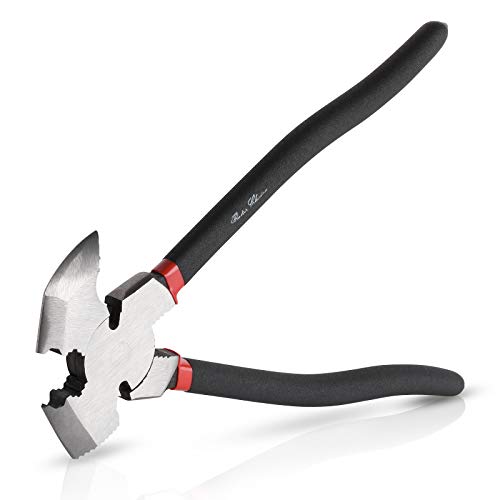
The Bates fencing pliers follow the same classic pattern in a slightly longer 10.8-inch frame. The head packs a staple claw, hammer face and wire cutters into one forging, and the extra length over standard pliers adds leverage when you are pulling staples out of hardwood posts or twisting stiff barbed wire into a splice.
At about 1.48 pounds it is a noticeable carry on a long fence walk, so it suits riders and drivers who keep tools on a vehicle or ATV as much as walkers. The cutting width is listed at 0.22 inches, sized for common fencing wire gauges. For buyers who want the traditional fencing plier layout at a working weight that favors leverage over portability, the Bates is a solid second option alongside the IRWIN, and many crews keep one of each so two people can work a repair from both sides.
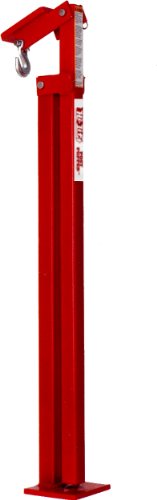
Pulling T-posts by hand or with a chain and tractor bucket bends posts and tears up the ground. The Post-Popper solves it with leverage: its jaw closes around a T-post and the lever frame lifts the post straight out of the soil, so the post comes out clean and reusable. For wooden posts, round posts or small stumps, you wrap a chain around the post and hook it to the puller instead.
Hi-Lift builds the frame from 1-1/2 inch square steel tubing, and the tool stands 39 inches high while weighing about 21 pounds, light enough to carry down a fence line and move from post to post. The straight vertical pull is the whole point: posts that come out straight can go straight back into a new line, and the hole left behind is small and easy to fill. For anyone resetting a fence line, this tool pays for itself in saved posts.
A come-along is the tensioning heart of fence building, and the Maasdam 144SB-6 is the classic American-made cable puller. It is rated at 2-ton capacity with 12 feet of 3/16-inch cable, giving 6 feet of lift or pull in a single setup, which is plenty to draw a long run of wire up to tension before you staple it off. The 30:1 leverage ratio keeps handle effort manageable as the wire comes tight.
Maasdam builds the puller with a one-piece aluminum alloy ratchet wheel and high-strength electro-plated steel parts, and the notch-at-a-time release lets you ease tension off gradually instead of letting a tight strand jump. At about 8.75 pounds it is heavy enough to feel substantial and light enough to haul to the work. For stretching new fence, pulling a sagging line back up, or dragging a fallen limb off a run, this is the tool crews reach for.
Not every repair justifies hauling a come-along down the line. The Backcountry Fence Stretcher from Saddlebag Solutions is a compact retractable stretcher with 10 feet of reach that weighs under 5 pounds, built to ride in a saddlebag, ATV box or day pack so it is actually with you when you find a broken strand or a wire loosened by stock.
It works with a wide range of wire types, clamping on and drawing the slack out so you can splice or re-tension a section working alone. The retractable design keeps the strap or cable tidy instead of tangling around everything else in the bag. It will not replace a come-along for building long new runs, and it is not meant to. Its job is the fast, far-from-home repair that keeps a fence stock-tight until you can come back with the full kit.
Specs
Item
Detail
Reach
10 feet, retractable
Weight
Under 5 pounds
Wire fit
Universal wire compatibility
Style
Compact portable stretcher
Best for
Solo repairs away from the truck
Brand
Saddlebag Solutions
Who Should Skip It
If your fencing is chain link, vinyl or wood privacy panels, most of this kit misses the point: those jobs need post-hole diggers, tension bars and panel hardware instead. Electric fence users with mostly polywire and step-in posts can also skip the heavy pulling gear, since that wire is tensioned by hand. And if you only mend a strand or two a year around a garden, fencing pliers alone will cover it; the pullers and come-along earn their space when you maintain long runs or reset whole lines.
FAQ
What do fencing pliers do that regular pliers cannot?
Fencing pliers combine a staple-pulling claw shaped for fence staples, a hammer face for driving them, gripping jaws for stretching and splicing wire, and cutters placed for wire held in the jaws or already on the line. Regular pliers lack the claw and hammer face, which are the two features fence work uses constantly.
Can a post puller remove wooden posts as well as T-posts?
Yes, with a different attachment. The Hi-Lift Post-Popper grips T-posts directly with its jaw, while wooden posts, round posts and small stumps are wrapped with a chain or cable that hooks to the puller frame. The lever then lifts them straight up in the same way.
How much tensioning capacity do I need in a come-along?
For most farm and ranch wire work, a 2-ton puller like the Maasdam 144SB-6 is the standard choice. What matters day to day is the cable length and lift: 12 feet of cable with 6 feet of pull lets you take up the slack in a typical run without resetting the anchor point.
Do I need both a come-along and a fence stretcher?
They do different jobs. A come-along pulls a wire toward an anchor over a long distance and holds serious tension. A compact stretcher clamps near a break or loose section and draws a short span tight for splicing. Crews building fence lean on the come-along; riders making quick repairs lean on the stretcher.
Final Verdict
Build the kit around fencing pliers: the IRWIN 2078901 for its proven head design and durable build, or the Bates for extra length and leverage. The Hi-Lift Post-Popper turns post removal from the worst job on the line into a quick lever pull, the Maasdam 144SB-6 handles tensioning with controlled, notch-at-a-time release, and the Saddlebag Solutions stretcher covers the repairs that happen far from the truck. With those five, there is very little wire fence work you cannot handle.
M
Miller the Driller Editorial Team
We compare specs, warranty terms, long-term owner feedback and street pricing before anything earns a spot. Rankings are never paid.
Affiliate disclosure. As an Amazon Associate we earn from qualifying purchases at no extra cost to you. Prices accurate as of the date shown.
Three wireless routers for small offices compared on device capacity, network separation, wired speed, and coverage, with specs taken from their Amazon listings.
Compare 5 mechanic tool sets for car repairs: a 247-piece DEWALT kit, a 450-piece CRAFTSMAN set, a drawer-box GEARWRENCH set, a 170-piece Crescent set and a 450-piece WORKPRO set.
Four splitting axes and mauls that actually split firewood: a long 36-inch axe for tall users, a shorter 28-inch option, and two 8 lb mauls for knotty rounds.
Learn whether a 20V rechargeable drill battery can be repaired, which faults you can check safely at home, and when replacing the pack is the safer choice.
A specs-based review of the officially licensed Retro-Bit Sega Saturn 2.4 GHz wireless controller: dual receivers, Genesis Mini and Switch support, battery, layout, limits, and FAQs.
Find the best drill battery for Power Wheels ride-on toys for families, with DeWalt, Milwaukee and Ryobi adapters, voltage and safety guidance in this guide.
Find the best hole saw for noching dom pipe: bi-metal saws, deep cups, and the right sizes for clean, tight notches in DOM tube for fabrication shops today.
Find the best diy tile saws for home tiling projects. Compare wet tile saws by blade size, cutting capacity, and features for ceramic and porcelain tile.

 IRWIN VISE-GRIP Fencing Pliers, 10-1/4 Inch (2078901)
 Bates Fencing Pliers, 10.8 Inch
 Hi-Lift Post-Popper Post Puller (PP-300)
 Maasdam Pow’R Pull 144SB-6 Come-Along
 Saddlebag Solutions Backcountry Fence Stretcher









