What's inside
As an Amazon Associate I earn from qualifying purchases. This post may contain affiliate links at no extra cost to you.
Installing concrete sleeve anchors is a straightforward job when the hole is straight, correctly sized and free of dust. The drill matters, but so do the carbide bit, the anchor’s instructions and the concrete itself. For occasional work, a compact cordless hammer drill is usually enough; repeated drilling into hard concrete calls for more battery capacity and a sturdier tool.
As an Amazon Associate we earn from qualifying purchases at no extra cost to you.



What we cover
What the job demands
A sleeve anchor needs a hole matching its specified diameter and minimum depth. For example, an anchor requiring a 1/2-inch hole must be drilled with a 1/2-inch masonry bit—not a bit chosen to match the anchor’s outside diameter by guesswork. Check the package for hole depth, embedment and tightening instructions. Drilling a little deeper than the required embedment leaves room for dust, but don’t exceed the bit’s safe working length or the anchor maker’s directions.
A hammer drill combines rotation with rapid impacts to help a carbide masonry bit cut concrete. Use hammer mode for concrete, steady forward pressure and a sharp bit. Let the tool work; leaning heavily on it can overheat the bit, stall the drill or produce a crooked hole. Keep the bit square to the surface, and pause to clear dust from deep holes. Dust left in the bore can stop the anchor seating fully and reduce its holding performance.
Which cordless drill to buy
For a few anchors in sound concrete, a standard 18V or 20V-class cordless hammer drill is the practical choice. It costs less and is easier to control than a rotary hammer. Look for a two-speed gearbox, a side handle, variable-speed trigger and a clutch for ordinary screwdriving jobs. The clutch is not a substitute for following the anchor’s specified final tightening method.
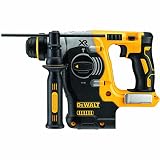
If you expect to drill many holes, work in harder concrete, or regularly use bits larger than about 1/2 inch, consider a cordless rotary hammer with an SDS-Plus chuck. Its hammering mechanism is more efficient for sustained masonry drilling, and SDS-Plus bits are quick to change. The trade-offs are higher cost, greater weight and less usefulness as a general-purpose drill for small fasteners. For a handful of small sleeve anchors, that extra capacity is often unnecessary.
Hammer drill or rotary hammer?
| Tool | Best fit | Trade-off |
|---|---|---|
| Cordless hammer drill | Occasional anchors; holes around 1/4 to 1/2 inch in ordinary concrete | Slower and more tiring when drilling many holes or larger diameters |
| Cordless SDS-Plus rotary hammer | Repeated concrete drilling, tougher material, or larger holes | Costs more and is bulkier; SDS bits need the matching chuck |
| Corded hammer drill | Infrequent work where a suitable corded tool is already on hand | Needs an outlet and extension cord; less convenient on ladders or outdoors |
Choose a cordless hammer drill if you want one tool for occasional anchor holes and general drilling. If concrete work is frequent, compare it with a cordless SDS-Plus rotary hammer. Battery platform compatibility can matter more than small differences in advertised torque if you already own batteries and a charger.
Bits, batteries and useful features
Buy a sharp carbide-tipped masonry bit in the exact diameter specified for the anchor. A worn or low-quality bit cuts slowly, wanders and can leave an oversized or ragged hole. A hammer drill uses round-shank bits held in its chuck; an SDS-Plus rotary hammer uses SDS-Plus bits. These systems are not interchangeable without the correct chuck or adapter, and an adapter can add wobble.
For a few holes, a compact battery may be adequate. For a row of anchors, a higher-capacity pack reduces interruptions, though it adds weight. If you’re drilling overhead or from a ladder, that weight can be a real drawback. A side handle is valuable for controlling a bind, especially with a larger bit. Avoid judging a drill by torque figures alone: concrete drilling depends heavily on hammer action, bit quality and how the tool manages heat.
Drilling and setting sleeve anchors
Check for hidden wiring, plumbing and reinforcing steel before drilling. Mark the hole location, hold the drill perpendicular, and start slowly enough to keep the bit from skating. Once it has established a straight start, use hammer mode and moderate pressure. If progress suddenly slows, stop rather than forcing the drill; the bit may be dull, the hole may contain debris, or it may have reached rebar. Don’t drill through reinforcing steel without confirming that it’s safe to do so.
Drill to the specified depth, then clear the bore with a vacuum or the cleaning method required by the anchor instructions. Wear eye protection and suitable respiratory protection: concrete dust contains respirable silica. Keep bystanders clear and follow local requirements for dust control. Insert the sleeve anchor through the fixture and into the hole as directed, then tighten with the specified wrench or tool. Over-tightening can damage the anchor or substrate; a spinning anchor may indicate an oversized hole, poor concrete or incorrect installation.
When a cheaper tool is enough
If you’re installing only a few small anchors in a garage slab or block wall, a basic hammer drill and a fresh masonry bit are usually a sensible, lower-cost setup. There is little value in buying a heavy rotary hammer for one short project. But if the bit repeatedly stalls, the drill gets hot, or each hole takes several minutes, stop and reassess: a sharper bit, dust removal, a charged battery or a rotary hammer may be the safer and faster fix. For regular concrete work, a quality SDS-Plus masonry bit set is a useful match for a rotary hammer; for a standard hammer drill, buy the correct round-shank bit instead.