What's inside
As an Amazon Associate I earn from qualifying purchases. This post may contain affiliate links at no extra cost to you.
What we cover
Best Drill Bit Sets for Drilling Metal with Reduced Burrs
The drill bit set that leaves the cleanest hole is not always the most expensive one. Burrs depend on the bit’s cutting edge, the metal being drilled, the drill’s speed, and whether you use enough pressure and cutting fluid. A good set helps, but technique still determines whether the exit side is clean or torn.
For general metalwork, look for a set of high-speed steel (HSS) bits with a 135-degree split point. For frequent drilling in stainless steel or hard steel, cobalt HSS is usually worth the additional cost. Titanium-coated sets can be useful for ordinary mild steel, but the coating does not make a basic bit perform like cobalt.
As an Amazon Associate we earn from qualifying purchases at no extra cost to you.

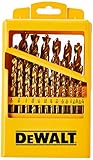
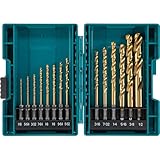
Quick comparison of metal drill bit sets
| Bit type | Best use | Burr performance | Main trade-off |
|---|---|---|---|
| Black oxide HSS | Mild steel, aluminum, sheet metal, occasional work | Good when sharp and properly supported | Edges dull faster in stainless and thick steel |
| Titanium-coated HSS | Repeated drilling in mild steel and general shop work | Good at first; declines as the coating wears | Usually should not be aggressively resharpened |
| Cobalt HSS | Stainless steel, harder steel, frequent use | Very good with low speed and cutting fluid | More brittle and considerably more expensive |
| Step drill bits | Thin sheet metal and enlarging existing holes | Often leaves a cleaner edge in thin stock | Not suitable for deep holes or thick plate |
Best general-purpose choice: black oxide HSS
A black oxide HSS set is the sensible starting point for most cordless-drill owners. It covers common sizes from roughly 1/16 to 1/2 inch and handles mild steel angle, brackets, hardware, aluminum, and thin-wall tubing. A split point helps the bit start without wandering, which reduces the oversized, ragged entry hole often caused by a conventional point.
Choose a set with clearly marked sizes and a rigid case. Loose bits in a soft pouch are easy to misplace and more likely to get damaged. For occasional repairs, a black oxide HSS metal drill bit set is usually a better value than premium bits you rarely use.
These bits are not the best option for repeated stainless-steel work. Stainless work-hardens if the bit rubs instead of cutting. Once that happens, even a new-looking bit may squeal, heat up, and produce a larger burr.
Best for stainless steel: cobalt HSS
Cobalt HSS bits, commonly sold in M35 or M42 grades, hold their hardness at higher temperatures than ordinary HSS. They are the safer purchase for stainless steel, hardened brackets, and frequent drilling in thicker steel. M42 generally contains more cobalt and can offer better heat resistance, but the exact quality still depends on the manufacturer and grinding.
A cobalt HSS drill bit set costs more and is more brittle. Do not use it as a pry bar, and avoid bending the bit in a cordless drill. For clean holes, run a 1/4-inch cobalt bit at approximately 600 to 900 rpm in mild steel, and slower in stainless. Use firm pressure so it cuts a continuous chip rather than polishing the surface.
Do not assume “titanium” means better than cobalt. Titanium nitride is a surface coating. It can reduce friction and improve wear resistance, but once the coating is removed at the cutting edge, the underlying HSS determines performance.
Best for thin sheet metal: step bits
Step bits are particularly effective in sheet metal, electrical boxes, ductwork, and automotive panels. Each step supports the cutting edge and enlarges the hole gradually, which can leave less tearing than forcing a twist bit through thin material. A single step bit may cover several sizes, reducing the number of bits needed for a project.
Buy a titanium-coated step drill bit set if you regularly make larger holes in thin stock. Step bits are not a replacement for twist bits: their cutting depth is limited, and they are inefficient in material thicker than about 1/8 inch. They also become expensive to replace if used on abrasive steel or allowed to overheat.
How to reduce burrs while drilling
Clamp the work securely and back thin material with a scrap of plywood or hardwood. That backing supports the exit side and prevents the sheet from flexing upward as the bit breaks through. On thicker stock, mark the location with a center punch. A small pilot hole, usually 1/8 inch, can make larger bits start more accurately, although many split-point bits can start without one.
Use cutting oil on steel and stainless steel. A few drops are enough; flooding the bit is unnecessary. Aluminum usually cuts well dry, though a light lubricant can prevent aluminum from sticking to the flutes. Do not use cutting oil where it could contaminate a surface that will later be painted or bonded without cleaning it first.
Use the slowest practical speed that still produces a steady chip. A common failure mode is running a bit at maximum cordless-drill speed with light pressure. The bit gets hot, the edge softens, and the hole exits with a sharp burr. If the bit squeals, smokes, or produces powder instead of chips, stop and reduce speed or increase pressure.
For the cleanest result, drill almost through the work, then reduce pressure as the tip approaches the back surface. A backing board is still preferable. After drilling, remove the remaining burr with a countersink, deburring tool, or a larger twist bit turned by hand. A light chamfer of about 1/32 to 1/16 inch is usually enough.
What to buy for your drill
For occasional household metal drilling, choose a 15- to 29-piece black oxide HSS set with split points. For stainless steel, buy a smaller, better cobalt set rather than a large assortment of mediocre bits. For sheet metal, add one step bit covering the hole sizes you use most.
A cordless drill with a variable-speed trigger is adequate for most jobs. Use a drill’s clutch only for driving, not drilling; set it to the drill symbol so it does not slip under pressure. An impact driver can accept hex-shank bits, but its hammering action is unnecessary for ordinary metal drilling and can damage delicate bits. If you already own one, use an appropriate hex-shank metal drill bit set for light-gauge sheet metal and small holes, not heavy stainless or thick plate.
Replace a bit when its cutting edges are visibly rounded, discolored blue, or require excessive force. A sharp inexpensive bit used at the right speed will usually leave a cleaner hole than a premium bit that has been overheated.