What's inside
As an Amazon Associate I earn from qualifying purchases. This post may contain affiliate links at no extra cost to you.
Plastic parts are easy to damage with the wrong bit. A standard twist bit can grab as it breaks through, leaving a ragged exit hole or splitting a thin panel. For clean, accurately placed holes, bit geometry matters more than buying the biggest set. Choose for the plastic you work with, the hole sizes you need, and whether the material is thin sheet or a thick molded part.
As an Amazon Associate we earn from qualifying purchases at no extra cost to you.


What we cover
Choose the right bit for the plastic
For general-purpose work, a sharp high-speed-steel (HSS) twist bit is a sensible starting point. It is inexpensive, widely available, and works well in acrylic, ABS, polyethylene, and many other plastics when used at a controlled speed. A set with common sizes from about 1/16 to 1/2 inch covers many repair and fabrication jobs. Check that the set includes the sizes you actually use; a large count of redundant sizes is not a benefit.
For thin sheet, a brad-point bit can help keep the hole centered, especially when the surface is smooth. Its center spur locates the bit, while the outer cutting edges score the hole perimeter. It can leave a clean edge, but the spur may push through thin material abruptly, so back the sheet with scrap and use light feed pressure. Brad-point bits are a poor choice for some thick or tough plastics if their outer spurs are not sharp enough to cut rather than scrape.
For larger holes in sheet, a step bit is often easier to control than a large twist bit. It enlarges the hole in stages and is less likely to catch suddenly. The trade-off is that it is intended for relatively thin material; it will not make a straight-sided hole through a thick block. A HSS brad-point bit set suits small, positioned holes in sheet, while a step bit is more useful for panel openings.
Compare the main bit types
| Bit type | Best use in plastic | Main trade-off |
|---|---|---|
| HSS twist bit | General holes in thin or moderately thick parts | Can wander or grab at breakthrough |
| Brad-point bit | Accurate small holes in supported sheet | Center spur can push through suddenly |
| Step bit | Enlarging holes in thin panels | Not suited to thick stock |
| Plastic-specific bit | Repeated work where edge quality matters | Costs more; less necessary for occasional holes |
What to buy for precision work
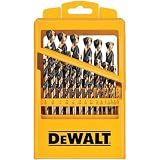
For occasional holes in household plastic, a basic HSS set is usually enough. Buy from a maker that publishes the sizes and supplies a usable case, then replace bits that are dull, chipped, or visibly overheated. A standard HSS twist-bit set is the cheaper, more versatile choice if you also drill wood or metal. Its limitation is control: you will need to mark, support, and feed carefully to prevent wandering and breakout.
If you regularly drill acrylic, polycarbonate, or finished plastic panels, look for bits sold specifically for plastic or acrylic. These often use a sharper, less aggressive cutting profile intended to reduce grabbing and cracking. They are not magic: poor support, a dull edge, excessive pressure, or a stressed part can still cause damage. A plastic and acrylic drill-bit set costs more than a general HSS set, so it makes most sense for repeated jobs or parts where a damaged hole is expensive.
Before buying, compare the usable diameter range, not just the number of pieces. A set that jumps from 1/8 to 1/4 inch may leave out a size you need for screws or cable pass-throughs. For fasteners, drill a test hole in scrap and check the fit: a clearance hole should let the screw pass without forcing, while a pilot hole should be sized for the screw and material. Do not assume a bit’s stated diameter guarantees a perfect fit in a flexible plastic part.
How to drill cleaner holes
Mark the center with a fine marker or a small piece of masking tape; a deep center-punch mark can start a crack in brittle acrylic. Clamp the part between flat scrap boards when possible. The backing supports the exit face and helps prevent a breakout crater. Keep clamps away from the drilling point, and do not crush hollow or thin-walled parts.
Use a cordless drill in low gear or a moderate trigger speed. A useful starting range for small bits is roughly 500–1,000 rpm in plastic; larger bits should run slower. These are starting points, not fixed rules, since plastic type, bit sharpness, and thickness all affect heat. Use steady, light pressure. If the hole edge starts to melt, the bit is rubbing or running too hot: stop, let the part cool, clear chips, and reduce speed. Melted chips can weld back onto the bit and spoil the edge.
As the bit approaches the far side, ease off pressure. On thin sheet, stop once the point breaks through, then finish gently from the other side if access allows. For a hole larger than about 1/4 inch in thin panel stock, step up gradually or use a step bit rather than forcing a large twist bit through in one pass. Deburr the edge with a countersink turned by hand or a sharp scraper; a powered countersink can remove material too quickly.
Avoid common mistakes
Do not use hammer mode on plastic. The impact can crack brittle parts and makes the bit harder to control. An impact driver is also a poor choice for precision holes: its pulsing torque encourages grabbing and is designed for driving fasteners, not controlled drilling. Use a drill with the clutch or hammer function off.
Finally, match the method to the part. A cheap twist-bit set is fine for a few holes in a sturdy ABS enclosure. Thin acrylic, visible panel work, or a costly molded component deserves better support, a sharp bit, and a test on scrap. If the plastic flexes, cracks, or melts despite careful drilling, change the setup before changing to a more expensive set.