What's inside
As an Amazon Associate I earn from qualifying purchases. This post may contain affiliate links at no extra cost to you.
A small utility shelf can look light and still put real leverage on its fasteners. A 12-inch-deep shelf holding detergent or tools pulls outward on its upper fasteners, especially if someone bumps it or loads the front edge. Choose anchors for the wall material and the shelf’s likely load—not just the shelf’s empty weight.
As an Amazon Associate we earn from qualifying purchases at no extra cost to you.


What we cover
Check the wall before buying anchors
Use a stud finder, then confirm likely stud locations with a small pilot hole or by locating an existing outlet’s side. If a bracket can land on a stud, drive a suitable wood screw into it; that is usually stronger and simpler than a drywall anchor. A screw should penetrate the stud by about 1 to 1½ inches, not just the drywall and its paper face.
If the brackets must go between studs, first make sure the wall is ordinary drywall rather than plaster, tile, or a hollow-core panel. A magnet can help find drywall screws and reveal stud edges. Also check for wiring or plumbing before drilling, particularly near outlets, switches, and sinks. Anchor ratings vary by drywall thickness, installation, and load direction; a package rating is not a promise that a shelf can safely hold that amount.
Which anchor suits a small shelf?
| Anchor type | Good fit | Trade-off |
|---|---|---|
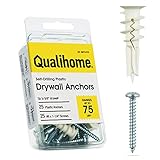
| Self-drilling plastic anchor | Very light items and small shelves with modest loads | Fast to install, but can spin, strip drywall, or pull out under leverage |
| Threaded metal drywall anchor | Light-to-medium loads when no stud is available | More bite than basic plastic; still depends on sound drywall |
| Toggle bolt or strap toggle | Heavier shelf loads spread across suitable brackets | Strong holding area, but needs a larger hole and clearance behind the wall |
| Wood screw into stud | Most shelves, especially those holding dense or shifting items | Requires bracket holes to line up with framing |
For a genuinely light shelf—such as one holding a few rolls of paper or small plastic containers—a correctly installed self-drilling drywall anchor can be the inexpensive, quick choice. These anchors screw into drywall without a pilot hole, but they are not forgiving of over-tightening. If the anchor spins before its flange seats, stop: the hole may already be damaged, and a second anchor placed nearby may not help.
For a shelf that may hold cans, cleaning products, or hand tools, use a sturdier fastener. A threaded metal drywall anchor is a reasonable middle ground where studs do not align with the brackets. For greater pull-out resistance, a strap toggle anchor spreads the load behind the drywall. It needs a hole sized for the toggle and enough empty space behind the wall to open.
Match the anchors to the shelf load
Estimate the total load: shelf, brackets, and everything stored on it. Then account for how far the load sits from the wall. A 10-pound load close to the wall is easier on the fasteners than the same load near the front edge of a deep shelf. Loads that shift, get pulled down, or are handled often also increase stress.
Use every mounting hole the shelf or bracket is designed for, and follow the anchor maker’s instructions for drywall thickness and screw size. Do not assume two anchors can simply be added together to get twice the capacity. A shelf bracket can concentrate force on its upper screw, and damaged or soft drywall can fail well below a listed rating. If the shelf will hold glass, heavy tools, or anything hazardous if it falls, attach the brackets to studs or add a properly secured support board across multiple studs.
Install without damaging the drywall
Mark the bracket holes level and check that the anchor locations will not land on a drywall seam or visibly damaged area. A drill makes the work quicker, but use a low speed and a clutch if the anchor is self-drilling. Do not use an impact driver to drive a plastic anchor into drywall: the sudden torque can strip the hole or break the anchor. For an anchor that needs a pilot hole, use the diameter stated on its package, not a larger bit chosen by guesswork.
Set the anchor flush without crushing the drywall paper. Then tighten the screw until the bracket is snug; forcing it further can loosen the anchor or deform the bracket. With a toggle, keep the strap or bolt straight during installation and confirm the toggle has opened behind the wall before tightening. If the fastener turns freely, the bracket moves, or the drywall starts to crumble, remove it and choose a new location or a larger anchor type. Do not keep tightening in the same damaged hole.
A practical buying choice
For the lowest-cost, light-duty setup, use self-drilling anchors only when the load is modest and the drywall is intact. For a utility shelf with everyday household supplies, look first for stud locations; if that is not possible, choose rated metal threaded anchors or toggles that match the bracket holes and wall thickness. A toggle is not automatically the best answer for every shelf: it costs more, requires a larger hole, and can be inconvenient if the shelf may be moved. But where the load is heavier or less predictable, that extra installation effort is often worthwhile.