We research everything we recommend. When you buy through our links, we may earn a commission. As an Amazon Associate we earn from qualifying purchases.
5 Best Hole Saws for Electrical Service (November 2026)
Compare hole saw kits built for electrical service, from compact conduit sizes to large enclosure cutouts, with bi-metal and carbide options.
As an Amazon Associate I earn from qualifying purchases. This post may contain affiliate links at no extra cost to you.
Choosing a hole saw for electrical service is really a decision about knockout sizes and sheet metal, not about drilling the biggest hole possible. Most service work repeats the same few openings: conduit entries into panels and boxes, holes through studs and top plates, and occasional larger cutouts for enclosures or recessed fittings. A kit earns its place when those repeated sizes are present, the teeth survive metal enclosures, and plugs come out without wasting time on every hole.
OUR TOP PICK
DEWALT Hole Saw Kit, Standard Electrician's Set, Bi-Metal (D180002)
This guide is for service electricians restocking a truck kit, maintenance crews who cut into panels and cabinets, and capable renovators adding circuits in wood framing and drywall. Every pick below was selected from its Amazon listing title and stated specifications, and each one is a hole saw kit rather than a set of twist drills or step bits.
As an Amazon Associate we earn from qualifying purchases
Product
Best for
Key spec from title
DEWALT Hole Saw Kit, Standard Electrician’s Set, Bi-Metal (D180002)
A compact electrician’s kit for everyday conduit work
Bi-Metal, Standard Electrician’s Set
LENOX Bi-Metal Speed Slot Hole Saw with T3 Technology, Electrician’s Kit (30800600L)
Fast plug removal on repeated box and panel holes
Speed Slot, Bi-Metal, 10-Piece
Klein Tools 31873 Heavy Duty Hole Cutter Kit, 8-Piece
Cutting stainless and mild steel sheet in panels
Carbide Hole Cutters, 8-Piece
Milwaukee 49-22-4185 All Purpose Professional Ice Hardened Hole Saw Kit, 28-Piece
One case covering conduit sizes and large cutouts
28-Piece, Hole Saw Kit
DEWALT Hole Saw Kit, 14-Piece (D180005)
Closer size steps between the standard conduit sizes
14-Piece, 2 Quick Change Mandrels
How to Choose
Match the Kit to Conduit Knockout Sizes First
Electrical service work revolves around a short list of diameters. The listings for the electrician’s kits in this guide centre on 7/8 inch, 1-1/8 inch, 1-3/8 inch, 1-3/4 inch, 2 inch and 2-1/2 inch saws, a sequence that lines up with common conduit and connector entries. Before comparing anything else, check that the sizes you reach for weekly are actually in the case. A kit missing the 1-3/8 inch saw forces a workaround on a routine job, while extra diameters you never use simply add weight to the truck.
Pick Bi-Metal or Carbide for the Material You Cut
Bi-metal saws are the general answer for wood framing, drywall, plastic and the mild steel of most enclosures, and four of the five kits here use bi-metal teeth. Carbide changes the calculation when the work is mostly sheet metal. The Klein Tools kit in this guide lists carbide cutters for stainless steel, mild steel, iron, copper and brass sheet up to 3/16 inch thick. If your service calls are panel-heavy, carbide suits that pattern. If you mostly open studs and ceilings, bi-metal covers the work without paying for a specialist cutter.
Check Cutting Depth Against Studs and Enclosures
A hole saw only helps if its cup is deep enough for the material in front of you. The DEWALT electrician’s kit lists a maximum cutting depth of 1-3/4 inch, which handles enclosure walls and single layers of framing comfortably, while shallow carbide cutters are built for sheet and stop at the flange by design. Think about where you drill most: through a panel wall, depth hardly matters, but through doubled top plates or thick blocking, a shallow cup leaves a second operation to finish the hole from the other side.
Look at Arbors, Pilot Bits and Plug Removal
The saw cup gets the attention, but the arbor system decides how the day feels. Quick-change mandrels, like the small and large mandrels listed with the DEWALT kits, speed up swaps when you alternate sizes on one job. Spare pilot bits matter because a bent pilot ruins accuracy for every saw in the case. Plug removal is the other hidden cost: the LENOX Speed Slot design uses staircase slots so a screwdriver can lever plugs out, which saves real time when you are cutting dozens of similar holes in a shift.
The 5 Best Options
DEWALT Hole Saw Kit, Standard Electrician’s Set, Bi-Metal (D180002)
Top Pick
DEWALT Hole Saw Kit, Standard Electrician’s Set, Bi-Metal (D180002)
Best for: Service electricians who want the standard conduit sizes in one compact case
This is the straightforward truck kit for electricians whose work stays inside the standard conduit sequence. Six bi-metal saws cover 7/8 inch through 2-1/2 inch, which matches the entries most service panels and boxes need, and the set keeps everything in one compact injection moulded case with a carrying handle. Two quick-change mandrels handle the small and large saws, and the included replacement parts, with extra Pilot Point centering bits, mean a worn pilot does not sideline the kit mid-job. It is a focused set rather than a sprawling one, and that focus suits daily service work.
LENOX Bi-Metal Speed Slot Hole Saw with T3 Technology, Electrician’s Kit (30800600L)
Runner-Up
LENOX Bi-Metal Speed Slot Hole Saw with T3 Technology, Electrician’s Kit (30800600L)
Best for: Electricians cutting many repeated holes who lose time clearing plugs from standard saws
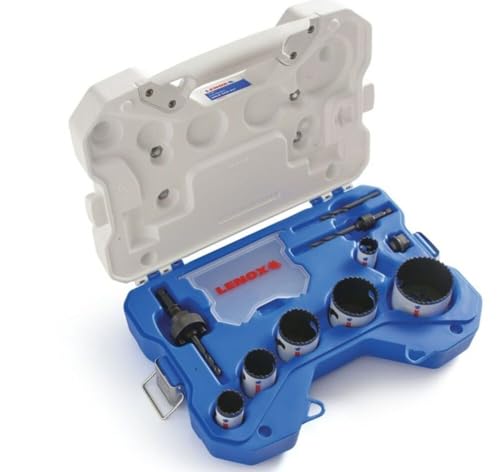
The LENOX electrician’s kit covers the same six core sizes as the DEWALT set, from 7/8 inch to 2-1/2 inch, but its distinguishing feature is the Speed Slot staircase design cut into the side of each saw. Those slots give a screwdriver several leverage points to work a plug free, which matters when you are cutting repeated holes in studs, plywood or enclosure steel and every stuck plug slows the run. The kit ships with 2L and 5L arbors, a pilot drill and an arbor adaptor, so it drops onto standard chucks without hunting for accessories before the first hole.
Klein Tools 31873 Heavy Duty Hole Cutter Kit, 8-Piece
Klein Tools 31873 Heavy Duty Hole Cutter Kit, 8-Piece
Best for: Panel and enclosure work in stainless and mild steel sheet
Klein built this kit for the metal side of electrical service. Its carbide hole cutters are listed for quick, precise holes in stainless steel, mild steel, iron, copper and brass sheet up to 3/16 inch thick, which is the material stack inside panels, cabinets and enclosures. Six cutters cover the conduit range from 7/8 inch to 2-1/2 inch, listed as conduit and pipe sizes from 1/2 inch to 2 inch. A split point pilot bit is included to reduce walking on flat sheet, and an integrated flange stops the cutter from drilling beyond the sheet metal, a useful guard on finished enclosures.
Milwaukee 49-22-4185 All Purpose Professional Ice Hardened Hole Saw Kit, 28-Piece
Milwaukee 49-22-4185 All Purpose Professional Ice Hardened Hole Saw Kit, 28-Piece
Best for: Service crews who need conduit sizes and large cutouts in a single case
Where the compact electrician’s kits stop at 2-1/2 inch, this Milwaukee case keeps going. Its listing covers hole saws from 3/4 inch up to 4-3/4 inch, so the same case that handles a 7/8 inch conduit entry also carries the larger diameters used for recessed fittings, bigger enclosures and vent or device openings. The current Hole Dozer version lists a 3.5 TPI tooth design and bi-metal construction, with arbors and pilot bits included in the 28-piece count. It is the one-kit answer for a service van that cannot predict whether the next call is a panel swap or a lighting layout.
DEWALT Hole Saw Kit, 14-Piece (D180005)
DEWALT Hole Saw Kit, 14-Piece (D180005)
Best for: Remodel and service work where fittings land between standard conduit sizes
This DEWALT master kit fills the gaps that the standard electrician’s sequence leaves out. Alongside the usual conduit sizes it adds 3/4 inch, 1 inch, 1-1/2 inch, 2-1/8 inch and 2-1/4 inch saws, giving eleven bi-metal saws between 3/4 inch and 2-1/2 inch. Those in-between diameters help when a fitting, grommet or device opening lands between the standard knockout steps. Two quick-change mandrels and a replacement parts set are included, and the whole set packs into a compact injection moulded case. It suits remodel and service work where openings vary more than they do in new panel installations.
Which One Fits Your Situation
Daily Service Calls on Panels and Boxes
Choose the DEWALT D180002 electrician’s set. Its six saws match the conduit entries that dominate service work, the case is compact enough to live on the truck, and the spare pilot bits keep it running when a bit wears or bends. The LENOX 30800600L is the close alternative if plug removal is your main frustration, since its Speed Slot sides are built for exactly that repeated-hole pattern.
Mostly Stainless or Steel Enclosures
Choose the Klein Tools 31873 kit. Its carbide cutters are listed specifically for stainless steel, mild steel, iron, copper and brass sheet up to 3/16 inch thick, and the integrated flange guards against punching through finished enclosures. The split point pilot helps the cutter start where you marked it instead of wandering across a panel door, which is where bi-metal kits feel least controlled.
Rough-In and Lighting Work With Bigger Openings
Choose the Milwaukee 49-22-4185 kit. It is the only set here that runs past 2-1/2 inch, reaching 4-3/4 inch, so recessed fittings, larger enclosures and mixed rough-in openings stay inside one case. You give up the compact footprint of the electrician’s kits, but you stop carrying a second case of large individual saws for the days when a layout changes on site.
Remodels Where Sizes Rarely Repeat
Choose the DEWALT D180005 master kit. Its eleven saws add the in-between diameters that remodel work keeps producing, from 3/4 inch up to 2-1/2 inch in closer steps than the electrician’s sets. When an old box, an odd fitting or a previous installer’s opening does not match the standard sequence, having the intermediate size in the case avoids enlarging a hole by hand.
Common Mistakes
Buying a general hole saw set without checking for the 7/8 inch to 2-1/2 inch conduit sequence, then discovering the size a panel needs is missing.
Running bi-metal saws at full drill speed in steel enclosures, which overheats the teeth and shortens the life of every saw in the kit.
Using a shallow sheet-metal carbide cutter on thick framing timber, where its listed depth and flange are designed for sheet only.
Forgetting spare pilot bits, so one bent pilot makes the whole kit inaccurate until a replacement arrives.
Forcing a stuck plug out through the centre hole and bending the arbor, instead of using the side slots the saw provides for leverage.
Frequently Asked Questions
Which hole saw sizes do electricians use most?
The electrician’s kits in this guide repeat the same sequence: 7/8 inch, 1-1/8 inch, 1-3/8 inch, 1-3/4 inch, 2 inch and 2-1/2 inch. Those diameters line up with common conduit and connector entries into panels and boxes. Larger work, such as recessed fittings, needs sizes beyond that sequence, which is why the Milwaukee kit extends to 4-3/4 inch.
Should I choose bi-metal or carbide hole saws for electrical work?
Choose bi-metal for mixed work across wood framing, drywall, plastic and ordinary enclosure steel, since it covers the widest range in this guide. Choose carbide when most holes are in sheet metal, especially stainless steel panels. The Klein kit lists carbide cutters for sheet up to 3/16 inch thick, a narrower but tougher brief than a general bi-metal set.
Can one kit handle both conduit holes and recessed lighting?
Only if its range reaches the larger diameters. The standard electrician’s kits here stop at 2-1/2 inch, which covers conduit entries but not most recessed fittings. The Milwaukee 49-22-4185 runs from 3/4 inch to 4-3/4 inch, so it spans both jobs in one case. Check the fitting manufacturer’s stated cutout size before assuming any kit covers it.
Why does plug removal matter so much on service work?
Because service work repeats the same sizes many times in one visit. A plug that sticks inside the cup has to be levered out before the next hole, and that delay multiplies across a panel change or a floor of rough-in openings. Designs such as the LENOX Speed Slot put staircase slots in the saw wall so a screwdriver can free the plug quickly.
M
Miller the Driller Editorial Team
We compare specs, warranty terms, long-term owner feedback and street pricing before anything earns a spot. Rankings are never paid.
Affiliate disclosure. As an Amazon Associate we earn from qualifying purchases at no extra cost to you. Prices accurate as of the date shown.
Find the best golf headcovers for woods, driver, fairway wood, and hybrid clubs. Compare knit, nylon, and leather sets that protect clubheads and fit modern woods.
Compare the best Porter-Cable routers for woodworking, from the compact 450 to the 691 D-handle router and the 693LRPK two-base kit, by motor and base.
Compare the best wood spoon sets in teak and sheesham, from 7-piece and 10-piece cooking sets with spatulas and ladles for nonstick pans and daily use.
Compare four tool box sets, from a stackable three-piece tower to steel boxes on wheels, with drawer, latch and capacity checks for home and site work.
Current Windows laptops for photographers chosen by colour-accurate screens, RAM, SSD storage and card readers, with a clear note on Windows 7 support.
Compare four insect repellent sprays for beach days, from picaridin and DEET aerosols to a plant-based pump, with sizes, coverage times and beach-bag fit.



 Milwaukee 49-22-4185 All Purpose Professional Ice Hardened Hole Saw Kit, 28-Piece
 DEWALT Hole Saw Kit, 14-Piece (D180005)
 Milwaukee 49-22-4185 All Purpose Professional Ice Hardened Hole9.5 x 16.5 x 4.75 Inches1 PoundsCheck on Amazon