What's inside
- Best High-Pressure Commercial Patio Misting Systems
- Quick comparison of commercial patio misting system types
- Best choice by patio situation
- Pump pressure and actual cooling coverage
- Filtration is a durability feature, not an optional accessory
- Tubing and nozzle materials: what survives commercial use
- Installation complexity and zoning
- Ownership realities: what wears first
- Bottom line
- Best High-Pressure Commercial Patio Misting Systems
- Quick comparison of commercial patio misting system types
- Best choice by patio situation
- Pump pressure and actual cooling coverage
- Filtration is a durability feature, not an optional accessory
- Tubing and nozzle materials: what survives commercial use
- Installation complexity and zoning
- Ownership realities: what wears first
- Bottom line
As an Amazon Associate I earn from qualifying purchases. This post may contain affiliate links at no extra cost to you.
What we cover
- Best High-Pressure Commercial Patio Misting Systems
- Quick comparison of commercial patio misting system types
- Best choice by patio situation
- Pump pressure and actual cooling coverage
- Filtration is a durability feature, not an optional accessory
- Tubing and nozzle materials: what survives commercial use
- Installation complexity and zoning
- Ownership realities: what wears first
- Bottom line
Best High-Pressure Commercial Patio Misting Systems
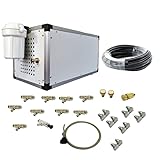
The best high pressure commercial outdoor misting systems for patios are usually 1,000–1,500 PSI stainless-steel systems with 20–30-inch nozzle spacing, a sediment-and-scale filtration stage, and enough pump capacity to run every installed nozzle without a noticeable pressure drop.
For a small café terrace or residential-style hospitality patio, a 1,000 PSI system is often the sensible balance between cooling performance, noise, installation cost, and maintenance. Large restaurants, event venues, and exposed patios benefit from a 1,500 PSI pump, particularly when the tubing run is long or the layout has several branches. Low-pressure garden misting kits cost less, but they generally produce larger droplets, wet furniture more readily, and struggle to deliver uniform coverage across a commercial seating area.
As an Amazon Associate we earn from qualifying purchases at no extra cost to you.



Quick comparison of commercial patio misting system types
| System type | Typical pressure | Recommended coverage | Nozzle spacing | Best use | Main compromise |
|---|---|---|---|---|---|
| Entry commercial high-pressure | 700–1,000 PSI | 300–800 sq. ft. | 24–36 in. | Small patios and seasonal service | Less reserve capacity and more visible wetting in humid weather |
| Standard commercial | 1,000–1,500 PSI | 600–1,500 sq. ft. | 20–30 in. | Restaurants, bars, and hotel terraces | Requires careful filtration and electrical planning |
| Heavy-duty modular | 1,500 PSI or higher | 1,200–3,000+ sq. ft. | 18–24 in. | Large venues and frequent daily operation | Higher purchase price, noise, and service requirements |
| Low-pressure fan or hose misting | 40–150 PSI | 100–400 sq. ft. per unit | Not applicable | Temporary events and low-cost cooling | Larger droplets, uneven cooling, and more surface moisture |
Best choice by patio situation
| Your situation | Recommended configuration | Why it fits |
|---|---|---|
| Under 500 sq. ft., occasional use | 700–1,000 PSI pump, 10–20 nozzles, 1/4-inch tubing | Lower upfront cost and simpler seasonal draining |
| 500–1,200 sq. ft. restaurant patio | 1,000–1,500 PSI pump, 20–40 nozzles, 3/8-inch main line | Good balance of cooling uniformity and installation complexity |
| Over 1,200 sq. ft. or several seating zones | 1,500 PSI modular pump with independently valved zones | Allows partial operation and reduces pressure loss |
| Hard water or mineral-heavy supply | Sediment filter, fine particulate filter, scale control, and flush points | Reduces clogged nozzles and pump wear |
| Frequent relocation or temporary events | Portable framed system or fan-based misting units | Permanent high-pressure tubing is labor-intensive to dismantle |
Pump pressure and actual cooling coverage
Pressure alone does not determine coverage. A pump must maintain pressure while supplying the total flow demanded by the nozzles. Commercial misting nozzles commonly use approximately 0.03–0.08 gallons per minute each, depending on orifice size and operating pressure.
For example, a patio with 32 nozzles rated at 0.05 gallons per minute uses:
32 nozzles × 0.05 GPM = 1.6 GPM
A pump should not be selected at exactly 1.6 GPM. Allowing roughly 20% reserve gives a target capacity of about 1.9 GPM at the required pressure. That reserve accommodates filter loading, tubing friction, elevation changes, and future nozzle replacement. A pump advertised at a high pressure but with inadequate flow may perform well at the first few nozzles while the end of the line produces weak, inconsistent mist.
For even coverage, place nozzles around the perimeter or in parallel rows rather than concentrating them over one seating section. A 24-inch spacing is a useful starting point for a typical commercial patio, while 18–20 inches may be better in very dry climates or areas with strong air movement. Humid conditions reduce evaporation, so adding more nozzles does not necessarily improve comfort; it can instead increase surface moisture.
Filtration is a durability feature, not an optional accessory
Fine mist nozzles have small orifices, making filtration one of the most important differences between a system that operates reliably and one that constantly drips or blocks. A practical commercial arrangement includes a coarse inlet strainer, a sediment filter, and a finer filter before the high-pressure pump or nozzle manifold.
- Coarse strainer: Captures pipe flakes, sand, and larger debris before it reaches the pump.
- Sediment filter: Reduces smaller particles that can obstruct nozzle inserts.
- Scale management: Helps in hard-water regions where calcium deposits accumulate on nozzle tips and pump components.
- Flush valve: Lets you clear the line before reinstalling nozzles after winter storage or plumbing work.
Filter capacity matters as much as micron rating. A small cartridge that loads quickly can cause pressure loss and encourage staff to bypass it. Choose a housing with a visible pressure gauge or a simple replacement schedule based on operating hours and water quality.
Tubing and nozzle materials: what survives commercial use
High-pressure nylon or polyethylene tubing is common because it is relatively easy to route, resistant to corrosion, and compatible with compression fittings. Stainless-steel tubing provides a more permanent appearance and better resistance to accidental impact, but it usually requires more precise cutting, deburring, and fitting work.
- Stainless steel nozzles: Preferable for daily commercial use and repeated cleaning.
- Brass fittings: Strong and widely available, but may show corrosion or mineral staining depending on the water supply.
- Plastic nozzles: Suitable for budget or seasonal installations, though threads and tips may wear faster during repeated servicing.
- UV-resistant tubing: Essential when lines are exposed to direct sunlight. Ordinary tubing can become brittle and discolored.
Use tubing rated comfortably above the system’s working pressure, not merely equal to it. Protect lines from sharp roof edges, chair movement, ladders, and areas where customers or staff may pull on them.
Installation complexity and zoning
A permanent system is more than a pump and a row of nozzles. The installer must provide a suitable electrical circuit, water shutoff, filter access, drain points, pressure-rated tubing, and protection from rain or accidental impact. Many commercial patios also need approval from a property manager or compliance with local electrical and plumbing requirements.
Divide larger layouts into zones when the patio has separate seating areas or when the pump cannot support every nozzle simultaneously. Solenoid valves or manual isolation valves allow unused sections to be shut off. Zoning also reduces water consumption during quiet periods and makes troubleshooting easier.
Keep the pump in a ventilated, sheltered location. An enclosed hot cabinet can shorten motor and seal life. Avoid placing it directly beside customer seating unless the manufacturer provides an acoustically suitable enclosure; even a well-built pump can create a persistent mechanical hum.
Ownership realities: what wears first
Nozzles, filter cartridges, pump seals, and tubing connections are the components most likely to require attention. A nozzle may appear clean but still deliver a distorted spray pattern because mineral buildup has partially changed the orifice. Replacing or soaking nozzles according to the manufacturer’s instructions is usually more reliable than probing them with wire, which can permanently enlarge the opening.
Inspect the system at the start of each operating day for dripping nozzles, wet pavement, loose fittings, unusual pump cycling, and reduced mist at the far end of the line. Dripping after shutdown can indicate a contaminated check valve, a damaged nozzle seat, or pressure trapped in the line.
At the end of the season, shut off the water, release pressure, drain low points, remove vulnerable nozzle inserts if recommended, and protect the pump from freezing. Freeze damage is often more expensive than routine filter and seal replacement.
Bottom line
Choose a 1,000–1,500 PSI commercial system for most permanent patios, then size the pump from nozzle flow rather than advertised pressure alone. Prioritize stainless-steel nozzles, UV-resistant pressure-rated tubing, accessible filtration, and a 20% flow reserve. For large or frequently occupied patios, a zoned 1,500 PSI installation is usually the stronger long-term choice. For occasional events, a lower-pressure or portable system may be more economical because it avoids the installation and winterization burden of permanent high-pressure equipment.