We research everything we recommend. When you buy through our links, we may earn a commission. As an Amazon Associate we earn from qualifying purchases.
4 Best Variable Speed Presses for Training (November 2026)
Variable speed drill presses for trade training workshops: Powermatic PM2800B, JET JWDP-12 and WEN models compared on readouts, ranges and durability.
As an Amazon Associate I earn from qualifying purchases. This post may contain affiliate links at no extra cost to you.
Teaching drilling on a variable speed press changes the lesson. Instead of a belt chart and a pulley cover, the trainee reads the material, picks an RPM, sets it on a dial and confirms it on a digital readout, which is exactly the workflow modern shops use. For a training workshop, the decision is which machines make speed selection teachable and repeatable for a whole cohort, while surviving being set up, reset and occasionally mis-set by beginners all term long.
This guide is for trade schools, colleges and apprenticeship centers equipping drilling stations where instruction is the point. The four machines below come from their Amazon listings: a floor-standing Powermatic with the widest speed range, two 12 inch benchtop models from JET and WEN, and a compact WEN for satellite benches. All run on single-phase power, which simplifies installation in teaching buildings, and three of the four display the set speed digitally for instructors to verify at a glance.
The practice-bench standard with a visible set speed
1/2 HP, variable 530-3,100 RPM, 12 in. swing
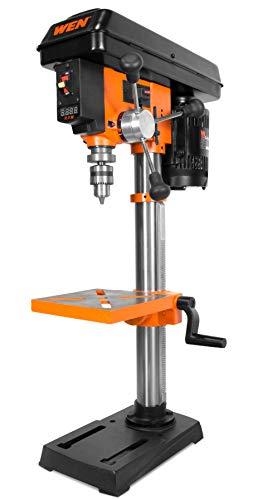
WEN 12-Inch Benchtop Drill Press, 6.2-Amp Variable Speed Motor with Cast Iron Construction, Laser and LED Work Light (DP1263V)
Setup aids that scaffold a beginner’s routine
6.2A, variable 580-3,100 RPM, 12 in. swing
WEN 10-Inch Benchtop Drill Press, 6.2-Amp Variable Speed Motor with Cast Iron Construction, and Laser (DP1062V)
The compact second station for finishing and small work
6.2A, variable 530-3,100 RPM, 10 in. swing
How to Choose
Make the readout a teaching requirement
A digital RPM readout turns speed setting into something an instructor can assess from three steps away. When an exercise specifies a speed for a given bit and material, the trainee sets it, the readout proves it, and the hole that results can be discussed honestly. Three of these four machines provide one. In a training context that visibility is not a luxury feature; it is the difference between teaching speed selection as a skill and hoping it happened inside a closed pulley cover.
Choose speed ranges that demonstrate the principle
Trainees learn speed selection by seeing contrast: a large bit in steel crawling at a few hundred RPM, a small bit in wood spinning near 3,000. The floor model’s 250 to 3,000 RPM range demonstrates that contrast most completely, and the benchtop models’ ranges, starting at 530 or 580 RPM, still show it for common tooling. A program should check its exercise list against the low end of any candidate machine, because the largest training bit in steel is the case that exposes a too-fast floor.
Match format to the room’s teaching layout
A floor press anchors a demonstration station where a whole group can watch a setup, while benchtop machines multiply into individual workstations along a bench run. Many programs need both shapes: one flagship station and several practice benches. The 85 pound benchtop models here are permanent bench residents, so the room plan must give each a level, bolted position with queue space. The compact 57 pound model suits a satellite bench, a maintenance corner or a second station for finishing operations.
Standardize workholding and setup routines across stations
Machines teach best inside a system. If every station carries the same vise class, the same chuck key storage and the same posted setup checklist, trainees carry habits between benches and instructors assess the work rather than the equipment lottery. Budget the workholding with the presses, note that chuck sizes here split between 5/8 inch on three machines and 1/2 inch on the compact model, and standardize training tooling on the size your main stations use to avoid mid-exercise incompatibility.
As a teaching flagship, the PM2800B has the specification instructors want: a mechanical variable range from 250 to 3,000 RPM, so every standard speed lesson, from large bits in steel to small bits in wood, can be demonstrated on one machine without belt changes. Six inches of spindle travel supports deep-hole exercises, and the 18 inch swing handles cohort project work at full size. Its floor format suits a demonstration position with room for a group to observe. It is the machine a program builds its drilling curriculum around.
The JWDP-12 is built for the practice bench role: variable speed from 530 to 3,100 RPM with a digital readout an instructor can verify while walking the room, a 5/8 inch chuck matching standard training tooling, and a cast iron base that tolerates cohort handling. The tilting table supports angled-hole exercises. Its 1/2 HP motor keeps the machine’s capacity honest for training stock, which is a quiet safety property in a room of beginners. As the station trainees repeat exercises on, it is the balanced choice here.
WEN 12-Inch Benchtop Drill Press, 6.2-Amp Variable Speed Motor with Cast Iron Construction, Laser and LED Work Light (DP1263V)
The DP1263V adds teaching scaffolding to the same 12 inch variable class: a laser guide that shows a trainee where the bit will land before they commit, an LED work light for clear visibility of layout lines, and a depth stop routine supported by a table roller extension for longer project stock. Its readout and 580 to 3,100 RPM range cover standard exercises. For programs whose early modules emphasize setup accuracy and confidence, those aids shorten the path from demonstration to independent work, which is the scarcest resource in any training room.
Specs
Motor: 6.2-amp induction motor, 120V, per the listing
Speed: mechanical variable speed, 580 to 3,100 RPM, with a digital LED readout
Swing: 12 in.
Spindle travel: 3-1/8 in.
Chuck: 5/8 in. keyed chuck
Table: 9-1/2 x 9-1/2 in., bevels 45 degrees left and right, with a roller extension
Listing features: laser guide, LED work light, adjustable depth stop
Weight: 85 lb
Best for: Early-module instruction where setup confidence and alignment are the lesson
Watch out for: Its 580 RPM low end is the highest here, so the largest steel exercises need the flagship machine; instructors should route those lessons accordingly.
ASIN: B0DQ9F3DX8
WEN 10-Inch Benchtop Drill Press, 6.2-Amp Variable Speed Motor with Cast Iron Construction, and Laser (DP1062V)
WEN 10-Inch Benchtop Drill Press, 6.2-Amp Variable Speed Motor with Cast Iron Construction, and Laser (DP1062V)
Best for: Satellite benches, small-part exercises and demonstration overflow
Motor: 6.2-amp induction motor, 120V, per the listing
Speed: mechanical variable speed, 530 to 3,100 RPM, with a digital readout
Every training room accumulates small work: the second operation, the small part, the quick demonstration at a side bench. The DP1062V covers that role in a 10 inch, 57 pound format while keeping the full variable speed workflow, 530 to 3,100 RPM with a readout, so the teaching method stays consistent with the main stations. Its 1/2 inch chuck and 2 inch travel define its envelope honestly. Placed as a satellite station, it relieves queues at the main benches and gives instructors a demonstration machine that does not dominate a small room.
Which One Fits Your Situation
A college fitting out a new drilling instruction room
Build the room around one Powermatic PM2800B as the demonstration and assessment station, then multiply practice benches with the JET JWDP-12 so every trainee repeats exercises on a consistent machine. The shared 5/8 inch chuck standard keeps tooling interchangeable. This flagship-plus-benches pattern is how the four models in this guide are designed to combine, and it scales by adding benches, not by rethinking the room.
A program teaching speed selection as an assessed skill
Any of the readout-equipped machines works, but the JET JWDP-12 and WEN DP1263V put the readout on the benches where assessment actually happens, at trainee scale. The Powermatic extends the lesson to the low speeds large steel work demands. Whichever stations you choose, post the material speed chart at each one and make the readout check part of the assessed setup routine.
An apprenticeship center with one bench and mixed trades
The WEN DP1263V is the single-bench answer for mixed groups: its alignment aids help rotating cohorts of beginners, the roller extension handles the long stock construction trades bring, and variable speed covers the material range. If the center’s work leans toward metal, the JET’s lower 530 RPM floor and cast iron build argue its case instead. Either way, one good variable station beats two fixed-speed compromises.
A maintenance training corner inside a larger facility
The WEN DP1062V suits a corner station: compact, lighter, and method-consistent with bigger variable presses, so a demonstration at the corner matches the main room’s workflow. Use it for the small-part and finishing exercises that otherwise queue behind full coursework, and keep its tooling set matched to its 1/2 inch chuck so trainees never force the wrong bit into the wrong station.
Common Mistakes
Equipping practice benches with machines whose speed setting cannot be verified at a glance.
Mixing chuck sizes across stations without standardizing training tooling, causing mid-exercise failures.
Checking the exercise list against top speed instead of the low end, where large steel work lives.
Bolting nothing down in a room where beginners will lean, hang and queue around the machines.
Buying a flagship floor press and no practice capacity, so trainees watch more than they drill.
Frequently Asked Questions
Why teach on variable speed presses instead of belt-drive models?
Because speed selection becomes a visible, assessable skill. The trainee chooses an RPM for the material and bit, sets it directly and confirms it on a readout, mirroring the workflow on modern production equipment. Belt-drive machines hide that decision inside a cover and a chart, which slows instruction and makes verification guesswork. The daily reps that build judgment happen faster and more safely on a readout-equipped variable drive.
How many stations does a training workshop need?
Enough that trainees drill more than they watch. A workable pattern is one demonstration station, here the floor-standing Powermatic, plus one practice bench per small group of trainees, with a compact satellite for overflow and small work. The exact count follows cohort size and session length, but the principle does not: queueing is the enemy of practical learning, and benches are cheaper than lost practice time across a term.
Are these machines durable enough for cohort use?
The cast iron benchtop models and the floor press here are built for shop duty, and variable drives remove the belt-handling that beginners are hardest on. Durability in a training room is mostly procedural: bolted installations, standardized tooling, posted setup routines and a term-start inspection of chucks, keys and tables. Programs that run that routine get years of service; programs that treat the machines as indestructible discover the exceptions expensively.
What should instructors check at the start of each term?
Confirm each station’s readout responds across its range, the chuck runs true and matches its stated size, the depth stop sets and holds, and the table locks square. Check that chuck keys are present and stored on the machine, and that the posted speed chart matches the exercises being taught. A one-hour audit prevents the small faults that otherwise surface as a cohort’s worth of poor holes.
M
Miller the Driller Editorial Team
We compare specs, warranty terms, long-term owner feedback and street pricing before anything earns a spot. Rankings are never paid.
Affiliate disclosure. As an Amazon Associate we earn from qualifying purchases at no extra cost to you. Prices accurate as of the date shown.
Find the best golf headcovers for woods, driver, fairway wood, and hybrid clubs. Compare knit, nylon, and leather sets that protect clubheads and fit modern woods.
Compare the best Porter-Cable routers for woodworking, from the compact 450 to the 691 D-handle router and the 693LRPK two-base kit, by motor and base.
Compare the best wood spoon sets in teak and sheesham, from 7-piece and 10-piece cooking sets with spatulas and ladles for nonstick pans and daily use.
Compare four tool box sets, from a stackable three-piece tower to steel boxes on wheels, with drawer, latch and capacity checks for home and site work.
Current Windows laptops for photographers chosen by colour-accurate screens, RAM, SSD storage and card readers, with a clear note on Windows 7 support.
Compare four insect repellent sprays for beach days, from picaridin and DEET aerosols to a plant-based pump, with sizes, coverage times and beach-bag fit.