What's inside
As an Amazon Associate I earn from qualifying purchases. This post may contain affiliate links at no extra cost to you.
What we cover
The quick answer
For ordinary drilling with a cordless drill, either shank can work. Choose a hex-shank bit if you want quicker bit changes, a more secure grip in a compatible chuck, or one bit to move between a drill and a 1/4-inch hex impact driver. Choose a round-shank bit if it fits the job and costs less; a standard three-jaw drill chuck holds it securely when tightened properly.
The shank is the part clamped by the tool, not the cutting end. A hex shank does not make a bit drill faster or cut better by itself. Bit material, geometry, diameter, and whether the bit suits wood, metal, or masonry matter more.
As an Amazon Associate we earn from qualifying purchases at no extra cost to you.
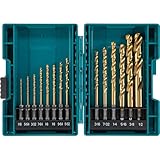


How the two shanks fit
A round shank is cylindrical. A drill chuck’s jaws close around it, so the bit can usually be clamped at any position along the smooth shank. Round shanks are common on general-purpose twist bits and are compatible with nearly all standard three-jaw cordless drill chucks.
A hex shank has flat sides, often in a 1/4-inch format. Those flats help resist rotation in a matching holder, and a quick-change hex holder can release it without opening chuck jaws. Some hex-shank bits are designed for drill chucks; others are intended for hex bit holders. Check the tool and bit specifications rather than assuming every 1/4-inch hex bit fits every chuck or holder.
In a three-jaw chuck, a correctly tightened hex shank can also be held securely. But its flats and corners may not line up neatly with the jaws, and clamping on the narrow corners can reduce contact. If the bit slips, stop, inspect the shank and chuck, and reclamp it. Don’t compensate by forcing the tool harder.
Hex vs. round shank at a glance
| Feature | Hex shank | Round shank |
|---|---|---|
| Best fit | Quick-change holders; compatible drill chucks | Standard three-jaw drill chucks |
| Bit changes | Fast in a matching quick-change holder | Requires loosening and tightening the chuck |
| Resistance to slipping | Flats help in a matching hex holder | Depends on chuck condition and clamping force |
| Availability | Common for driver accessories and selected drill bits | Very common across general-purpose drill bits |
| Best reason to buy | Convenience or use across compatible tools | Lower cost and broad chuck compatibility |
Choose for the tool you actually own
If you have a cordless drill with a three-jaw chuck, you can use either type when the bit is rated for the material and the shank fits the chuck. For occasional household work, a basic round-shank drill bit set is usually a sensible buy. It is often less expensive, and there is no practical benefit to paying extra for hex shanks if you rarely change bits or only use the drill.
A 1/4-inch hex impact driver is different. Its quick-change holder accepts compatible hex accessories, not ordinary round-shank twist bits. Use bits specifically intended for impact-driver use when drilling with an impact driver; a conventional drill bit may not tolerate repeated impact loading and can break. A hex-shank drill bit set for impact drivers can be handy for pilot holes and light drilling, but it does not turn an impact driver into a full substitute for a drill.
For frequent changes between drilling and driving, a hex-shank bit is convenient if your drill has a compatible quick-change adapter or holder. The trade-off is that the extra adapter adds length and can introduce wobble, particularly with long bits. For precise holes, clamp the bit directly in the drill chuck when possible.
Why bits slip—and what to check
Shank style is only one part of the grip. A dirty or worn chuck, an undersized bit, or jaws that do not close evenly can let either shank slip. On a keyed chuck, use the key in each chuck opening to tighten evenly. On a keyless chuck, hold the rear sleeve and tighten the front sleeve firmly according to the tool’s instructions. Remove dust and oil from the shank before clamping.
Slipping can polish or score a shank, damage the chuck, and leave the bit spinning while the motor turns. Stop if you see the bit rotate in place, hear repeated clicking, or smell hot metal. Don’t hold the bit with pliers while the drill runs. If a chuck cannot grip a clean, undamaged bit, it may be worn or defective.
Match the bit to the material
For wood, a twist bit works for small holes, while a brad-point bit is easier to center cleanly. For metal, use a suitable high-speed steel bit, keep the bit sharp, and reduce speed as the diameter increases. A 1/2-inch hole generally needs a slower speed and more control than a 1/8-inch pilot hole. Use steady pressure; excessive force can overheat the cutting edge or twist the bit.
For brick or concrete, use a masonry bit. A regular cordless drill may manage small holes in softer masonry, but a hammer drill is usually faster in tougher material. Check whether the bit is rated for hammer-drill use. Do not use a standard drill bit for masonry just because its shank fits.
Shank size can also limit the hole you can drill. A large bit may have a reduced shank so it fits a smaller chuck; check the maximum chuck capacity, commonly 3/8 or 1/2 inch, before buying. A bit that fits the chuck may still exceed the drill’s practical power, especially in thick stock. In that case, drill a pilot hole, use a slower gear, and back out periodically to clear chips.
What to buy
Buy round-shank bits for a standard cordless drill when cost and broad compatibility matter more than fast changes. Buy hex-shank bits when you already use a compatible quick-change holder, need to share accessories with an impact driver, or find a particular bit you need in that format. Keep a chuck-style drill bit set for precision work and a small selection of compatible hex accessories for quick pilot holes or driving tasks.
Before ordering, check the shank diameter, holder compatibility, maximum hole size, and material rating. A well-made round bit is a better choice than a low-quality hex bit for the job; the shank alone is not a quality grade. If the only difference is a modest time saving during frequent bit changes, hex can be worth it. For a few holes around the house, the cheaper round-shank option is fine.