What's inside
As an Amazon Associate I earn from qualifying purchases. This post may contain affiliate links at no extra cost to you.
A long decking fastener is a demanding job for an impact driver: the tool has to deliver repeated bursts of torque without camming out, overheating, or exhausting its battery halfway across the deck. For most homeowners, a compact 18V or 20V-class brushless driver is the best balance of speed, control, and runtime. The best choice depends less on the biggest torque figure in an ad than on the fasteners, lumber, and number of screws you plan to install.
As an Amazon Associate we earn from qualifying purchases at no extra cost to you.



What we cover
What makes a good driver for deck fasteners
Look for a brushless motor, a variable-speed trigger, and at least two speed settings. Brushless models generally make better use of battery capacity and run cooler than comparable brushed tools. A slower setting helps start a screw straight and reduces the chance of snapping its head; higher speed is useful once the screw is tracking properly. A three- or four-mode tool can be helpful, but it is not essential.
Grip and balance matter over hundreds of screws. A very short, light driver is easier to use between joists and near railing posts, while a heavier tool with a large battery may feel steadier but tire your wrist. Try to keep a long driver bit close to the chuck: extra length increases leverage on the bit and makes it easier to tilt the screw.
Choose by the size of the job
| Decking job | Practical choice | Main trade-off |
|---|---|---|
| Small repair or a few dozen screws | Existing 18V/20V-class impact driver, preferably with a fresh 2.0–4.0Ah battery | No need to buy a high-output kit if your current tool is healthy |
| Full deck installation | Brushless driver with variable speed, two or more modes, and two batteries | A second battery costs more but avoids stopping to recharge |
| Frequent heavy fastening or dense hardwood | Higher-output brushless driver, plus a suitable pilot-hole plan | More power can break screws or damage boards if you do not control depth |
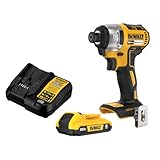
For a new purchase, compare brushless impact driver kits with two batteries. A kit that includes a charger and spare battery is often better value for a deck than a bare tool, unless you already own compatible batteries.
Battery, modes, and control
Battery capacity is measured in amp-hours (Ah). A 2.0Ah pack keeps the tool light; a 4.0Ah pack typically offers more working time, though actual runtime varies with screw diameter, length, wood, and driver settings. For a large deck, two mid-sized packs are usually more comfortable than one very large pack. Keep a charged spare nearby and swap before the tool slows noticeably.
Do not buy solely on advertised torque. Manufacturers measure and present torque differently, and maximum output does not tell you how gently a tool starts a screw. A driver with a useful low-speed mode is often easier to live with than a more powerful model with a sharp trigger. If possible, test the trigger and mode selector before buying.
A standard brushed driver can be a sensible lower-cost choice for occasional repairs, especially if you already own the battery platform. For regular deck building, the efficiency and cooler operation of a brushless tool are worthwhile. Avoid upgrading just for a higher voltage label if your current driver already installs the specified fasteners cleanly.
Bits and fasteners matter as much as the tool
Use exterior-rated decking screws, not general-purpose interior screws. Follow the fastener maker’s guidance for screw length, coating, spacing, and the bit type. A screw’s drive recess may be Torx-style, square, or another design; the exact matching bit should seat fully without wobble. Keep spare bits on hand. Worn or mismatched bits slip, round the recess, and can leave a screw stuck partway through a board.
Use a long bit only when the board layout requires the reach. A 2- to 3-inch bit can help clear a countersink or reach a tight spot, but a longer bit flexes more and magnifies poor alignment. For ordinary surface fastening, a short impact-rated bit holder and a quality bit usually provide better control. Look for impact-rated bits matched to your decking screws.
Install long screws without damaging the deck
Set the driver to its lower speed or assist mode and start the screw perpendicular to the board. Apply firm pressure in line with the screw; leaning sideways is a common cause of cam-out. Once the screw is established, let the impact mechanism do the work rather than forcing the tool. Ease off as the head approaches the surface. Driving until the head crushes the wood can create a water-catching divot and weaken the board around the fastener.
Some dense hardwoods, end-grain locations, and screws near board ends need pilot holes. Use the fastener manufacturer’s instructions, since the correct pilot diameter depends on the screw and material. Pre-drilling can reduce splitting and lower the load on the driver, but it adds time. Do not assume an impact driver makes pilot holes unnecessary.
Watch for warning signs: a hot battery, a driver that slows sharply, repeated bit slip, or a screw that stops turning before its head seats. Stop and check for a dull bit, a misaligned screw, a knot, or an over-deep pilot hole. Forcing a stalled screw can snap it or strip the drive recess. Back it out if possible, replace the bit or fastener, and correct the cause before continuing.
A practical buying decision
For a full deck, choose a brushless 18V/20V-class impact driver with a low-speed mode, a comfortable grip, and a spare battery. For occasional repairs, a serviceable tool you already own is usually enough; spend first on the correct screws and fresh bits. If you are comparing compact brushless drivers with variable speed, prioritize control and battery availability over headline torque. The right driver installs screws quickly, but careful alignment and depth control are what keep the boards intact.