What's inside
As an Amazon Associate I earn from qualifying purchases. This post may contain affiliate links at no extra cost to you.
What we cover
What matters when driving composite-deck screws
Composite decking is less forgiving than ordinary softwood. A driver that is too forceful can strip a screw head, break a screw, or leave a damaged surface around the fastener. The right impact driver is not necessarily the most powerful one: controllable speed, a good bit fit, and the correct decking screw matter at least as much as peak torque.
For most homeowners, a compact 18V or 20V cordless impact driver with a variable-speed trigger is sufficient. A lower-speed setting is useful near board ends and when driving stainless-steel or long screws. If you already own a compatible drill-driver, it can be the better choice for delicate work because its clutch can stop driving at a set resistance. An impact driver has no conventional clutch, so you control depth with the trigger and practice.
As an Amazon Associate we earn from qualifying purchases at no extra cost to you.


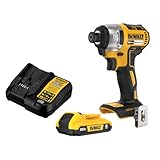

Impact driver options
| Option | Best for | Trade-off |
|---|---|---|
| Compact 18V or 20V impact driver | Most composite-deck installations and repairs | Needs a careful trigger hand; more power than small screws need |
| Impact driver with selectable speed or drive modes | New users and work near board ends | Extra modes do not replace correct screw selection or a test board |
| Cordless drill-driver with adjustable clutch | Short screws, delicate trim, or occasional repairs | Slower in dense material; may stall on longer fasteners |
| Premium high-torque impact driver | Frequent framing and other heavy fastening beyond decking | Usually unnecessary for a deck; harder to control at full trigger |
For a dedicated purchase, compare compact variable-speed impact drivers rather than choosing by maximum torque alone. A comfortable grip, predictable low-speed response, and a useful low mode are more relevant here than a headline torque figure.
Choosing the right driver
Brushless models tend to run efficiently and often offer more control settings, but a brushed driver can handle a typical deck project just fine. If you already have batteries in a tool platform, buying a bare tool can save money. For occasional DIY use, there is little reason to pay extra for a high-torque model that will spend most of its time on low speed.
Check that the driver accepts standard 1/4-inch hex bits and has a trigger you can feather without sudden surges. A work light is handy in shadowed gaps, but it is not a reason by itself to upgrade. If the job involves hundreds of screws, a lighter compact tool can reduce fatigue. If the same tool will also drive structural screws or lag screws, a stronger full-size model may be a reasonable compromise.
A cordless drill-driver with an adjustable clutch is a sensible cheaper option if you already own one or are fastening only a few boards. It is easier to limit depth, though a long screw in dense material may make it work harder. Do not assume a drill’s numbered clutch settings correspond to a particular depth; test them on scrap.
Use the right screws and bits
Buy screws specified for your decking brand and installation method. Composite boards can call for color-matched face screws, hidden fasteners, or a particular thread and head design. Coated or stainless screws are common outdoors, but the right choice depends on the board maker’s instructions and local exposure. A general-purpose wood screw may not hold or finish properly, and its head can leave a conspicuous divot.
Use a fresh driver bit in the exact size and style required by the screw head. A worn or mismatched bit can cam out, rounding the recess before the screw is seated. Keep spare bits nearby: even a good impact driver can damage a head when the bit slips. For a larger job, consider composite-decking installation screws matched to the boards rather than buying fasteners by appearance alone.
Drive screws without damaging the boards
Read the decking maker’s installation guide for required spacing, edge distances, and whether pilot holes are needed. Composite products vary, so there is no reliable universal rule. Pilot holes are often useful near board ends, in cold conditions, or with dense material, but drilling every hole adds time. If you do pilot, use the specified diameter; an oversized hole can reduce holding power.
Make a short test run on an offcut or a concealed spot. Start the screw square to the board, use low speed, and ease off as the head approaches the surface. The goal is a seated head without crushing or mushrooming the composite. If a screw spins without tightening, stop: the hole may be stripped, the screw may be wrong, or the board may need a different fastening method. Do not keep pulsing the driver into a damaged hole.
Keep the bit fully seated and apply steady pressure. If it begins to slip, stop and inspect the bit and screw recess rather than pushing harder. Overdriving can leave a crater that collects water and dirt; underdriving leaves a proud head that can catch shoes. Adjust technique after each test screw instead of relying on a single trigger pull for every board.
Common mistakes and when to spend more
One frequent mistake is using maximum speed because the driver sounds busy. Impact action can make a screw feel as though it is advancing normally even while its head is stripping. Another is using long structural screws for ordinary deck-board fastening. They can take more force to drive and may be inappropriate for the board system. Follow the deck manufacturer’s fastener schedule.
Spend more for a driver if you will use it often, need several speed modes, or want one tool for both deck work and heavier fastening. Save money if this is a small repair and a clutch-equipped drill is already in your kit. Whichever tool you choose, a correct fastener, sharp bit, and careful test drive prevent more failures than extra torque does.