What's inside
As an Amazon Associate I earn from qualifying purchases. This post may contain affiliate links at no extra cost to you.
Self-drilling metal screws cut their own pilot holes, but that does not make them easy to drive. The bit must stay seated while the screw point cuts through the sheet; too much speed or torque can strip the head, snap the screw, or dimple thin metal. For occasional work, a basic 18V impact driver is often enough. For repeated fastening, prioritize speed control, a comfortable trigger, and a reliable 1/4-inch hex chuck over the biggest torque number on the box.
As an Amazon Associate we earn from qualifying purchases at no extra cost to you.



What we cover
What matters for this job
Look for a cordless impact driver with variable-speed control, a low-speed setting, and a 1/4-inch hex collet that holds bits securely. A brake that stops the tool quickly after you release the trigger helps prevent overdriving. Three or more speed modes are useful, but a smooth trigger matters more than a long list of modes: you need to start slowly, let the screw point bite, then ease off as the head approaches the sheet.
Most 18V/20V-class tools have ample power for common self-drilling screws in sheet metal. A compact 12V driver can be easier to control and lighter overhead, but may be slower in thicker material or during long runs. Battery capacity affects runtime and weight, not just power. A 2.0Ah pack is easier on your wrist; a 4.0Ah pack is more practical for a full day of fastening.
Impact driver options compared
| Type | Best for | Trade-off |
|---|---|---|
| Compact 12V impact driver | Short jobs, light sheet, overhead work | May bog down or run slowly in heavier-gauge metal |
| 18V/20V brushless driver with speed modes | Regular installation and mixed materials | Costs more; power can damage screws if poorly controlled |
| Basic 18V/20V brushed driver | Occasional repairs and small projects | Usually heavier or less refined; fewer control features |
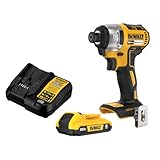
For most homeowners and small crews, a brushless 18V/20V driver with at least two speed settings is the versatile choice. Compare brushless 18V impact drivers with speed settings if you expect to use the tool regularly. If you already own batteries in a tool system, buying a bare tool can save money. A basic brushed model is fine for a few dozen screws a year; spend extra only if better control, lower weight, or frequent use justifies it.
Choose the bit and screw for the material
Match the driver bit to the screw recess exactly. A worn or slightly wrong-size Phillips bit can cam out under impact and chew up the head. Use a fresh, correctly sized bit; for hex-washer-head screws, use the matching nut setter, commonly 1/4 inch, and keep it straight. Magnetic holders help with placement, but can add wobble. Replace a bit as soon as its corners round over.
Check the screw’s stated drilling capacity against the combined thickness of the sheets or metal it must penetrate. Self-drilling points are designed for a limited material range; a longer screw is not automatically a better one. For thicker steel, the point may overheat or fail to cut, while the driver keeps hammering and eventually twists off the screw. If the screw manufacturer gives a recommended drill speed, use it. Otherwise, start with low-to-medium speed and steady pressure rather than full trigger.
How to drive without stripping or overdriving
Clamp or support the metal so it cannot vibrate. Set the driver to its lowest speed mode, place the screw perpendicular to the surface, and press firmly enough to keep the bit seated. Start with a controlled trigger pull. Let the drill point cut through before increasing speed; forcing a screw that is not cutting can polish or burn the point and leave a damaged hole.
As the threads engage and the washer or screw head nears the surface, release the trigger early. The impact mechanism delivers repeated rotational blows, so a small extra burst can crush a sealing washer, strip thin sheet, or pull the screw through. Do not use the driver’s clutch as a precise torque limiter unless its manual specifically supports that use; many impact drivers have no conventional clutch. For a long run, practice on scrap of the same thickness and inspect the first few fasteners.
A seated screw should be snug, with the washer compressed evenly if the design includes one. A tilted head, torn hole, spinning screw, or visibly crushed washer is a warning to stop. Do not try to rescue a stripped hole by driving a larger screw without checking the material and fastening specification. The repair may need a larger approved fastener, a new location, or a different fixing method.
When an impact driver is not the best tool
For thin sheet metal, soft aluminum, or fasteners that need consistent compression, a variable-speed drill/driver can be easier to control because it applies steady rotation rather than impact blows. It is also a sensible choice when the screw manufacturer calls for a specific low drilling speed. The drawback is that it may stall more readily on thicker steel or during repetitive work. A dedicated screw gun can make sense for high-volume roofing or cladding, but is usually hard to justify for a small repair.
When choosing between a compact driver and a heavier high-output model, consider access and fatigue. A shorter head helps in tight framing, and a lighter tool is easier to hold square above shoulder height. Extra torque is not a substitute for correct screws, a sharp point, or controlled technique. For occasional sheet-metal repairs, compare compact 12V impact-driver kits if low weight is the priority, or variable-speed 18V drill/drivers if smoother control matters more than impact action.
Make the choice fit the job
Buy an 18V/20V impact driver with speed control for frequent fastening, mixed projects, or thicker material within the screw’s rated capacity. Choose a compact 12V model for light, occasional work where weight and access matter. Keep the bit fresh, match the screw to the material, and test your speed on scrap. Those choices prevent more failed fasteners than chasing maximum torque.