What's inside
As an Amazon Associate I earn from qualifying purchases. This post may contain affiliate links at no extra cost to you.
What we cover
Choosing a hole saw set
The right hole saw set depends on the opening diameter, the wood, and how often you expect to use it. A set for installing cabinet hardware is not necessarily a good choice for repeated cuts in thick framing lumber. Before buying, check the saws’ diameter range, cutting depth, arbor compatibility, and whether replacement saws are available.
For occasional work in plywood, drywall, or thin softwood, a basic carbon-steel set can be adequate. For frequent cuts, hardwood, or mixed materials, bi-metal saws generally last longer and tolerate heat better. A set with many sizes is useful only if you will use those sizes; a smaller, better-made set can be the better buy.
As an Amazon Associate we earn from qualifying purchases at no extra cost to you.

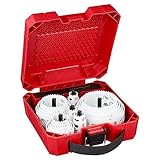

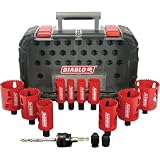
Compare hole saw types
| Type | Best for | Trade-off |
|---|---|---|
| Carbon steel | Occasional cuts in softwood, plywood, or drywall | Lower cost, but teeth dull faster in hardwood and heat-sensitive work |
| Bi-metal | Regular use in wood and mixed materials | Costs more than basic carbon steel; still needs proper speed and chip clearing |
| Carbide-tooth | Frequent large or abrasive cuts, including some composites | Higher price; avoid twisting or side-loading, which can damage the teeth |
| Adjustable cutter | Infrequent holes in sheet goods when the exact diameter varies | Less forgiving than a fixed saw; setup and balance matter |
Match diameter and cutting depth
Measure the opening you actually need, not just the pipe or fitting’s nominal size. A vent, cable pass-through, or recessed light may need clearance beyond the object’s outside diameter. Check the manufacturer’s required opening size and allow for any trim ring or grommet.
Hole saws are commonly sold in sets covering roughly 3/4 to 2-1/2 inches, though the range varies. Large openings above that range may call for a dedicated saw or a different method. Also check cutting depth. Many standard saws cut around 1-1/2 inches deep; a thicker workpiece may require cutting from both sides or using a deeper cup. Do not assume a larger diameter means enough depth for a thick countertop or timber.
If you need a useful spread of common sizes for wood, compare bi-metal hole saw sets for wood. Look at the individual diameters and included arbor rather than choosing by the number of pieces alone.
Check the arbor and drill
The arbor holds the saw and usually includes a pilot bit. Confirm that its shank fits your drill chuck; a 3/8-inch shank will not fit every older 1/4-inch chuck. Some kits include multiple arbors or adapters, while others require a separate arbor for larger saws. If the set uses a quick-change system, check that replacement saws and arbors are compatible before you commit.
A hole saw puts more load on a drill than an ordinary twist bit. Use a drill with a chuck and side handle suited to the diameter and material. For a large saw, a geared low-speed drill is easier to control than a compact drill that struggles under load. An impact driver is generally not the right tool: its hammering action can make the cut rough and the sudden torque can jerk the tool. A hammer drill should be set to drill mode, not hammer mode.
Cut large holes safely and cleanly
Clamp the work securely and support the back of the cut with scrap wood when possible. This reduces breakout as the pilot bit and teeth exit. Mark the center, then let the pilot bit establish the path before applying steady pressure. Keep the drill square to the surface; leaning on the handle can bind the saw and enlarge or damage the opening.
Start at low speed, especially with larger diameters. The correct speed depends on the saw maker’s instructions and the material, but large hole saws generally need slower rotation than small ones. Excessive speed produces heat, burns the wood, dulls teeth, and can leave a smoky, ragged edge. Ease pressure if the drill slows sharply. Clear packed chips regularly by backing the saw out with the drill stopped, then resume the cut.
For a hole deeper than the saw’s cup, stop when the pilot point emerges, then finish from the opposite side using that pilot hole to align the cut. This helps prevent a plug from breaking out and tearing the surface. If you cannot reach the back, remove the saw periodically and clear the plug rather than forcing the drill through a jam.
What to buy for your job
For a few holes in inexpensive sheet goods, a basic carbon-steel hole saw set is a reasonable budget choice. Expect shorter tooth life if you use it repeatedly in hardwood, and stop if the teeth are burning instead of cutting. If you have one specific opening to make, buying a single saw in the correct diameter may cost less and leave you with fewer unused pieces.
For regular workshop use, a carbide-tooth hole saw set may make sense when its sizes match your jobs and replacement parts are available. It is not automatically the best choice for every cut: a bi-metal saw can be a more sensible general-purpose option, while carbide teeth need careful handling. Whichever set you choose, prioritize the sizes you need, a secure arbor, and a cutting depth that matches your stock.