What's inside
As an Amazon Associate I earn from qualifying purchases. This post may contain affiliate links at no extra cost to you.
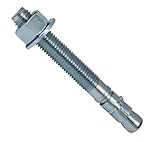
A wedge anchor is a permanent, expansion-style fastener for attaching a base plate to sound concrete. It can work well for a compressor, workbench, or other equipment with a fixed mounting footprint—but the right anchor depends on the equipment loads, concrete condition, and installation details. Bigger is not automatically safer: an anchor set too close to an edge, in cracked concrete, or in an undersized hole can fail even when its diameter looks substantial.
As an Amazon Associate we earn from qualifying purchases at no extra cost to you.



What we cover
Start with the load and the concrete
Check the equipment manual or base-plate drawing for anchor count, diameter, embedment, edge distance, and required concrete strength. Do not guess these values for a lift, vehicle restraint, overhead load, or machinery that can impose strong vibration or sudden forces. Those installations may need an engineered anchorage design and anchors specifically qualified for the conditions.
A wedge anchor expands against the sides of its drilled hole as the nut is tightened. It is intended for solid concrete, not brick, hollow block, or a thin slab with an unknown thickness. Before drilling, locate reinforcing steel, post-tensioning cables, utilities, and embedded conduits. Never drill into a suspected post-tensioned slab without approval and reliable locating information.
Look for cracks, spalling, and the slab edge. Anchor capacity falls when anchors are too close together or too close to an edge; the manufacturer’s technical data gives minimum spacing and edge distances for each size and embedment. If the slab is thin, badly cracked, or its condition is uncertain, pause and get the design checked rather than substituting a longer anchor.
Pick the diameter and material
Use the diameter specified by the equipment maker or design. Common wedge-anchor diameters include 1/4, 3/8, 1/2, and 5/8 inch, but size alone does not tell you capacity. A larger anchor needs a larger, deeper hole and more clearance; it may also put greater splitting forces into concrete near an edge. Match the anchor’s effective embedment and length to the base plate thickness, washer, nut, and required embedment.
For a dry indoor shop, zinc-plated carbon steel is often the economical choice. For wet areas, washdown, or outdoor exposure, consider hot-dip galvanized or stainless steel, while checking that the selected anchor is approved for the concrete and environment. Stainless costs more and is not a fix for poor edge distance or weak concrete. If you need to compare common options, browse zinc-plated concrete wedge anchors and stainless steel wedge anchors.
Compare the practical choices
| Option | Best fit | Main trade-off |
|---|---|---|
| Zinc-plated wedge anchor | Dry, indoor concrete installations | Usually low cost; less corrosion resistance outdoors |
| Galvanized or stainless wedge anchor | Damp or outdoor locations, if approved for the job | Higher cost; material choice must suit exposure and specifications |
| Concrete screw | Some lighter-duty or removable attachments | Different installation and load ratings; not a direct substitute for a specified wedge anchor |
| Adhesive anchor system | Applications where a qualified design calls for it | Requires correct hole cleaning, adhesive, cure time, and installation conditions |
A concrete screw can be easier to remove, but don’t swap it for a wedge anchor where the equipment maker specifies an expansion anchor. Adhesive anchors can suit some edge-sensitive or engineered applications, but they are especially sensitive to hole cleaning and installation procedure. Use the system and approved installation instructions called for by the design.
Drill the hole accurately
Use a hammer drill or rotary hammer with a sharp carbide-tipped masonry bit of the exact diameter listed on the anchor package. A standard twist bit is not suitable for drilling concrete. For several holes in a thick pad, a rotary hammer generally drills faster and with less effort; a hammer drill is adequate for occasional smaller holes in sound concrete. Check bit diameter for wear: an oversized or worn bit can leave a hole that will not grip properly.
Mark the hole centers through the equipment’s base plate, then move it aside and confirm the locations. Drill perpendicular to the slab and at least as deep as the anchor manufacturer requires, allowing extra depth for concrete dust. Keep the hole within required edge and spacing limits. Do not force an anchor into a shallow or dirty hole. Clean it using the method specified by the manufacturer—often a brush and compressed air or a vacuum—and wear eye and hearing protection. Concrete dust contains respirable silica; use suitable dust control and respiratory protection.
Set and tighten without damaging the joint
Place the equipment, insert each anchor through the base plate, and tap it into the hole with a hammer until it reaches the specified position. Leave enough thread for the washer and nut. Tighten to the manufacturer’s stated torque with a calibrated torque wrench when a torque value is specified; an impact driver is not a reliable way to control final torque. Over-tightening can damage threads, distort a plate, or overstress the concrete. Under-tightening may leave the expansion clip improperly set.
Snug the anchors evenly so the base plate seats flat. If the equipment rocks, correct the support with an appropriate leveling method rather than pulling a warped plate down hard with the nuts. Recheck alignment and torque as directed by the equipment maker, especially on vibrating machinery. A spinning anchor, cracked concrete, a loose base plate, or an anchor that will not reach the specified torque is a stop-work sign—not a reason to keep tightening.
What to check before buying
Buy anchors that state the diameter, length, material, approved concrete conditions, required drill-bit size, minimum embedment, and installation torque. Confirm the usable length accounts for the base plate and washer, not just the hole depth. Buy the correct bit separately if needed, and avoid mixed assortments with unclear specifications for equipment anchoring. For a routine indoor installation that matches the maker’s instructions, a basic zinc-plated set may be entirely adequate. For critical, heavily loaded, or exposed equipment, follow the specified anchor system and have the design verified rather than choosing by price or appearance.