What's inside
As an Amazon Associate I earn from qualifying purchases. This post may contain affiliate links at no extra cost to you.
Choosing between a wedge anchor and an epoxy-set anchor comes down to the load, the concrete, and how much installation control you have. Wedge anchors are quick, relatively inexpensive, and reliable in sound concrete. Epoxy anchors take longer and require more care, but can work where an expansion anchor is a poor fit, such as near a concrete edge or in some cracked-concrete applications. Neither is automatically stronger: capacity depends on anchor size, embedment, concrete condition, spacing, and the manufacturer’s data.
As an Amazon Associate we earn from qualifying purchases at no extra cost to you.



What we cover
How the anchors work
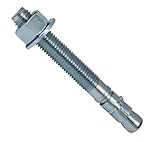
A wedge anchor is a mechanical fastener. You drill a hole, insert the anchor, then tighten its nut. Tightening pulls a tapered end into an expansion clip, pressing the clip against the sides of the hole. That outward pressure is what holds the anchor in place. It also means the anchor pushes against the concrete, which matters near edges and in cracked or weak concrete.
An epoxy anchor uses a threaded rod or reinforcing bar set into a hole filled with a two-part adhesive. After the adhesive cures, the bond between rod, adhesive, and concrete resists the load. There is no expansion clip forcing outward against the hole, but the adhesive needs a properly prepared hole and enough time at the right temperature to cure.
Wedge vs. epoxy at a glance
| Factor | Wedge anchor | Epoxy anchor |
|---|---|---|
| Installation | Drill, clean, insert, tighten | Drill, clean, inject adhesive, set rod, wait for cure |
| Time to load | Usually ready after tightening | Must wait for the product’s stated cure time |
| Best conditions | Sound, adequately thick concrete with room for edge and spacing requirements | Applications needing a bonded rod, or where expansion force is a concern |
| Common risks | Hole too large or shallow, poor edge distance, over-tightening | Dust or water in the hole, incomplete fill, moving the rod before cure |
| Cost and tools | Usually lower cost; needs a hammer drill and masonry bit | Higher material cost; needs compatible adhesive dispensing equipment and hole-cleaning tools |
When a wedge anchor makes sense
For a railing base, equipment bracket, or other attachment to sound concrete, a wedge anchor is often the straightforward choice if the anchor’s published specifications suit the load and layout. It is fast, easy to inspect, and does not leave you waiting for adhesive to cure. For a modest, noncritical attachment with adequate concrete thickness, paying extra for epoxy may not improve the job.
Use a carbide masonry bit matched to the anchor’s specified diameter. A hammer drill speeds the work in typical concrete; a rotary hammer is useful for repeated holes or harder concrete. For example, a 1/2-inch wedge anchor commonly calls for a 1/2-inch hole, but follow the package instructions rather than assuming every product is the same. Drill at least the specified depth—often deeper than the anchor’s embedment to leave room for dust—and clean the hole as directed. A set of concrete masonry bits is a practical purchase if you need several hole sizes.
Keep the required distance from edges and other anchors. The expansion action can split or spall concrete when a fastener is too close to an edge, too close to another anchor, or installed in a thin slab. Don’t use a wedge anchor in a hole that has been enlarged by a wandering bit or repeated drilling. Tighten to the specified torque with a torque wrench where the application calls for one; overtightening can damage the concrete or fastener.
When epoxy is the better option
Epoxy anchors are worth considering when the design calls for a bonded threaded rod, when edge distance makes expansion pressure undesirable, or when a qualified anchoring system is specified for cracked concrete. Some adhesive systems also allow installation in damp holes, but that is product-specific; “epoxy” does not mean any adhesive will work in any hole. For structural, overhead, seismic, or life-safety attachments, use an anchor system approved for the application and follow its technical data or get an engineer’s direction.
Hole cleaning is not optional. Dust left by drilling can prevent a proper bond. Follow the adhesive maker’s sequence, which commonly uses repeated brushing and blowing with the specified brush and oil-free air or a hand pump. Inject from the bottom of the hole outward to limit air pockets, then insert the rod with a twisting motion. Don’t load, adjust, or spin the rod after installation unless the instructions permit it. Cure time varies with adhesive type and concrete temperature; it may be much longer in cold conditions. Check the product data before planning the work.
A concrete anchoring adhesive is not a shortcut around the manufacturer’s hole-cleaning and cure instructions. If a job needs only one ordinary attachment in sound concrete, the extra materials and preparation may not be worthwhile.
Drilling and installation checks
Before drilling, locate embedded utilities and reinforcing steel where possible. Hitting rebar can deflect a bit, damage the bit, or compromise the planned hole; don’t simply force your way through it. Use a properly sized bit, keep it aligned, and clear dust regularly. A hammer drill for concrete handles occasional holes; for many holes or dense concrete, a rotary hammer may be faster and less tiring.
Both anchor types can fail if the concrete itself is weak, cracked, too thin, or deteriorated. Other common causes include incorrect embedment, insufficient edge distance, poor hole cleaning, wrong adhesive cure conditions, and loads that were never checked against an anchor’s rated capacity. A fastener’s diameter alone does not tell you how much it can safely hold.
A practical buying decision
Choose a wedge anchor when the concrete is sound, the installation meets edge and spacing requirements, and the manufacturer’s load data fits the job. It is usually the cheaper, faster option for straightforward attachments. Choose an adhesive anchor when the application specifically benefits from a bonded rod or requires a tested system suited to the concrete and geometry. For either type, match the anchor to the actual load and installation conditions—not just to the hole you already drilled. If failure could injure someone or cause major damage, don’t guess at capacity; use a rated design and follow the complete installation specification.