What's inside
As an Amazon Associate I earn from qualifying purchases. This post may contain affiliate links at no extra cost to you.
The best bassinets are the ones with a firm, flat mattress, breathable mesh or open sides, a stable base, and dimensions that let you reach your newborn without bringing the product into an unsafe position beside your bed.
For most families, a bedside bassinet with locking wheels and a height-adjustable side is the most useful choice. Choose a compact standalone cradle for small rooms, a lightweight folding model for travel, or a higher-capacity smart bassinet only if its extra features justify the cost and maintenance. Whatever the style, the sleep surface should remain flat and the baby should sleep on their back with no pillows, blankets, bumpers, toys, or positioners.
As an Amazon Associate we earn from qualifying purchases at no extra cost to you.


What we cover
Our Top Picks
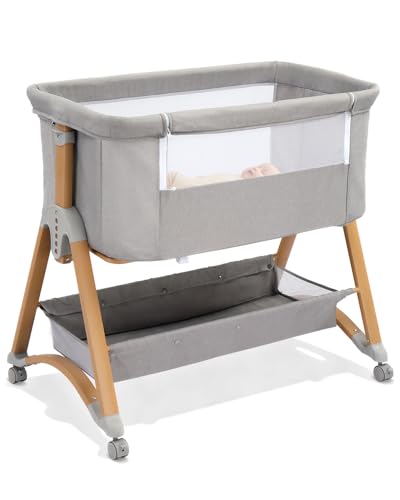
 GROWNSY 5-in-1 Baby Bassinet Bedside Sleeper with GentleStandard39.7 x 21.4 x 31.4 Inches22 PoundsCheck on Amazon
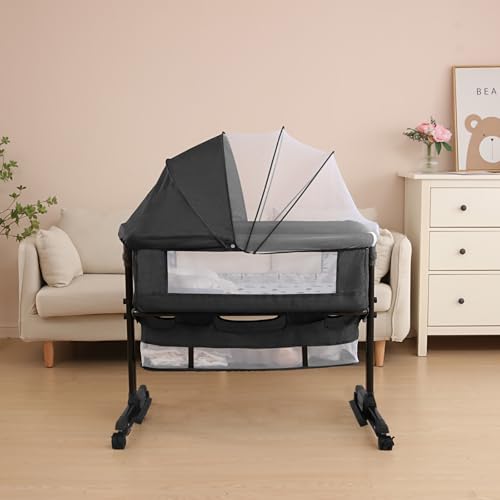
 Ktaxon 5 in 1 Baby Bassinet Bedside SleeperFull23.62 x 28.74 x 35.43 inches23.15 PoundsCheck on Amazon

Best bassinets by sleeping situation
| Situation | Best bassinet type | Useful target specifications | Main compromise |
|---|---|---|---|
| Beside the parents’ bed every night | Bedside bassinet | Height adjustment of roughly 24–32 inches; at least two locking wheels; breathable sides; one-hand drop side | Usually heavier and wider than a travel model |
| Small bedroom or apartment | Compact stationary cradle | Footprint near 30 x 20 inches or less; under 20 lb; vertical rather than wide storage | Less room for a larger baby and fewer bedside-access features |
| Frequent visits or travel | Folding travel bassinet | Under 15 lb; carry bag; fold time under two minutes; washable fitted sheet | May have no wheels or height adjustment |
| Parents who value motion and monitoring | Smart or powered bassinet | Secure backup mode, cord management, removable washable sleep surface, clear manual controls | Higher price, electrical parts, app dependence, and more cleaning complexity |
| Limited budget | Basic freestanding bassinet | Firm mattress, fitted sheet, stable legs, intact locking mechanism, current safety labeling | Often has less storage and no bedside height adjustment |
What matters most when comparing bassinets
1. Mattress firmness and fit
Mattress firmness is more important than plush padding. A newborn sleep surface should be firm, flat, and level, with a fitted sheet made for that exact mattress. Press the center and edges: the surface should not form a deep depression, and there should be no visible gap between the mattress and the bassinet walls. Do not add a topper, folded towel, aftermarket wedge, or extra padding to make a bassinet softer.
Check the manufacturer’s stated mattress dimensions before buying replacement sheets. A common bassinet mattress is approximately 30 to 33 inches long and 15 to 22 inches wide, but dimensions vary substantially. A sheet that seems close can loosen at the corners, creating a hazard. Use only a properly fitting sheet approved for the model.
2. Breathable materials without unsafe softness
Mesh panels improve visibility and airflow around the sides, but “breathable” does not make a bassinet safe if it contains padded liners, loose fabric, or an inclined surface. Look for taut mesh that cannot sag into the sleep area, smooth seams, and a firm base. Removable fabric should be machine washable or wipe-clean, since spit-up, milk, and diaper leaks are normal parts of ownership.
Do not confuse a soft, nest-like product with a bassinet. Cushioned loungers, pods, and sleep positioners are not substitutes for a flat bassinet or crib. Follow the product’s age, weight, and developmental limits, and stop using it when the baby reaches the stated limit or can push up, roll, kneel, or sit, whichever comes first.
3. Fit beside the parents’ bed
Measure the bed rather than guessing. Record the floor-to-top-of-mattress height, the distance from the bed to the nearest wall, and the width available for walking. Then compare those measurements with the bassinet’s lowest and highest settings. A bassinet that reaches the mattress height may still be unusable if its frame cannot slide close enough or if the bed’s overhanging frame blocks the legs.
Bedside models should stand independently on their own stable base. If a side panel lowers, it should do so only according to the manufacturer’s instructions; do not remove a rail, wedge the bassinet against the bed, or secure it with improvised straps. Check that wheels lock and that the bassinet cannot roll when an adult leans against it.
4. Portability and storage
Weight is only part of portability. A 12-pound bassinet with a compact fold and carry bag may be easier to move than a 9-pound cradle with a rigid frame. Check folded dimensions, handle placement, whether the mattress folds, and whether the sheet must be removed before folding. For everyday room-to-room use, two locking wheels are more useful than four unbraked casters.
Storage baskets are convenient for diapers and burp cloths, but avoid filling them with heavy items that could destabilize the frame. A practical capacity is roughly 5 to 10 pounds for light supplies. Keep cords, chargers, and adult bedding away from the sleep area.
Head-to-head: bedside, compact, travel, and smart bassinets
A bedside bassinet is usually the strongest all-rounder. Models such as the HALO Bassinest and Maxi-Cosi Iora represent this category: they emphasize access from the bed, height adjustment, and a larger footprint than travel cradles. They are useful during nighttime feeding and settling, but their bases can occupy valuable floor space, and not every bed frame accommodates them.
A compact cradle, such as the BabyBjörn Cradle, is easier to place in a small room and is relatively light to move. Its simpler design means fewer parts to clean or repair. The trade-off is reduced storage and, depending on the model, less bedside height adjustment.
A folding travel bassinet wins when the bassinet must move frequently. Look for a rigid, level base after unfolding rather than choosing solely by the smallest packed size. A fold that is difficult to lock completely is not a useful convenience. Inspect every hinge before use.
Powered products, including the SNOO Smart Sleeper, can add motion, sound, and monitoring features. They also add motors, fabric components, electrical connections, and subscription or service considerations that basic bassinets do not have. Confirm current availability, safety notices, replacement-part support, and the manual’s sleep-position requirements before purchase. Technology does not replace supervision or safe-sleep practices.
Durability and ownership costs
The parts most likely to wear first are fitted sheets, mattress covers, wheel locks, folding hinges, and mesh panels near frequently used zippers or fasteners. Before buying, price a replacement sheet and mattress cover and check whether the manufacturer sells them separately. A bassinet with a low initial price can become expensive if its proprietary cover is unavailable.
As a rough planning example, suppose a $180 bassinet is used for five months, or about 150 nights. The frame cost is approximately $1.20 per night. If two $25 fitted sheets are added, ownership rises to about $1.53 per night, before tax and cleaning supplies. A $500 powered model used for the same period costs about $3.33 per night before any service, subscription, or replacement components. This does not determine value, but it clarifies what convenience features cost over a short newborn-use window.
Cleaning routine
- Follow the label for machine washing, drying, and disinfecting; harsh chemicals can weaken mesh or waterproof coatings.
- Remove the sheet promptly after a leak and inspect the mattress for fluid penetration.
- Wipe the frame, wheels, and locking points regularly, especially if the bassinet is moved between rooms.
- Never use a mattress that is wet, warped, torn, or no longer flat.
- After folding or relocating the bassinet, verify every lock before placing the baby inside.
Buying checklist
- Is the mattress firm, flat, and specifically fitted to the bassinet?
- Can the bassinet stand level beside the bed without leaning against it?
- Do the dimensions fit the room with a clear walking path?
- Are the sides taut and free of loose padding, ties, or decorative fabric?
- Can you buy replacement sheets, covers, and—if needed—electrical parts?
- Does the product have clear use limits for weight and developmental milestones?
- Are wheels, brakes, folding joints, and height locks easy to verify?
- Will the required cleaning routine fit your household?
Bottom line
Choose a height-adjustable bedside bassinet with a firm fitted mattress if it will stay beside the parents’ bed. Choose a compact stationary model for limited floor space, a folding model for frequent travel, and a powered bassinet only after weighing its ownership costs and extra components. The safest choice is not the softest or most feature-packed one; it is the stable, correctly assembled bassinet that keeps a newborn on a firm, flat, uncluttered sleep surface.
This is general product information, not medical advice. For questions about a baby’s sleep position, breathing, reflux, premature birth, or a specific health condition, consult a pediatrician or other qualified healthcare professional.