We research everything we recommend. When you buy through our links, we may earn a commission. As an Amazon Associate we earn from qualifying purchases.
Best Bench Vises: Five Picks for a Stronger Workbench
Compare the best bench vises by jaw width, opening, iron grade, and swivel base, from a 6-inch Wilton ductile-iron vise to a compact Wilton shop vise.
If you want one answer up front: the Wilton WVA6 Apprentice Vise is the strongest all-around bench vise in this group, because its 72,000 PSI ductile iron body pairs 6-inch jaws and a full 6-inch opening with pipe jaws, a 360-degree swivel base, and a stated clamping force of 8,300 pounds. If your work is mostly pipe and round stock, the Yost 750-DI adds a rotating head that presents three jaw sets instead of one. The Forward HY-DT150B-6IN brings the rotating-head idea to a mid-range tool, the IRWIN 226306ZR is the straightforward 6-inch cast iron option, and the Wilton 11104 is the compact 4-inch pick.
One boundary before the picks: this roundup covers bench-mounted mechanics vises, the bolt-down cast body design found on garage and metal shop workbenches. It does not cover post vises, the leg-mounted blacksmith design, or drill press vises, the low-profile tools that bolt to a drill press table; those are separate classes with different mounting and jaw geometry.
As an Amazon Associate, we earn from qualifying purchases.
Jaw width is not jaw opening. The headline size of a vise is its jaw width, the side-to-side width of the jaw faces. What decides the biggest part you can grip is the jaw opening, and the two numbers often differ: a vise sold as 4.5 inches wide may open only 3 inches. Throat depth, the distance from the top of the jaws down to the slide, is the third dimension: it decides how far below the jaw tops a tall part can sit. Match all three to the parts you actually hold, not to the box label.
Iron grade sets the ceiling on abuse. Gray cast iron, usually rated around 30,000 PSI tensile strength, is the traditional vise material and serves holding, filing, and sawing work well, but it is brittle under hammer blows and heavy cheater-bar torque. Ductile iron, rated from about 60,000 PSI upward, flexes instead of cracking and is the material to choose if the vise will take striking work or high clamping loads. The PSI figure is the most honest durability number on a vise listing, because it describes the casting itself rather than a marketing category like heavy duty.
Clamping force figures are maker numbers. There is no shared industry test for clamping force, and no independent lab publishes measured force across brands, so treat the pound figures in listings as each maker’s own claim rather than a cross-brand score. Use the figure to compare models inside one brand’s line, and iron grade and weight to compare across brands.
Swivel base and lockdowns. Most bench vises rotate on their base so the work can be angled without re-clamping. The useful differences are the rotation range, a full 360 degrees against the 120 degrees of the compact Wilton below, and twin lockdown handles, which hold position far better than one. A rotating head, fitted to the Yost and Forward below, indexes different jaw faces, flat, pipe, and angled, to the top.
Pipe jaws, anvil, and replaceable faces. Pipe jaws are the V-shaped teeth below or behind the main jaws that grip round stock without it rolling; their stated capacity range matters more than their presence. A flat anvil behind the fixed jaw is the striking surface for light flattening and rivet work. Replaceable jaw faces are the long-term feature: serrated steel faces wear smooth over years, and a vise whose faces unbolt can be renewed.
Mounting is part of the tool. A bench vise only performs as well as its mounting. Through-bolts with large washers or a backing plate hold far better than lag screws, the vise needs a bench edge position that lets the fixed jaw clear the bench front for long vertical work, and a heavy vise on a thin bench top will flex the top instead of clamping the part. Mounting bolts are normally bought separately; plan the hardware for your bench thickness.
The WVA6 is Wilton’s ductile iron apprentice-series vise, with a spec sheet close to the bigger mechanics models: a 72,000 PSI ductile iron body, 6-inch jaw width with a full 6-inch opening, a 3-3/4 inch throat depth, and a stated clamping force of 8,300 pounds. The 360-degree swivel base locks down for angled work, built-in pipe jaws handle round stock, and a large anvil sits behind the fixed jaw. The jaw faces are replaceable hardened steel, so the wear part of the tool can be renewed. Against the Yost below it gives up the rotating head; against everything else here it is simply the strongest casting, which is why it leads the list for a permanent repair bench.
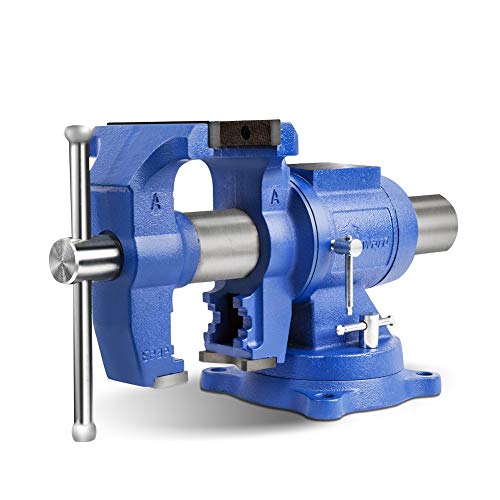
The 750-DI is built around a rotating head: the head indexes between flat serrated jaws, pipe jaws, and a second jaw set, locking at set increments so round, flat, and angled work each get the right grip without a second tool. The body is 65,000 PSI ductile iron with a 5-inch jaw width, a 5-inch opening, and a 4-inch throat depth, the deepest throat in this group, and Yost states a clamping force of 9,000 pounds. The pipe jaw capacity runs from 1/8 inch to 3-1/2 inches, the widest pipe range here. The base swivels a full 360 degrees under the rotating head. At about 63 pounds it is a bolt-it-and-leave-it tool, and the pick when pipe and tubing are regular work rather than occasional.
The Forward HY-DT150B-6IN applies the rotating-head layout at a mid-range position. Its ductile iron body, which Forward rates at 60,000 PSI, carries 6-inch jaws with a 5-inch opening and a 2-5/8 inch throat depth, and the head rotates so the pipe jaws, rated from 0.6 inch to 2-1/2 inches, come to the top when round stock is on the bench. The base swivels 360 degrees, the jaw faces are replaceable, and a flat anvil sits behind the fixed jaw. The honest limits are the shallow throat, the shallowest here, which crowds tall parts, and a spec sheet that leaves clamping force unstated in the manual data, so its case rests on the iron grade and the head design rather than a force figure.
Specs
Model: HY-DT150B-6IN
Tier: Mid-range
Jaw width: 6 in
Jaw opening: 5 in
Throat depth: 2-5/8 in
Body: Ductile iron, 60,000 PSI per maker data
Clamping force: Not stated in the maker manual data reviewed
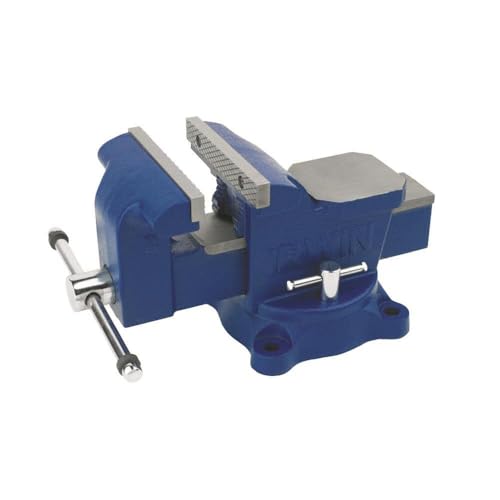
The 226306ZR is the conventional entry: a 6-inch cast iron vise with a 5-inch opening, a 360-degree swivel base, an incorporated anvil, and pipe jaws under the main faces. Its distinguishing feature is the captured safety jaw, which keeps the sliding jaw from pulling free of the body when the vise is cranked fully open, a small guard that matters in shared shops. Amazon’s listing data states a 3,000 pound clamping rating and an item weight of 32.2 pounds, making this the lightest of the 6-inch vises here and the easiest to mount on a lighter bench. IRWIN publishes less than the other makers: no iron grade is stated, so the durability case rests on the cast iron body and the brand’s workshop line rather than a PSI number.
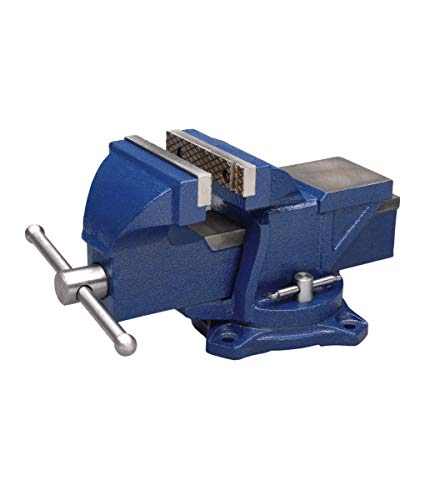
The 11104 is Wilton’s compact general purpose vise, a 4-inch model in 30,000 PSI gray cast iron for smaller benches without the room or mounting strength for a 60-pound tool. Its jaws open 3 inches with a 2-1/4 inch throat depth, the base swivels 120 degrees rather than a full circle, and the serrated jaw inserts are replaceable, which is not a given at this size. A small anvil sits behind the fixed jaw for light flattening work. The trade-offs are the gray iron body, which should not take heavy hammer work, and the smaller capacity in every direction. For a home garage bench that holds parts for filing, sawing, and assembly rather than daily mechanic work, it is the proportionate choice.
Which Vise Fits Your Work
For a permanent repair bench, the Wilton WVA6 is the default: the strongest iron, the widest opening, and replaceable faces under a lifetime warranty. For shops that clamp pipe and tube every week, the Yost 750-DI earns its place with the rotating head and the widest pipe capacity. The Forward HY-DT150B-6IN is the choice when that rotating-head layout is the point but the budget is mid-range, accepting the shallow throat. The IRWIN 226306ZR suits a general workshop that wants a 6-inch vise at a weight a lighter bench can carry, and the Wilton 11104 fits the small garage bench, where a compact footprint matters more than capacity.
Frequently Asked Questions
What size bench vise do I need?
Start from the parts, not the bench. A 4-inch vise with a 3-inch opening covers small parts, sharpening, and assembly work. A 5- or 6-inch vise with a 5- or 6-inch opening covers most automotive and fabrication parts. Check the opening and throat depth alongside the jaw width, because width is the headline number while opening decides the largest part that fits, and a bigger vise needs a bench and mounting that can carry its weight.
What is the difference between ductile iron and gray cast iron in a vise?
Gray cast iron, typically rated near 30,000 PSI tensile strength, is hard and stable but brittle, so it can crack under heavy hammer blows or extreme clamping torque. Ductile iron, rated from about 60,000 PSI upward, has a structure that flexes under load instead of fracturing, which is why professional mechanics vises use it. For holding, filing, and sawing, gray iron is sufficient; for striking work and high loads, ductile iron is the safer body.
Can a bench vise hold pipe and round stock?
Yes, through the pipe jaws: a V-shaped toothed section, usually below the main jaws or on a rotating head, that cradles round stock so it cannot roll while it is cut or threaded. What varies is the capacity range, from 1/8 inch to 3-1/2 inches on the Yost 750-DI in this list, against 0.6 inch to 2-1/2 inches on the Forward. Gripping pipe in the flat main jaws instead concentrates force on two edges and can dent thin-wall tube.
How should a bench vise be mounted?
Through-bolt it to the bench top with large washers or a metal backing plate under the top; lag screws into a bench top pull loose under load. Position the base so the fixed jaw sits at or just past the bench edge, which lets long parts hang vertically past the bench front, and seat the base on a flat, clean surface. Mounting bolts are normally bought separately to match the bench top thickness.
Conclusion
The five vises here divide by iron and by layout. The Wilton WVA6 pairs the strongest ductile iron body with a full 6-inch opening for a permanent bench. The Yost 750-DI and the Forward HY-DT150B-6IN add rotating heads that bring pipe jaws to the work, at premium and mid-range positions respectively. The IRWIN 226306ZR keeps the classic 6-inch cast iron formula, and the Wilton 11104 scales the idea down to a compact 4-inch vise. Match the iron grade to the force your work applies, the opening to your largest parts, and the mounting to your bench.
M
Miller the Driller Editorial Team
We compare specs, warranty terms, long-term owner feedback and street pricing before anything earns a spot. Rankings are never paid.
Affiliate disclosure. As an Amazon Associate we earn from qualifying purchases at no extra cost to you. Prices accurate as of the date shown.
Three wireless routers for small offices compared on device capacity, network separation, wired speed, and coverage, with specs taken from their Amazon listings.
Compare 5 mechanic tool sets for car repairs: a 247-piece DEWALT kit, a 450-piece CRAFTSMAN set, a drawer-box GEARWRENCH set, a 170-piece Crescent set and a 450-piece WORKPRO set.
Four splitting axes and mauls that actually split firewood: a long 36-inch axe for tall users, a shorter 28-inch option, and two 8 lb mauls for knotty rounds.
Learn whether a 20V rechargeable drill battery can be repaired, which faults you can check safely at home, and when replacing the pack is the safer choice.
A specs-based review of the officially licensed Retro-Bit Sega Saturn 2.4 GHz wireless controller: dual receivers, Genesis Mini and Switch support, battery, layout, limits, and FAQs.
Find the best drill battery for Power Wheels ride-on toys for families, with DeWalt, Milwaukee and Ryobi adapters, voltage and safety guidance in this guide.
Find the best hole saw for noching dom pipe: bi-metal saws, deep cups, and the right sizes for clean, tight notches in DOM tube for fabrication shops today.
Find the best diy tile saws for home tiling projects. Compare wet tile saws by blade size, cutting capacity, and features for ceramic and porcelain tile.