We research everything we recommend. When you buy through our links, we may earn a commission. As an Amazon Associate we earn from qualifying purchases.
Best Biscuit Joiners for Strong, Aligned Wood Joints
Compare the best biscuit joiners for panel glue-ups and face frames, with fence accuracy, biscuit sizes, dust collection, and corded vs cordless picks.
A biscuit joiner does one job, and it has to do it precisely: it plunges a small 4-inch blade into the edge of a board to cut a crescent-shaped slot. A compressed beech biscuit drops into the slot with glue, swells as it absorbs moisture, and locks the two pieces together. The biscuit adds some strength, but its real value is alignment: it keeps boards flush during a glue-up and stops face frame parts shifting while clamps go on.
The five joiners below range from a budget kit with biscuits and a case included to a cordless model for site work. All cut the three standard biscuit sizes, and they differ mainly in fence design, the part that decides whether slots line up or wander. A sloppy fence cannot be fixed with technique.
As an Amazon Associate, we earn from qualifying purchases.
For most woodworkers, the Makita PJ7000 is the best biscuit joiner here: its rack-and-pinion fence keeps slots aligned across both workpieces, and its six depth stops cover every common biscuit size. The DEWALT DW682K is a close second for heavy panel work, the Makita XJP03Z cuts the cord, and the WEN JN8504 suits first-time users on a budget.
Makita PJ7000 Plate Joiner
Top Pick
Makita PJ7000 Plate Joiner
Best for: Frequent panel glue-ups where fence repeatability matters most.
The PJ7000 is built around its fence, which is where a biscuit joiner should spend its engineering budget. The vertical fence adjusts on a rack-and-pinion system, so the knob moves it smoothly and repeatably instead of sliding it by hand and hoping it stays put. The cast aluminum pivot fence has positive stops at 0, 45 and 90 degrees, covering edge joints, miters and face frame work.
Six preset depth stops handle the standard 0, 10 and 20 biscuits plus specialty settings, and the 5.6-amp motor spins the blade at 11,000 RPM, fast enough to leave clean slot walls in hard maple or oak. For regular panel glue-ups, this joiner removes fence fiddling from the process.
Specs:
– Motor: 5.6 amp, corded
– Blade speed: 11,000 RPM
– Blade: 4-inch carbide-tipped
– Fence: rack-and-pinion, stops at 0, 45 and 90 degrees
– Depth stops: six presets for biscuits 0, 10 and 20
– Weight: about 5.5 pounds
DEWALT DW682K Biscuit Joiner Kit
Runner-Up
DEWALT DW682K Biscuit Joiner Kit
Best for: Cabinet and furniture shops that want a proven, heavy-duty joiner for daily panel and frame work.
The DW682K has been a shop staple for years because its dual rack-and-pinion fence stays parallel to the blade across its whole travel. That parallelism keeps a slot in one board the same distance from the reference face as the slot in the mating board, so the faces come together flush. The fence tilts from 0 to 90 degrees, and a retractable notch in the shoe registers the tool on the outside corner of a miter joint.
The 6.5-amp motor turns at 10,000 RPM with enough reserve for dense hardwoods and sheet goods alike. Preset depth stops cover the 0, 10 and 20 biscuits, the shoe is machined aluminum, and the dust bag can be swapped for a vacuum hose. This is the proven choice for a busy shop.
Specs:
– Motor: 6.5 amp, corded
– Blade speed: 10,000 RPM
– Blade: 4-inch carbide-tipped
– Fence: dual rack-and-pinion, tilts 0 to 90 degrees, retractable 45-degree notch
– Depth stops: presets for biscuits 0, 10 and 20
– Weight: about 6.5 pounds
PORTER-CABLE 557 Plate Joiner Kit
PORTER-CABLE 557 Plate Joiner Kit
Best for: Face frame specialists and anyone who joins angled or odd-shaped parts that defeat simpler fences.
The 557 comes from the company that pioneered the modern plate joiner, and it has the most versatile fence here. The fence tilts from 0 all the way to 135 degrees, with a positive stop at 90, so it can cut slots on the inside of an already-angled joint where other fences cannot register. A micro height adjustment lets you nudge the slot position in fine increments, valuable in stock slightly off standard thickness.
Its seven-position rotating depth stop is the other standout. Alongside the usual settings, it includes an FF setting for the small biscuits used in narrow face frame rails, plus specialty Simplex, Duplex and Max positions. The 7-amp motor is the strongest here at 10,000 RPM. The trade-off is weight: at about seven and a half pounds it is the heaviest of the five.
Specs:
– Motor: 7 amp, corded
– Blade speed: 10,000 RPM
– Blade: 4-inch carbide-tipped
– Fence: tilts 0 to 135 degrees, positive stop at 90, micro height adjustment
– Depth stops: seven positions including FF, 0, 10, 20 and Max
– Weight: about 7.5 pounds
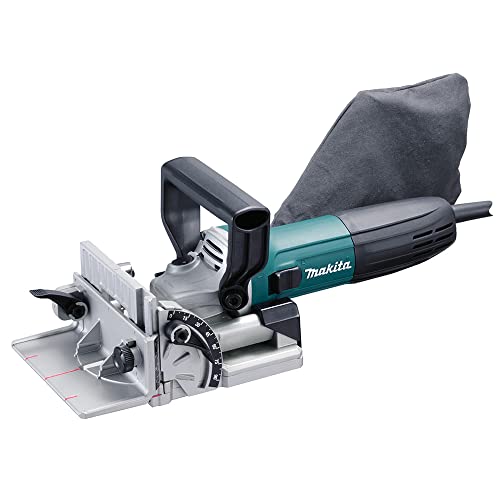
Makita XJP03Z 18V LXT Cordless Plate Joiner
Makita XJP03Z 18V LXT Cordless Plate Joiner
Best for: Installers and Makita 18V owners cutting slots on site, away from the bench.
The XJP03Z takes the fence system of Makita’s corded joiners and puts it on the 18V LXT battery platform. It keeps the rack-and-pinion fence and cast aluminum pivot fence of the corded models, so slot accuracy does not drop just because the cord went away. Six depth settings with one-touch stops cover the 0, 10 and 20 biscuits, and the maximum groove depth matches the corded tools.
Makita rates the tool for up to 320 cuts, about 160 joints, on a single charge from a 3.0Ah battery, and the motor runs at 12,000 RPM, the fastest here. It can work across a room or on an installed cabinet where dragging a cord is a genuine nuisance. It is sold as a bare tool, so it suits shops already running Makita 18V batteries best.
Specs:
– Power: 18V LXT lithium-ion battery, tool only
– Blade speed: 12,000 RPM no load
– Blade: 4-inch carbide-tipped
– Fence: rack-and-pinion, stops at 0, 45 and 90 degrees
– Depth stops: six settings, one-touch stops for biscuits 0, 10 and 20
– Weight: about 6.7 pounds with battery
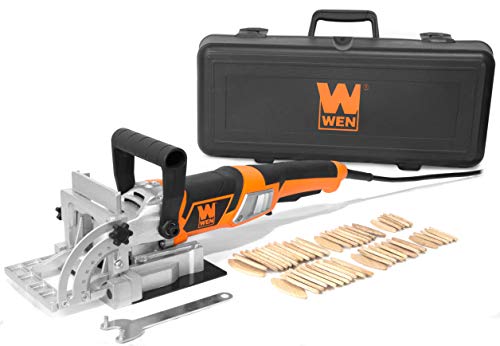
WEN JN8504 Plate and Biscuit Joiner
WEN JN8504 Plate and Biscuit Joiner
Best for: First-time buyers and hobby shops gluing up panels a few times a year.
The JN8504 is the entry point to biscuit joinery, packaged as a complete starter kit: the joiner, a blow-mold case, a dust bag, and 50 biscuits split across the 0, 10 and 20 sizes. The 8.5-amp motor spins the 4-inch carbide-tipped blade at 10,000 RPM, plenty for pine, plywood and common hardwoods.
Where the savings show is the fence. It adjusts with a simpler scale-and-knob arrangement rather than a rack-and-pinion drive, so height changes take more care: loosen, slide, check against a ruler, lock, and make a test cut in scrap before committing to good stock. The fence tilts from 0 to 90 degrees for miters, and preset stops cover the three standard sizes.
Specs:
– Motor: 8.5 amp, corded
– Blade speed: 10,000 RPM
– Blade: 4-inch carbide-tipped
– Fence: adjustable, tilts 0 to 90 degrees, scale-and-lock height setting
– Depth stops: presets for biscuits 0, 10 and 20
– Weight: about 7 pounds
How to choose
Start with the fence, because fence quality is the heart of alignment accuracy. A rack-and-pinion fence, like the ones on the two Makita models and the DEWALT, moves on a geared track, so it stays parallel to the blade and returns to the same height every time. Simpler slide-and-lock fences can shift slightly as the lock knob tightens, which shows up as a step between boards. Positive stops at 0, 45 and 90 degrees cover nearly all real work; the PORTER-CABLE’s 135-degree tilt exists for slots on angled faces.
Biscuit sizes are standardized. Size 0 suits thin stock and small frames, size 10 is the general-purpose choice for three-quarter-inch panels and face frames, and size 20 is the largest, made for wide panels and tabletops. Every joiner here cuts all three; the PORTER-CABLE adds an FF setting for miniature face frame biscuits. Match the depth stop to the biscuit before every cut, because a mismatched setting will split the work.
Dust collection matters more than it looks, because packed chips in a shallow slot change its depth; a vacuum on the port clears slots best, though the included bag keeps the marks visible. On power, corded joiners are lighter and always ready, while the cordless Makita earns its place on installed cabinets and site work. Know the limits as well: biscuits excel at aligning panel glue-ups, tabletops and face frames and add modest strength, but they are no substitute for mortise and tenon or dovetail joinery in anything that takes racking loads.
One safety point deserves plain language. The blade is hidden inside the housing until the base plunges, at which moment it is fully exposed inside the cut, so treat every plunge with respect: keep both hands gripping the tool body, behind the fence and never in front of the shoe, clamp the workpiece to the bench instead of holding it by hand, and unplug a corded tool or remove the battery before any blade change. Wear eye protection, because a plunging blade throws chips back toward the operator.
Who should skip
Skip a biscuit joiner if the joinery you actually do is structural. Chairs, stools, bed frames and workbenches need mortise and tenon, loose tenon or dowel joints that resist racking, and biscuits will disappoint there. Also skip it if pocket screws already handle your casework and you rarely glue up wide panels, because panel alignment is this tool’s one standout job. For small boxes and picture frames, a doweling jig serves as well for less money.
FAQ
What size biscuit should I use for a tabletop?
Use size 20 biscuits for tabletops and wide panels. They give the most glue surface and alignment help across a long edge. Space them roughly six to eight inches apart, and drop to size 10 if the stock is thinner than three quarters of an inch.
Are biscuit joints strong enough on their own?
For panels, casework sides and face frames, yes: the glued biscuit and the long-grain glue line between the boards carry the load together. For joints that flex or rack, like a chair rung or a table leg, biscuits alone are not enough. Use them there for alignment only, with a stronger joint doing the real work.
Can I use a biscuit joiner on face frames?
Yes, and it is one of the tool’s best uses. Biscuits keep rails and stiles flush while the glue sets, which saves a lot of sanding. Narrow rails need smaller biscuits, so use size 0, or the FF biscuits the PORTER-CABLE 557 is set up to cut. Make sure the rail is wide enough for the slot.
Why do my glued panels come out with a step between boards?
A step almost always means the fence moved between cutting the two mating slots, or the boards were referenced from opposite faces. Always register the fence against the same face of both boards, the face that will show, and confirm the fence lock is tight before each cut. A rack-and-pinion fence reduces this problem, since its height setting does not drift.
Final verdict
Buy the Makita PJ7000 if you want one joiner that gets the fence right; its rack-and-pinion adjustment is the feature you will appreciate on every glue-up. The DEWALT DW682K is the alternative for heavier daily use, the PORTER-CABLE 557 is the specialist’s pick for face frames and angled work, and the Makita XJP03Z is the one to get when slots happen away from an outlet. On a tight budget, the WEN JN8504 kit cuts honest slots and includes everything needed to start.
M
Miller the Driller Editorial Team
We compare specs, warranty terms, long-term owner feedback and street pricing before anything earns a spot. Rankings are never paid.
Affiliate disclosure. As an Amazon Associate we earn from qualifying purchases at no extra cost to you. Prices accurate as of the date shown.
Three wireless routers for small offices compared on device capacity, network separation, wired speed, and coverage, with specs taken from their Amazon listings.
Compare 5 mechanic tool sets for car repairs: a 247-piece DEWALT kit, a 450-piece CRAFTSMAN set, a drawer-box GEARWRENCH set, a 170-piece Crescent set and a 450-piece WORKPRO set.
Four splitting axes and mauls that actually split firewood: a long 36-inch axe for tall users, a shorter 28-inch option, and two 8 lb mauls for knotty rounds.
Learn whether a 20V rechargeable drill battery can be repaired, which faults you can check safely at home, and when replacing the pack is the safer choice.
A specs-based review of the officially licensed Retro-Bit Sega Saturn 2.4 GHz wireless controller: dual receivers, Genesis Mini and Switch support, battery, layout, limits, and FAQs.
Find the best drill battery for Power Wheels ride-on toys for families, with DeWalt, Milwaukee and Ryobi adapters, voltage and safety guidance in this guide.
Find the best hole saw for noching dom pipe: bi-metal saws, deep cups, and the right sizes for clean, tight notches in DOM tube for fabrication shops today.
Find the best diy tile saws for home tiling projects. Compare wet tile saws by blade size, cutting capacity, and features for ceramic and porcelain tile.



 Makita XJP03Z 18V LXT Cordless Plate Joiner
 WEN JN8504 Plate and Biscuit Joiner









