We research everything we recommend. When you buy through our links, we may earn a commission. As an Amazon Associate we earn from qualifying purchases.
Best Moisture Meters for Wood, Drywall and Firewood Checks
Compare the best moisture meters for wood, drywall, and firewood, with pin and pinless picks, species settings, reading depths, and dry targets.
As an Amazon Associate I earn from qualifying purchases. This post may contain affiliate links at no extra cost to you.
⭐ Key Takeaways
Quick answer: Our top pick is Wagner Meters Orion 920 Pinless Wood Moisture Meter, with Klein Tools ET140 Pinless Moisture Meter as a strong alternative.
Wood moves as it dries, floors cup when they go down over a damp subfloor, and firewood that is still wet smokes more than it heats. A moisture meter turns those guesses into a number, so you can tell whether a board is ready to mill, whether a wall has dried after a leak, and whether the cordwood is ready to burn. The tool is simple, but the reading only means something when you know which scale you are looking at and what the number should be.
This guide compares five widely sold meters across both measuring styles. Pin meters push two small probes into the material and read at that exact spot, while pinless meters scan a wider area without leaving a mark. The picks cover lumber work, drywall checks after leaks, and firewood testing; the buying guide explains species settings, depth, and targets.
As an Amazon Associate, we earn from qualifying purchases.
For most homeowners, the General Tools MMD4E is the right first meter: a simple pin model covering wood and building materials. For scanning finished walls without pinholes, choose the Klein Tools ET140. Woodworkers wanting the most trustworthy lumber readings should pick the Wagner Orion 920, mixed-species firewood burners will like the Tavool MT270, and the Proster PST050 handles basic checks for the least money.
Wagner Meters Orion 920 Pinless Wood Moisture Meter
Top Pick
Wagner Meters Orion 920 Pinless Wood Moisture Meter
Best for: Flooring installers and woodworkers checking thin stock, veneer, and acclimation before installation.
The Orion 920 is the shallow-depth member of Wagner’s pinless Orion line, built to read lumber and flooring without leaving a mark. A flat sensor pad presses against the surface and reads moisture in the top quarter inch, the layer that decides whether a finish adheres and whether flooring has acclimated to the room. Readings are true moisture content for wood, not a relative score.
What separates the Orion from cheaper scanners is the species setting: you dial in the specific gravity of the wood being measured and the meter corrects for that density, which is where pinless accuracy is won or lost. It also calibrates on site with the included block. The trade-offs: wood only, shallow by design, and a far higher cost than the pin meters here.
Specs:
– Type: Pinless electromagnetic sensor
– Reading depth: Quarter inch into the wood
– Wood range: Four to thirty-two percent
– Species settings: Programmable specific gravity values
– Calibration: On-site calibrator included
– Power: 9V battery
Klein Tools ET140 Pinless Moisture Meter
Runner-Up
Klein Tools ET140 Pinless Moisture Meter
Best for: Homeowners and inspectors tracing leaks and damp patches in finished walls without leaving pinholes.
The ET140 is a pinless scanner aimed at walls rather than lumber. Its sensor reads up to three-quarters of an inch below the surface and reports a relative number from zero to one hundred, making it a mapping tool: slide it across a wall and watch the number climb as you near damp areas. Four material modes cover drywall, masonry, hardwood, and softwood, so one sweep covers bathroom walls, brick, and wood floors.
Because the scale is relative, the ET140 works best against a reference: read a wall area you know is dry, then compare suspect areas against it. The housing is built for job sites, with drop protection and a clear bar graph display. It gives no true percentage for lumber, so it complements a pin meter rather than replacing one.
Specs:
– Type: Pinless electromagnetic sensor
– Reading depth: Up to three-quarters of an inch
– Display: Relative scale from zero to one hundred with bar graph
– Material modes: Drywall, masonry, hardwood, softwood
– Power: 9V battery
– Build: Drop-protected housing for job site use
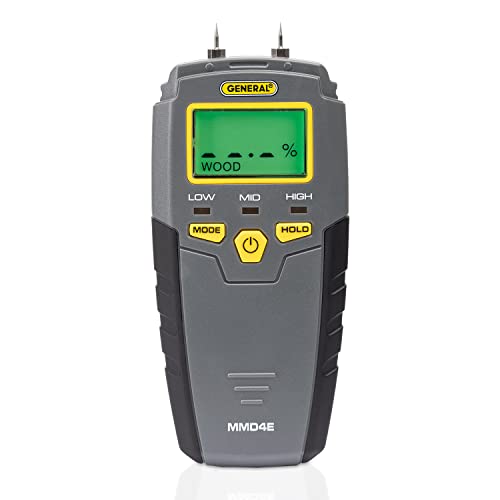
General Tools MMD4E Digital Moisture Meter
General Tools MMD4E Digital Moisture Meter
Best for: Homeowners who want one inexpensive meter for firewood, framing, and after-leak spot checks.
The MMD4E is the straightforward pin meter found in tool drawers everywhere. Two short pins push into wood, drywall, or masonry and give a direct reading at that spot, with separate ranges for wood and building materials. A backlit screen shows the number, and alerts flag low, medium, and high moisture, so checks stay easy in dark crawl spaces.
It is a spot checker, not a scanner: each reading covers only the area between the pins, and the pins leave two tiny holes, so it is a poor choice for finished furniture or painted walls. The protective cap doubles as a calibration check, spare pins are included, and the hold function freezes a reading taken in an awkward spot. For firewood, framing, and confirming a dried wall, it covers the basics well.
Specs:
– Type: Pin meter with replaceable pins
– Wood range: Five to fifty percent
– Building material range: One point five to thirty-three percent
– Display: Backlit LCD with high, medium, and low alerts
– Extras: Hold function, calibration check cap, spare pins
– Power: 9V battery
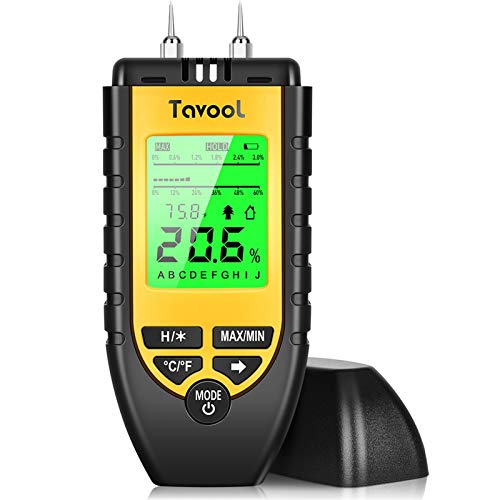
Tavool MT270 Wood Moisture Meter
Tavool MT270 Wood Moisture Meter
Best for: Firewood burners and sawyers checking mixed species who want species-corrected readings.
The MT270 is a pin meter built around species correction. Where basic pin meters use one scale for every wood, the Tavool offers eight calibration scales matched to groups of species, so dense oak and light pine are each corrected for how they conduct. That matters most at the woodpile, where mixed hardwood and softwood splits can read several points apart on a one-scale meter even when cut and stacked the same day.
The range runs from green timber to kiln-dried stock, and a building mode gives rough wall and floor checks. The backlit display also shows surrounding temperature, and hold plus maximum and minimum memory help when working through a stack of splits. The pins are short, so thick rounds should be split and measured on the fresh face, as with any pin meter. Its species scales make firewood readings more trustworthy than a one-scale meter’s.
Specs:
– Type: Pin meter with stainless steel pins
– Wood range: Six to sixty percent
– Building material range: Up to forty percent display scale
– Calibration: Eight wood species scales plus a building material mode
– Display: Backlit LCD with temperature readout, hold and max/min memory
– Power: Two AAA batteries
Proster PST050 Wood Moisture Meter
Proster PST050 Wood Moisture Meter
Best for: First-time buyers who mainly need firewood and rough lumber checks on a tight budget.
The Proster PST050 is the budget pin meter that anchors many first toolkits. The formula is simple: two pins under a protective cap, a large LCD, and four wood groups that sort common species by density so readings land closer than a single fixed scale. Push the pins into a fresh split face or the end of a board, and the number appears in about a second.
Expectations should match the format. The headline range is very wide, but it is most believable in the middle band where firewood and lumber decisions are made, and it is a wood meter first, suited to firewood, lumber, paper, and cardboard rather than wall diagnosis. The hold button, automatic shutoff, and included storage case are genuinely handy at the woodpile. For first checks of firewood and boards, it does the job for very little money.
Specs:
– Type: Pin meter with 10 mm pins
– Wood range: Up to ninety-nine point nine percent
– Resolution: A tenth of one percent
– Calibration: Four wood groups covering common species
– Display: Large LCD with data hold
– Power: 9V battery, storage case included
How to choose
Start with the sensing method, because it decides what the number means. A pin meter measures resistance between two probes pushed into the material, so the reading reflects moisture at that depth and spot, and on wood it is a genuine moisture content figure. The cost is two small holes and a reading no wider than the pins. A pinless meter reads a shallow layer beneath the surface with an electromagnetic sensor, letting you sweep a wall or floor quickly with no marks, though the result depends on density and is a true percentage only on wood with the species set.
Species correction separates serious meters from novelties: species differ in density, both meter types respond to denser wood differently at the same moisture level, and settings or group scales correct for that, while one fixed scale can miss by several points on dense hardwoods. Surfaces dry first, so a freshly split face gives a truer firewood reading than a weathered round. Pinless depth is fixed: a quarter-inch meter suits thin stock and finish layers, while three-quarter-inch reach suits boards and wall assemblies.
Targets are simple once the scale is understood. Firewood burns cleanly under twenty percent, and most stoves do best between fifteen and twenty percent. Furniture and interior trim should sit near the room’s own level, roughly six to eight percent in most heated homes. Flooring should acclimate until board and subfloor readings settle close together. Drywall and masonry read on relative scales, so compare a known dry area against the suspect area and follow the gradient. And remember the honest limit: a meter finds moisture, but it does not identify mold or locate a leak. Find and fix the water source first, then confirm the material has dried.
Who should skip
Skip these meters if you are dealing with major flooding, sewage backup, or a slab that needs documented drying; that work calls for a restoration contractor with professional meters. A handheld meter also cannot check for mold, identify what is growing inside a wall, or replace in-floor probes used for formal concrete slab testing. And if your only question is whether one stack of firewood is ready, the least expensive pin meter here answers it; no flooring-grade scanner is needed for the woodpile.
FAQ
What moisture level should firewood be before burning?
Under twenty percent is the standard target, and wood between fifteen and twenty percent burns with the best heat and cleanest combustion. Split a piece and push the pins into the freshly exposed face, because the outside dries first and reads low. Measure in the middle of the fresh face for the number that matters.
What is a good moisture reading for furniture and flooring lumber?
For heated indoor spaces, furniture wood is usually happiest around six to eight percent. Flooring is judged less by one absolute number and more by the gap between boards and subfloor: let it acclimate in the room until readings settle near the subfloor’s, and follow the maker’s stated limits.
Can a moisture meter tell me if I have mold?
No. A moisture meter measures water in a material, nothing more. Sustained moisture lets mold grow, so a high reading shows where growth is likely, but it cannot confirm mold or identify a species. Visible growth or health concerns call for a qualified inspector or remediation professional.
Why does my drywall reading not match a percentage scale?
Because on drywall and masonry most meters report a relative or reference value, not a true moisture percentage. Those numbers are meant for comparison: take a baseline on a wall you know is dry, then scan for readings that climb well above it. Only wood readings, taken with the correct species setting, should be treated as real percentages.
Final verdict
Match the meter to the material you check most. The Wagner Orion 920 is the pick when lumber numbers have money riding on them. The Klein ET140 is the wall scanner for finished rooms. The General Tools MMD4E is the sensible all-round pin meter for most homes, the Tavool MT270 earns its place at a mixed-species woodpile, and the Proster PST050 covers first checks for the least money. Whatever you buy, fix the water source first.
M
Miller the Driller Editorial Team
We compare specs, warranty terms, long-term owner feedback and street pricing before anything earns a spot. Rankings are never paid.
Affiliate disclosure. As an Amazon Associate we earn from qualifying purchases at no extra cost to you. Prices accurate as of the date shown.
Three wireless routers for small offices compared on device capacity, network separation, wired speed, and coverage, with specs taken from their Amazon listings.
Compare 5 mechanic tool sets for car repairs: a 247-piece DEWALT kit, a 450-piece CRAFTSMAN set, a drawer-box GEARWRENCH set, a 170-piece Crescent set and a 450-piece WORKPRO set.
Four splitting axes and mauls that actually split firewood: a long 36-inch axe for tall users, a shorter 28-inch option, and two 8 lb mauls for knotty rounds.
Learn whether a 20V rechargeable drill battery can be repaired, which faults you can check safely at home, and when replacing the pack is the safer choice.
A specs-based review of the officially licensed Retro-Bit Sega Saturn 2.4 GHz wireless controller: dual receivers, Genesis Mini and Switch support, battery, layout, limits, and FAQs.
Find the best drill battery for Power Wheels ride-on toys for families, with DeWalt, Milwaukee and Ryobi adapters, voltage and safety guidance in this guide.
Find the best hole saw for noching dom pipe: bi-metal saws, deep cups, and the right sizes for clean, tight notches in DOM tube for fabrication shops today.
Find the best diy tile saws for home tiling projects. Compare wet tile saws by blade size, cutting capacity, and features for ceramic and porcelain tile.


 Tavool MT270 Wood Moisture Meter
 Proster PST050 Wood Moisture Meter









