We research everything we recommend. When you buy through our links, we may earn a commission. As an Amazon Associate we earn from qualifying purchases.
Best Combination Squares for Layout and Machine Setup
Compare the best combination squares for layout and machine setup, from premium machinist sets to budget 12 and 16 inch squares for the shop.
A combination square is the layout tool that quietly decides whether everything downstream fits. It marks ninety and forty-five degree lines, sets blade and bit heights, checks depth, finds centers and verifies machine fences, so a square that is not truly square corrupts every measurement it touches. The five picks below span the quality tiers that matter: a premium machinist set in the Starrett tradition, two mid-range squares with hardened blades and proper etched graduations, and two affordable IRWIN models in twelve and sixteen inch lengths for general shop and site work.
As an Amazon Associate, we earn from qualifying purchases.
The Brown & Sharpe combination square set is the precision pick, with hardened components and all three heads for machine setup and layout. The iGaging Premium and Accusize four-piece set cover serious woodworking and metalworking for less, while the IRWIN twelve-inch is the dependable budget square and the IRWIN sixteen-inch adds reach for sheet goods and wide stock.
How to Choose
Head material separates the tiers more than any other feature. Premium squares use cast iron or hardened steel heads that are machined and ground, so the reference faces stay flat and the head slides without rocking. Budget squares use die-cast zinc or aluminum heads, which are lighter and cheaper but can wear out of square over years of use. For machine setup and joinery layout, a ground cast iron head is worth paying for; for rough carpentry checks, die-cast is acceptable.
Blade quality comes next. Look for hardened steel blades with etched or engraved graduations rather than printed ones, because printed markings wear off and sit on the surface where they introduce parallax. A satin chrome finish cuts glare under shop lights and resists rust. Graduation style matters too: the 4R pattern, with eighths, sixteenths, quick-reading thirty-seconds and sixty-fourths, is the machinist standard and the most versatile for fine work, while simpler 16R or inch-only patterns read faster for carpentry.
Blade length is a practical choice. Twelve inches is the default because it covers most board widths, machine fences and depth checks. Sixteen-inch blades earn their keep on sheet goods, wide panels and longer machine tables. Six-inch squares are pocket tools for small parts. Finally, decide whether you need a set. A square head alone covers marking and setup basics; adding a center head finds the middle of round stock instantly, and a protractor head lays out and checks arbitrary angles. Buying the set costs less than adding heads later, and compatibility across brands is not guaranteed.
Care habits decide how long any of these squares stays trustworthy. Wipe the blade with an oily rag before it goes back in the drawer, because a rust bloom on the reference edge or inside the graduations ruins both accuracy and readability. Store the square flat or hanging, never loose in a drawer of chisels where the head can be knocked. If a square takes a hard drop onto concrete, run the flip test again before trusting it; cast iron heads usually survive, but a bent blade or a bruised head face shows up immediately in the doubled line. Treating the square as a measuring instrument rather than a pry bar or scraper is what separates a lifetime tool from a seasonal one.
TESA Brown & Sharpe 599-439-1204 Combination Square Set
Brown & Sharpe is one of the founding names in precision measurement, and this set, sold under the TESA Brown & Sharpe line, is the machinist-grade option in this group. The twelve-inch blade is hardened steel with crisp graduations, and the set includes square, center and protractor heads, so it handles layout, center finding on shaft stock, and angle work without extra purchases. The heads are finished and fitted to the standard expected in inspection and toolroom work, where a combination square doubles as a reference for checking other tools. It is the most expensive route here, and casual users will not exploit its accuracy, but for machine setup and precision layout it is the set that removes doubt.
Specs
Blade
12 inch hardened steel
Set contents
Square, center and protractor heads
Graduations
4R
Maker
TESA Brown & Sharpe
Best for
Toolroom and machine setup
TESA Brown & Sharpe 599-439-1204 Combination Square Set
iGaging has built a reputation for delivering machinist-style quality at workshop prices, and this premium two-piece square is its flagship layout tool. The twelve-inch blade carries true 4R graduations, etched into hardened steel with a satin chrome finish that reads cleanly under bright lights. The head is heavy, well-machined cast iron in the traditional pattern, with a smooth lock that holds position without marring the blade. Owners comparing it against far pricier squares consistently find the ninety-degree reference trustworthy, which is the whole point of the tool. As a two-piece outfit it covers the square-head essentials; shops that later want center or protractor heads should confirm compatibility before ordering additions.
Specs
Blade
12 inch hardened steel
Graduations
4R etched
Finish
Satin chrome
Head
Cast iron
Set contents
2 pieces
Accusize Industrial Tools 12-Inch 4-Piece Combination Square Set
Runner-Up
Accusize Industrial Tools 12-Inch 4-Piece Combination Square Set
Accusize supplies the import machine-shop trade, and this four-piece set is its answer to the classic combination square outfit. You get a twelve-inch satin chrome blade with 4R graduations plus square, center and protractor heads, which covers the full range of layout, center finding and angle tasks in one case. The blade is fully hardened and tempered, so it stays stiff and straight when scribing, and the micro-fine graduations are easy to read for setup work on mills, lathes and table saws. Fit and finish sit a notch below the Brown & Sharpe set, as expected at this level, but the functional coverage is identical. For a working shop that needs a complete set without toolroom pricing, it is a pragmatic choice.
The IRWIN 1794469 is the everyman combination square: a metal-bodied twelve-inch tool with a precision-etched stainless steel blade, sold everywhere and priced for site bags and starter benches alike. The etched markings will not rub off the way printed graduations do, the blade resists rust in damp garages, and the head includes the standard scriber and a self-aligning draw stud that keeps the blade seated squarely. Accuracy is aimed at carpentry and general shop work rather than inspection, and the die-cast construction will not match a ground cast iron head for long-term reference duty. For framing checks, deck layout, and everyday marking, it does the job honestly and carries a limited lifetime warranty.
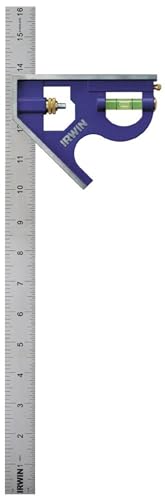
The sixteen-inch IRWIN answers a specific frustration: a twelve-inch blade that runs out before the edge of a wide panel, a sheet of plywood or a long machine fence. Those extra four inches let you strike full-width lines on sheet goods, check longer jointer and planer setups, and use the head as a deeper depth gauge. It shares the family design of its smaller sibling, with a metal body and a precision-etched stainless blade, so markings stay legible and rust stays away. The longer blade flexes a little more if you lean on it, and it is bulkier in a tool belt, but as a second square dedicated to wide work it earns its place on the rack.
Specs
Blade
16 inch stainless steel
Markings
Precision etched
Body
Metal
Best for
Sheet goods and wide stock
Extras
Built-in scriber
Who Should Skip It
If your layout work is framing and rough carpentry, a speed square and a good tape will serve you faster than any combination square. Woodworkers who only ever mark ninety-degree lines on narrow boards can also skip the full sets: a single quality twelve-inch square head outfit covers that work, and the center and protractor heads would gather dust. Machinists needing certified inspection references should buy through metrology suppliers with calibration documentation rather than general listings. And anyone tempted by the very cheapest unbranded squares should know that an out-of-square layout tool is worse than none, because every line it marks is confidently wrong.
FAQ
How do I check whether a combination square is actually square?
Draw a line along the blade against a straight board edge, then flip the square over and draw a second line from the same point. If the square is true, the lines coincide; any wedge between them shows twice the actual error. Check a new square this way before trusting it for joinery or machine setup.
What does 4R graduation mean?
A 4R blade carries four scales: eighths and sixteenths on one side, and quick-reading thirty-seconds and sixty-fourths on the other. It is the standard machinist pattern because it covers both quick carpentry readings and fine setup work without swapping blades. Metric and combination inch-metric blades exist for shops that work in both systems.
Is a twelve-inch or sixteen-inch blade better?
Twelve inches is the better default: it covers most boards, fences and depth checks, and stays rigid and easy to handle. Choose sixteen inches as a second square if you regularly mark sheet goods or wide panels, where the shorter blade forces you to move the head mid-line and risks a kink in the layout.
Can a combination square set machine tools?
Yes, within its accuracy class. A quality square checks table saw blade and fence alignment, sets router bit and blade heights using the blade as a rule, and verifies jointer fence angles. For final precision work, confirm critical setups with test cuts or dial indicators, and keep a premium square reserved as the shop reference.
Final Verdict
Buy the Brown & Sharpe set if precision is the priority and the budget allows; it is the reference-grade tool here. The iGaging Premium is the sweet spot for most serious shops, the Accusize set adds all three heads at a working-shop level, and the two IRWINs cover honest general work in the two most useful lengths. Whichever tier you choose, verify squareness on day one with the flip test, keep the blade lightly oiled, and store the square where the head cannot be knocked out of truth.
M
Miller the Driller Editorial Team
We compare specs, warranty terms, long-term owner feedback and street pricing before anything earns a spot. Rankings are never paid.
Affiliate disclosure. As an Amazon Associate we earn from qualifying purchases at no extra cost to you. Prices accurate as of the date shown.
Three wireless routers for small offices compared on device capacity, network separation, wired speed, and coverage, with specs taken from their Amazon listings.
Compare 5 mechanic tool sets for car repairs: a 247-piece DEWALT kit, a 450-piece CRAFTSMAN set, a drawer-box GEARWRENCH set, a 170-piece Crescent set and a 450-piece WORKPRO set.
Four splitting axes and mauls that actually split firewood: a long 36-inch axe for tall users, a shorter 28-inch option, and two 8 lb mauls for knotty rounds.
Learn whether a 20V rechargeable drill battery can be repaired, which faults you can check safely at home, and when replacing the pack is the safer choice.
A specs-based review of the officially licensed Retro-Bit Sega Saturn 2.4 GHz wireless controller: dual receivers, Genesis Mini and Switch support, battery, layout, limits, and FAQs.
Find the best drill battery for Power Wheels ride-on toys for families, with DeWalt, Milwaukee and Ryobi adapters, voltage and safety guidance in this guide.
Find the best hole saw for noching dom pipe: bi-metal saws, deep cups, and the right sizes for clean, tight notches in DOM tube for fabrication shops today.
Find the best diy tile saws for home tiling projects. Compare wet tile saws by blade size, cutting capacity, and features for ceramic and porcelain tile.

 iGaging Combination Square Premium 2-Piece 12 Inch 4R
 Accusize Industrial Tools 12-Inch 4-Piece Combination Square Set
 IRWIN Tools Combination Square 12-Inch (1794469)
 IRWIN Tools Combination Square 16-Inch (1794471)










